

When custom cuffed beanies feel comfortable without decoration but tight across the finished logo, do not immediately increase the whole hat size. Check the decorated cuff first. The folded knit, backing and patch may be behaving like a short, rigid belt. Changing the width alone can leave the back loose while the front still presses against the forehead.
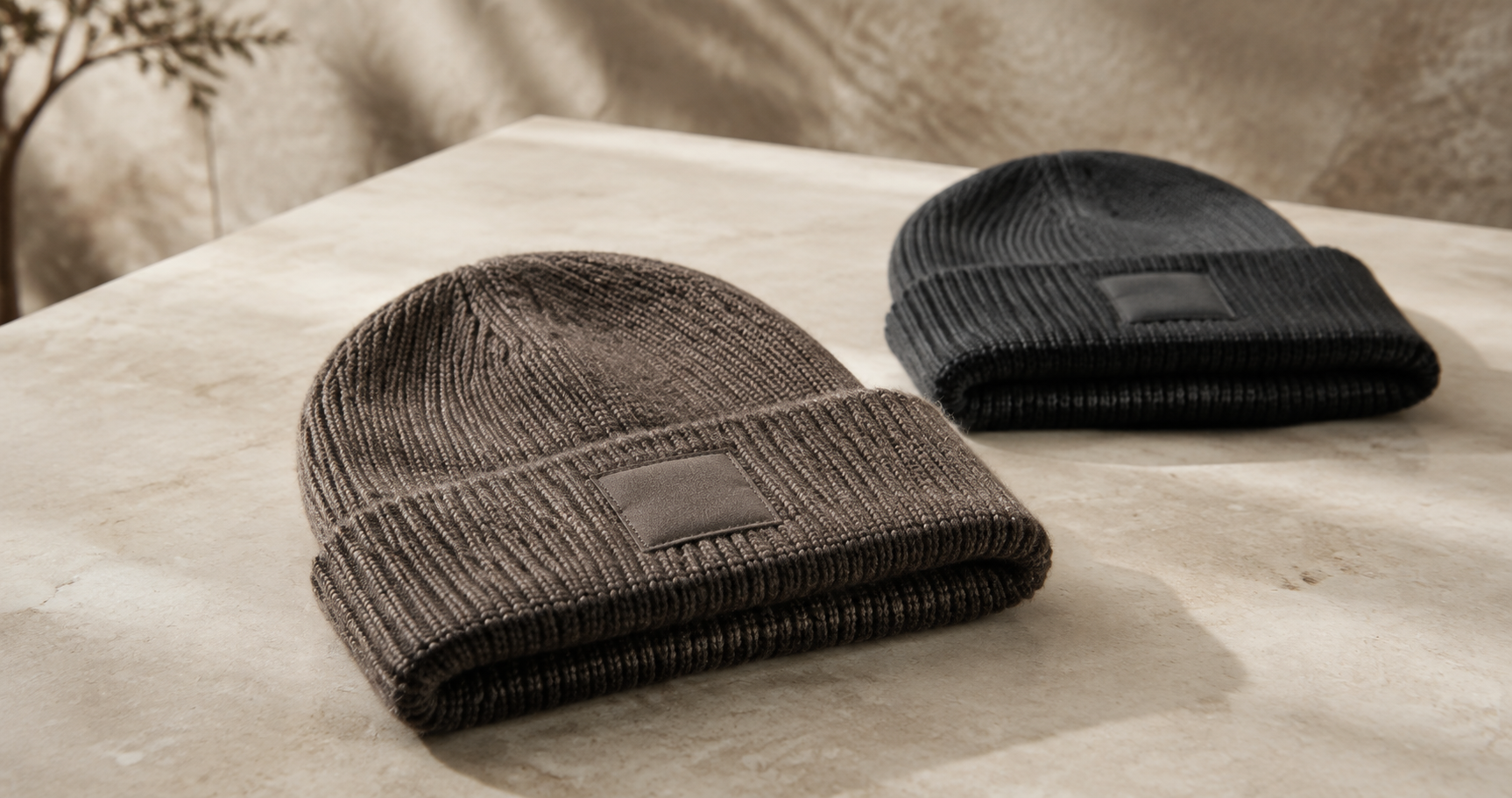
This troubleshooting article is for adult headwear collections, retail buyers and brand developers. It is not a medical fit assessment or a specification for children's headwear. Start with a blank sample and a decorated sample made from the same yarn and knitting setup. A photograph cannot reveal how either one feels after repeated wear.
The blank fits. The finished beanie does not.
Imagine a sample review with two otherwise matching beanies: one blank and one carrying a broad badge. This is an illustrative comparison, not a QSHeadwear customer case. If only the decorated piece feels restrictive, that difference gives the team a useful starting point. Inspect the area behind the badge before changing the knitting program.
Ask the wearer to describe location, not just intensity. Pressure under the badge, pressure around the entire cuff and a crown that pulls upward are different problems. Record whether the discomfort begins immediately or after the wearer rolls the cuff higher. Keep the wear duration consistent across samples so a quick try-on is not compared with an afternoon outdoors.
Four fit measurements for custom cuffed beanies
For custom cuffed beanies, the overall length, folded height, relaxed width and comfortable wearing range deserve separate entries. A deeper fold puts more fabric around the head and changes where the logo sits. A longer crown can add visual slouch without solving a tight opening. An extended stretch measurement is not automatically a comfortable fit measurement.
| Specification | How to record it | What it helps diagnose |
|---|---|---|
| Relaxed body width | Lay flat without pulling; state the measuring position | Whether knitting or finishing changed the base |
| Overall length | Measure unfolded from opening to crown | Length lost to the fold |
| Finished cuff depth | Record the intended wearing fold | Forehead coverage and badge position |
| Wearer range | Use approved adult fit trials, not maximum stretch | Comfort across the intended customer group |
| Decoration footprint | Measure the patch and backing separately | Local restriction rather than whole-hat tightness |
Give every sample a code and record which measurements were taken before and after wear. Measure again after the agreed rest period. Without that pause, the team may compare a freshly handled knit with one that has already recovered on the table. The method matters as much as the number.
Yarn choice changes the question
Acrylic, wool and blended yarns should be compared as finished beanies, not ranked by the fiber name alone. Yarn construction, knit structure, finishing and care all influence the result. Request composition and yarn references, then assess touch, bulk and recovery in the actual build. A softer swatch does not prove that the folded cuff will be comfortable.
The QSHeadwear beanie product page describes ribbed and other knitting options, several yarn families and custom labels or patches. Treat that as a development menu. Confirm the proposed combination and its availability for your order instead of assuming every yarn can run with every stitch structure at the same minimum quantity.
Three branding routes, three different compromises
Before rejecting a patch, ask whether the same identity could work with a smaller badge, a light woven label or direct embroidery. None is universally more comfortable. The useful comparison is between three decorated samples at the intended fold depth, with their inside surfaces visible. Compare appearance and restriction together.
| Route | Potential advantage | What to check on the cuff |
|---|---|---|
| Compact woven label | A small branding footprint | Edge softness, attachment and orientation after folding |
| Direct embroidery | No separate badge edge | Backing feel, stitch concentration and distortion |
| Sewn-on patch | A distinct surface and recognizable shape | Patch stiffness, corners and the length of restrained knit |
For custom cuffed beanies, the quiet detail on the inside can decide whether the outside works. Photograph the attachment stitches, any exposed backing and the seam under the fold. Do not approve a thick patch from its front view only. A change in backing should trigger another comfort check even when the visible logo has not changed.
Use a short wear sequence with an unchanged baseline
Keep one blank sample untouched as a comparison. Have the same adult wearers try the blank, then the decorated version, at the same cuff depth. Record whether they need to adjust the fold, whether the badge pulls the rib lines sideways and whether the hat rides upward. These observations are proposed buyer checks, not a standardized laboratory test.
Next, repeat normal putting-on and taking-off movements using the same sequence for both pieces. Let the samples rest and measure them again. Set acceptance limits before you see the results. If the team changes the wearing time, wearer group or fold halfway through, note it rather than presenting the results as directly comparable.
Care instructions belong in the sample review
The yarn and the decoration need to tolerate the same care route. Ask the supplier for an appropriate washing and drying recommendation for the complete beanie. Then check size, shape, surface and label appearance after that route. A patch that remains attractive while the surrounding cuff distorts is not a successful result.
Use an independent textile laboratory when a formal test report is needed. Request a named method, procedure and acceptance criteria rather than a vague promise that the material is washable. The published method and the actual sample construction should match. Do not describe an informal sink wash as certification.
For care-label communication, consult GINETEX's textile care information. It explains the care-labelling system; it does not establish which washing procedure your custom cuffed beanies can tolerate. That decision still needs evidence from the complete yarn, decoration and label combination.
A supplier quote should keep decoration visible
Ask for yarn, knitting, decoration, private labels, packing and development costs to be identifiable in the quotation. Minimums may apply to yarn colors and labels as well as finished units. A small order of custom cuffed beanies can carry unused component costs that are easy to miss when only the finished unit price is discussed.
Confirm who stores surplus labels and whether they can be used on a later order. Check the artwork version and the quantity retained. If the patch is reduced after fitting, obtain a revised price and approval sample; do not assume that an apparently smaller detail will use the same tooling, stitch program or attachment route.
Production release is a separate decision from sample approval
QSHeadwear describes OEM work from buyer references and ODM support for product development on its OEM/ODM service page. A buyer can supply a successful reference beanie or ask for suitable base options. In either route, retain the final decorated sample and the measurements that explain why it was accepted.
Request an order-specific calendar that includes yarn availability, sample review, label production, bulk knitting and final inspection. Do not commit a retail launch solely from a general sampling estimate. Capacity for custom cuffed beanies depends on the actual yarn, color split and finishing steps, not just the number of finished hats.
For bulk checks, compare cuff depth, logo position, rib alignment, seams, loose ends and shade against the approved sample. Define which variation is acceptable and what requires rework. Inspect packaging too: a folded beanie should arrive in the approved presentation, not with a distorted badge or a cuff rolled to a different height.
What the product page should tell the customer
Explain the intended fit, fiber composition and care route in plain language. Show the beanie worn and laid flat with the cuff in the same position. Avoid calling it universally suitable merely because the knit stretches. Buyers comparing custom cuffed beanies need to know whether the design is close-fitting, relaxed or intended to sit above the ears.
Keep a short post-launch log of fit questions and return reasons. Separate tightness at the logo from general sizing complaints; otherwise the next order may solve the wrong problem. Do not rewrite the specification from a single comment, but use repeated observations to choose a controlled sample change.
Send the pressure point, not just a logo file
Browse the headwear collection and company profile before submitting your brief. Include the reference beanie, intended wearer, yarn preference, fold depth, logo dimensions, color quantities and target delivery date. Ask QSHeadwear to compare branding options on custom cuffed beanies when the decoration is part of the fit problem.
Questions from a beanie sample review
Should I make the beanie wider first?
Only after comparing blank and decorated samples. Local pressure may come from the patch or backing rather than the whole circumference.
Is a maximum stretch measurement a size range?
No. Record a comfortable wearing range separately and validate it with the intended adult wearers.
Can the cuff be rolled twice?
Test the exact wearing configuration. Another fold changes coverage, bulk, decoration position and pressure.
Is embroidery always softer than a patch?
No. Backing, stitch concentration and placement can make direct embroidery restrictive too.
What information should accompany a yarn sample?
Request composition, yarn reference, proposed knit structure, finishing and the intended care route.
How do I compare two samples fairly?
Use the same wearer group, fold depth, wear sequence, rest period and measuring method.
Can one label work across several yarn colors?
Possibly, but approve contrast and attachment on each background and confirm component minimums.
What changes require another wear check?
Changes to yarn, knitting, cuff depth, patch dimensions, backing or attachment should be reviewed on a complete sample.
Which evidence should I keep for a reorder?
Keep the approved decorated beanie, measurement method, yarn and color references, logo file, care notes and packing photos.
What does QSHeadwear need for an initial discussion?
Send the fit reference, intended wearer, proposed decoration, quantity by color, destination and required delivery date.