

A repeat order can match the original artwork, fabric code and colour yet feel tighter or looser on the head. The change may come from the crown block, sweatband, closure, seam allowance, fabric relaxation or the way the finished cap is measured. Calling both runs “one size” does not prove that they fit the same.
For a brand, this is more than a measurement dispute. Fit drift affects returns, replenishment trust, team distribution and the credibility of a product customers already know. The answer is not to add one arbitrary number to a tech pack. It is to define a repeatable measurement method, set product-specific acceptance boundaries, sample every batch and distinguish random unit variation from a systematic shift.
This guide presents an operational control method. It does not prescribe a universal head range, tolerance, sample size or statistical limit. Those values must follow the actual cap construction, material behaviour, closure system, customer group and historical process evidence.
Define what “same fit” means for the programme
Separate consumer fit from factory dimensions
A wearer experiences pressure, depth, stability and adjustment range. A factory records dimensions such as internal opening, crown depth, panel length and closure travel. Connect the two. A cap can meet one circumference target yet feel different because the crown sits higher or the sweatband behaves differently.
Use the approved first run as evidence, not folklore
Retain the approved sample, measurement record and actual first-batch distribution. Do not rely on a remembered statement such as “the last order fitted well.” The reference should identify style, material, closure, measurement condition and production revision.
Define the wearer group
A fashion cap, performance cap, youth programme and uniform issue can tolerate different fit variation. The existing Japan and Korea market-entry guide shows why consumer size expression and factory measurement evidence should be controlled separately.
Lock the measurement method before setting tolerance
Name every measurement point
Specify where the tape, ruler or fixture begins and ends. For internal circumference, state whether the sweatband is included and where the closure is positioned. For crown depth, define the seam and edge landmarks. A number without landmarks cannot be reproduced.
Control cap condition
Record whether the cap is relaxed, fastened, stretched or placed on a fixture. State how long it rests after packing or steaming. Compression and recovery can alter the reading even when the sewn structure has not changed.
Control the tool and operator action
Use an appropriate calibrated tool and define pulling force or “no tension” where relevant. Train operators with the same examples. Two inspectors can create a false batch difference if one compresses the cap or pulls the sweatband while the other does not.
Map the components that change fit
Crown block and seam allowance
Panel shape, seam depth and assembly sequence set the three-dimensional crown. Small changes repeated across several seams can shift the internal opening or crown depth. Compare the finished shape, not only individual cut panels.
Sweatband and internal tapes
Sweatband width, thickness, elasticity and shrinkage influence both measured opening and perceived pressure. A nominally equivalent substitute can change fit. Connect every repeat order to the approved component identity through the private-label product identity system.
Closure system and adjustment hardware
Snap positions, strap length, buckle travel, elastic recovery and hook-and-loop overlap define usable range. Maximum hardware movement is not always the comfortable wearer range. Record a standard closure position for batch comparison.
Shell material and finishing
Washing, coating, steaming, heat, moisture and fabric direction can change dimensions or recovery. The material may also relax after unpacking. Measure at a controlled stage and avoid comparing a compressed arrival unit with a rested approval sample.
Create a product-specific tolerance band
Start from function and construction
The tolerance must protect intended fit without demanding precision the construction cannot repeatedly deliver. Review closure range, material behaviour, panel count, seam stack and wearer sensitivity. A fitted cap and an adjustable snapback should not inherit the same rule automatically.
Separate specification limits from process behaviour
Specification limits describe what the product may accept. Process data describes what production currently delivers. A batch can sit inside a wide specification while drifting away from the approved centre. Monitor both conformity and movement.
Use historical evidence carefully
Collect comparable data from approved production, not mixed styles and methods. Remove measurement-method changes from the comparison. If the method changed, establish a new baseline instead of pretending the records are continuous.
Sample the batch to see distribution, not one answer
Spread units across the lot
Take units from different cartons, production periods or lines where applicable. A cluster from one convenient carton may hide a shift elsewhere. Preserve carton and lot identity so unusual readings can be investigated.
Record individual readings
An average alone hides range. Keep each measurement, sample identity and operator. Compare centre, spread and pattern with the approved baseline. The AQL inspection plan explains lot identity and sampling discipline, but dimensional records still need their own defined measurement method.
Do not invent a universal sample size
The appropriate quantity depends on risk, lot structure, process history and the decision being made. A buyer may use a screening sample for routine monitoring and expand it when readings show a shift. Document that escalation before inspection begins.
Distinguish scattered variation from a shifted batch
Look for a moved centre
If most sampled caps are consistently tighter or deeper than the baseline, the issue may be a systematic process shift even when individual units remain within broad limits. Investigate the common change: material lot, pattern, seam setting, finishing or closure component.
Look for excessive spread
A batch with both tight and loose units may have unstable assembly, mixed components or inconsistent measurement. More sorting will not cure the source. Isolate subgroups by line, time, material or carton to find where variation entered.
Look for non-random patterns
NIST’s official control-chart guidance explains that a measured quality characteristic can be plotted by sample number or time and that non-random behaviour can matter even when points sit within limits. A headwear programme can apply that principle to batch measurements without copying a generic statistical limit. Use a qualified quality practitioner to design any formal statistical control method.
Investigate the first changed input
Compare product records
Check pattern revision, seam allowance instruction, sweatband code, closure length, thread and finishing route. A silent component substitution or production instruction change can move fit. Link the evidence to the actual repeat order rather than a generic style file.
Compare production conditions
Review line, machine settings, operator group, steaming, washing, drying and packing timing. The aim is not to blame the last operation automatically but to find the earliest point where the process diverged.
Compare measurement conditions
Before launching corrective action, confirm that tools, rest time, closure position and landmarks match the baseline. A false signal caused by a new inspection method wastes time and may lead production away from a stable setting.
Choose the response by pattern and use risk
Release only when fit remains acceptable
If readings vary but the wearer range and programme requirement remain protected, release may be appropriate with a documented record. Do not change the specification after seeing the batch merely to make it pass.
Sort when the population can be separated
Sorting can work when a reliable measurement divides acceptable and unacceptable units. Define the method, verification and disposition of rejected caps. Include the labour and delay in the commercial decision.
Rework only with a proven method
Some closures or internal components can be adjusted; others cannot be changed without damaging shape or decoration. Approve a representative reworked unit before applying the method broadly. If goods have already arrived nonconforming, connect the decision to the bulk claim and settlement process.
Keep replenishment records connected to logistics
Protect caps from measurement distortion
Over-compression can flatten crowns and alter immediate readings. The carton-load planning method helps balance space use with safe compression. Give caps a defined recovery period before comparing them with uncompressed references.
Keep destination and market versions separate
Regional labels or packouts can introduce different sweatband attachments, inserts or folding. The regional market-entry comparison helps keep channel and market changes visible so they are not mistaken for unexplained fit drift.
Account for cost without hiding the quality signal
Extra inspection, sorting, air freight or replacement affects landed cost, but cost pressure should not erase the dimensional record. Use the landed-cost framework to show commercial impact separately from product acceptance.
Use body-measurement principles without misapplying clothing standards
Keep the wearer reference clear
The official scope of ISO/TC 133 covers clothing size designation systems based on body-size measurement methods and digital fitting. That supports a basic discipline: product measurements and consumer body dimensions are related but not interchangeable. This article does not claim that a particular ISO clothing standard sets a universal cap tolerance.
Translate product dimensions into fit evidence
Use fit trials and real customer information to connect internal opening, crown depth and adjustment range with the intended wearer group. Keep the factory record precise even when a sales channel uses a simplified size name.
Write the next purchase order from the evidence
Correct the centre, not only the outliers
If the batch shifted systematically, update the process input that controls the centre. Do not merely remove a few extreme units and leave the next run on the same setting.
Carry forward measurement method and examples
The next order should receive the same landmarks, tool method, closure position, rest condition, tolerance and approved reference. Include photographs or diagrams where words could be interpreted differently.
Review the tolerance when the product changes
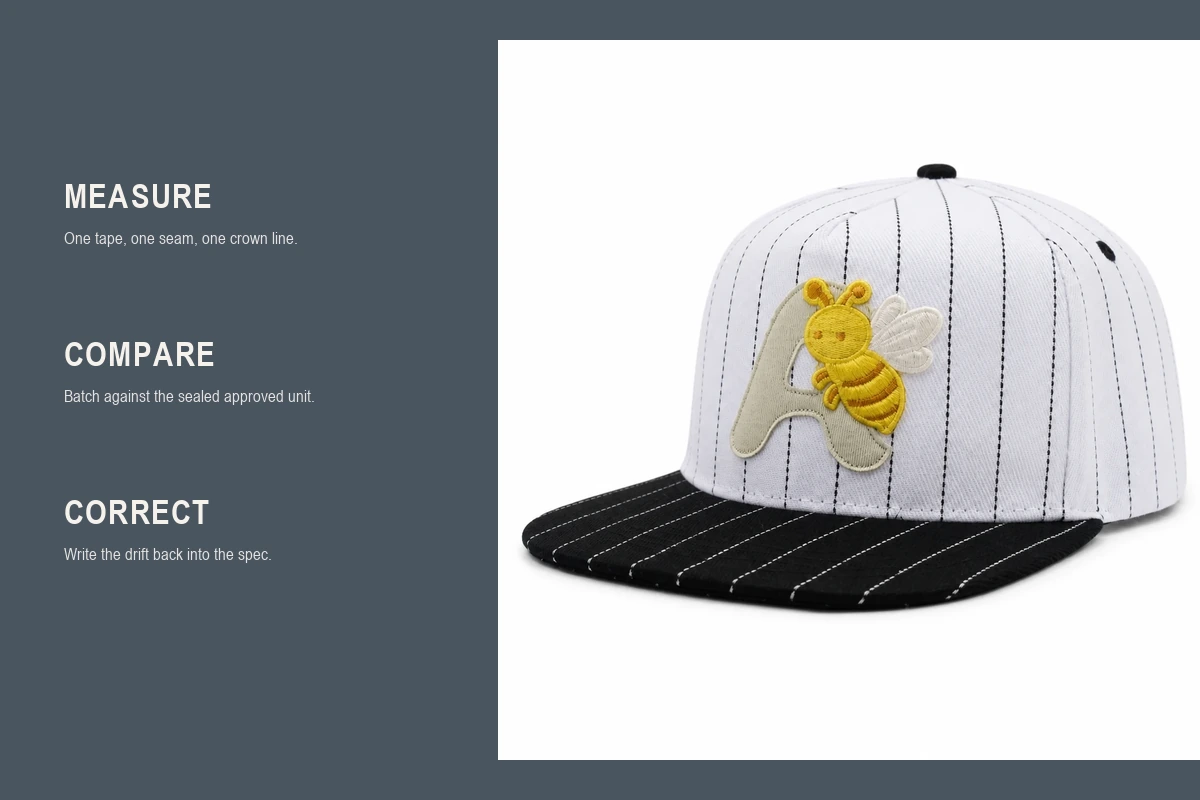
A new material, sweatband, closure, finish, pattern or market version can change behaviour. Revalidate rather than copying the old range automatically. For products such as the referenced structured striped snapback, the crown, closure and decoration must be evaluated as one finished system.
Make repeat fit a controlled output
Repeat-order consistency comes from a repeatable method: define the wearer outcome, lock measurement points and conditions, set construction-specific acceptance boundaries, sample the batch, read centre and spread, investigate the first changed input and carry the evidence into the next order.
For a repeat headwear programme, share the approved sample, prior batch readings, fit feedback, materials, closure system, packing method and intended wearer group. QSHeadwear can help translate those inputs into measurable checkpoints for sampling and bulk review without pretending one universal tolerance fits every cap.