

An AQL result is useful only when every party knows what was sampled, what counted as a defect and who may release the shipment. Without those decisions, a buyer can receive a polished inspection report that still leaves the commercial question unanswered: may these cartons ship?
A practical headwear AQL inspection plan connects the purchase order, approved product baseline, lot identity, sampling scheme, defect library and release authority. It does not turn a sample into proof that every unit is perfect. It creates a consistent rule for making a lot decision with limited inspection, then records the evidence behind that decision.
This guide shows brand teams how to build that rule before final inspection. It is operational guidance, not a replacement for a qualified quality professional, an agreed inspection standard or the terms in your purchase contract.
Start with the decision, not the AQL number
Teams often begin by copying three severity numbers from an old report. That reverses the process. First define the decision the inspection must support. A pre-shipment inspection may decide whether a production lot is released, held for sorting, reworked or escalated for buyer review. The selected sampling plan should serve that decision.
Separate process control from lot acceptance
In-line checks help the factory detect drift while work can still be corrected. Final acceptance sampling evaluates a defined lot near shipment. One cannot replace the other. A stable sewing line can still produce a mixed packing error, while a passing final sample does not prove that every earlier process was controlled.
Treat AQL as a contractual input
Record the named standard or buyer-approved scheme, edition, inspection level, lot size, sample basis and accept-or-reject rule in the purchase or inspection file. Do not ask an inspector to choose these commercial settings after arrival. The current Danish Standards listing for ISO 2859-1:2026 describes single, double and multiple attribute-sampling plans indexed by an acceptance quality limit. It also explains that the system balances pressure for process quality with limits on consumer risk. The page does not authorize a buyer to invent a sample size from memory.
Define the inspection lot before cartons are selected
A sampling result belongs to a specific lot. If the lot definition changes, the result may no longer support the same release decision. The inspection booking should identify the purchase order, style, color, size, production location, quantity completed and carton range available.
Keep materially different groups visible
Different fabrics, wash recipes, decoration programs, closures or production dates may carry different risks. Decide whether they form separate lots or require proportional representation in one lot. Do not let a large, easy colorway hide a small but high-risk colorway inside the sample.
Reconcile physical and system quantities
The carton count, packing list, factory completion statement and units physically available should agree. If only part of the order is complete, record that fact. A result based on a partial lot should not silently release later production that was never available for selection.
A disciplined lot identity complements the traceability route used during a one-day headwear factory audit: both controls ask whether physical goods and records refer to the same order.
Freeze the product baseline the inspector will use
An inspector cannot classify a deviation unless the expected condition is clear. Supply the latest approved specification, measurement chart, bill of materials, color references, artwork revision, packaging instructions and approved sample status. Each file should carry an identifier or revision date.
Link approval records instead of sending loose files
The pre-production sample release docket should identify the approved baseline, while the engineering change log explains approved deviations after that release. The inspector needs both. An old tech pack beside a new sample creates an argument, not a standard.
Resolve subjective language before inspection
Words such as clean, centered, soft or premium are not sufficient on their own. Add measurable tolerances, boundary photos or signed comparison samples where appearance matters. For washed finishes and handmade effects, define the acceptable range rather than pretending every unit will be identical.
Build a headwear-specific defect library
A generic garment checklist misses the interactions that define cap fit and appearance. Build the library around the product family and construction. Each defect entry should include a name, location, inspection method, severity, boundary example and required photograph.
Cover visual and construction defects
Visual checks can include staining, shade inconsistency outside the approved range, panel distortion, asymmetry, puckering and visible needle damage. Construction checks can include open seams, skipped stitches, insecure sweatbands, sharp trim, broken eyelets and closure failure. Measurement checks should identify the dimension, method, tolerance and conditioning requirement.
Inspect decoration as a system
Embroidery, patches, print, rhinestones and metal emblems require different evidence. Check placement, orientation, dimensions, density or coverage, loose threads, backing exposure, edge finish and attachment security. Technical stitch acceptance should remain tied to the approved embroidery sew-out record, while rights approval remains in the separate artwork authorization file. Quality approval does not prove permission to use an artwork.
Include packaging and assortment accuracy
A good cap in the wrong polybag, carton or size assortment is still a commercial failure. Verify hangtags, care labels, barcodes, carton marks, quantity, color-size ratio and protective packing against the approved pack-out. State whether packaging errors are counted per unit, per inner pack or per carton.
Assign defect classes by consequence
Severity should reflect the consequence of the defect, not how quickly it can be repaired. A defect library normally separates issues that create an unacceptable safety or legal risk, issues that make the product unusable or materially unsaleable, and smaller departures that do not remove the intended function. Use the terminology agreed in the inspection contract.
Write classification questions
For each defect ask: can the item be used safely; does it meet the approved identity and function; would a reasonable buyer reject it at full price; can it be corrected without creating a new risk; and does the issue affect one unit or indicate a systematic process failure? These questions make severity decisions more repeatable.
Control boundary disputes
Create paired photographs showing an acceptable boundary and a rejectable example. Name the product area, viewing distance, lighting and manipulation allowed during the check. When the inspector finds a new condition, require escalation rather than forcing it into the nearest old label.
Lock the sampling scheme and random-selection method
The buyer or appointed quality professional should select the scheme that fits the commercial risk and contract. Record the source and version used. The Senegalese standards body’s overview of ISO 28590:2017 explains that the ISO 2859 family contains different attribute-sampling systems and provides guidance for choosing an appropriate inspection system. That is why “use AQL” is not a complete instruction.
Do not publish copied sampling tables in the purchase order
A screenshot detached from its standard may omit switching rules, notes or edition changes. Instead, name the agreed standard or controlled buyer procedure and keep licensed or authorized reference material available to the inspection team. Record the calculated code, sample size and acceptance criteria in the report for that lot.
Protect random selection
Cartons should be selected across accessible positions, pallet zones, production times and relevant variants. The factory should not present a prepared “inspection sample.” Record which cartons were opened and how units were chosen. If cartons are inaccessible, note the limitation before making a release decision.
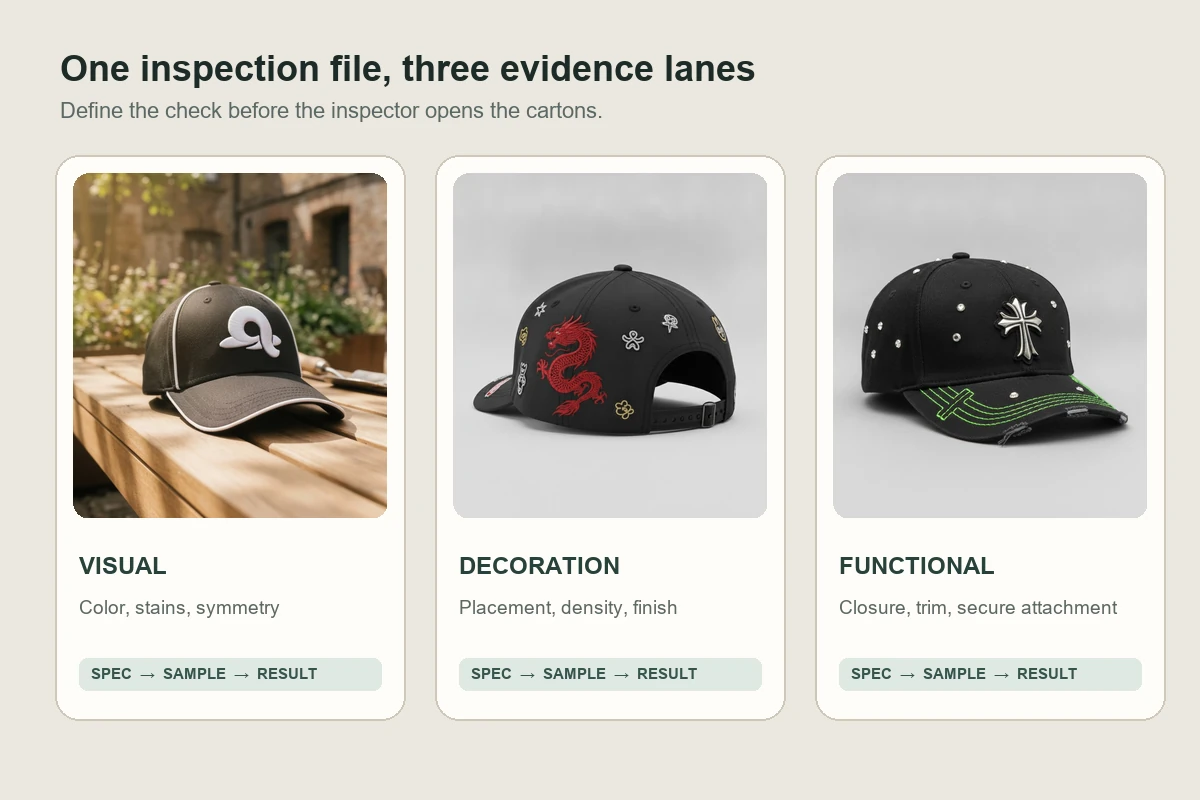
Create three evidence lanes
Organize the checklist so that every observation falls into a visible lane: visual, dimensional and functional. Decoration and packaging can be sub-lanes where the product risk warrants them.
Visual evidence
Specify overview and close-up photographs, consistent lighting and a scale reference where useful. Photograph both conforming construction and each counted defect. A defect total without image linkage is difficult to review remotely.
Dimensional evidence
Name the measuring tool, measurement points, sample quantity and tolerance source. Keep actual readings, not only a pass label. For a product family, connect the current measurement chart to the controlled cross-style specification system so methods do not drift between similar silhouettes.
Functional evidence
Define the action and expected result: cycle a snapback closure, check hook-and-loop engagement, test a buckle, inspect sharp edges, verify a detachable trim or confirm that a label remains readable. Do not describe a destructive test unless the method, quantity and disposition of tested units are agreed.
Set rules for repeated and systemic defects
A numerical total can hide a pattern. Five isolated thread tails do not carry the same cause as five emblems rotating in the same direction. Require the inspector to flag clustering by carton, color, operator, decoration head, component lot or production time.
Escalate pattern evidence
When a pattern appears, expand investigation according to the agreed procedure, isolate affected inventory and compare process records. The response may include sorting, rework, additional sampling or a buyer hold. Do not quietly replace defective sample units and continue counting.
Connect findings to supplier learning
Inspection results should feed the next supplier performance review. Track repeat defects, response time, containment quality and corrective-action effectiveness. This turns reports into longitudinal evidence rather than a folder of disconnected PDFs.
Define the pre-shipment release gate
The report should end with a decision state, not only observations. Use controlled outcomes such as release, conditional release by named buyer authority, hold for review, rework and reinspection, or reject under the purchase terms.
Separate inspector recommendation from buyer authority
The inspector records evidence and applies the agreed rule. The contract should identify who can approve an exception, what evidence is required and whether approval applies to the whole lot or a defined subset. A factory request to “ship first and fix next time” is not a release record.
Prevent shipment while status is unresolved
Link the quality decision to warehouse and logistics controls. Held cartons need visible identification, restricted loading authority and quantity reconciliation. If rework occurs, create a new status and retain the original report; do not overwrite the history.
Use a complete inspection-file checklist
- Purchase order, style, color, size and lot identity.
- Quantity ordered, completed, packed and available.
- Approved specification, sample and revision references.
- Named sampling scheme, edition, inspection level and calculated plan.
- Defect library with severity and boundary examples.
- Random-selection record and carton references.
- Visual, dimensional, functional and packaging results.
- Photographs linked to counted findings.
- Pattern or systemic-risk observations.
- Disposition, release authority and any reinspection requirement.
Questions to send before booking the inspection
- What exact lot will be complete and accessible?
- Which controlled files will the inspector use?
- Which sampling standard or buyer procedure and edition apply?
- How are defect classes and boundary examples approved?
- Who may change the plan or approve an exception?
- How are held cartons blocked from loading?
- What triggers sorting, rework or reinspection?
- Where will raw measurements and photographs be stored?
Make the inspection plan reusable, not generic
A reusable plan keeps its governance but changes its product-specific checks. The same file structure can serve baseball caps, bucket hats and beanies, while their measurement points, decoration risks and functional checks remain distinct.
The strongest headwear AQL inspection plan does not promise zero defects. It creates traceability from the approved product to the selected sample, from each finding to a defined severity, and from the report to a named shipment decision. Build that chain before inspection day, and the final report becomes an executable control rather than a late-stage debate.