

A factory quote is not a landed-cost answer. The unit price can be accurate while the import budget is wrong because the product description is incomplete, the tariff classification is assumed, origin evidence is missing or the customs value excludes an addition that the importer must consider. When those inputs are settled after production, the buyer has little room to redesign the product, change the route or protect margin.
A practical headwear landed cost file connects five decisions: what the product physically is, how the destination classifies it, where it originates, how its customs value is built and which party owns each import cost. It should make uncertainty visible before a buyer compares quotations.
This guide is an operational framework, not customs, tax or legal advice. Classification, origin, valuation and tariff treatment depend on the destination, product facts, transaction and entry date. The importer should confirm the current treatment with qualified customs professionals and official authorities.
Keep factory price, customs value and landed cost separate
These figures may overlap, but they do not answer the same question. Factory price describes the commercial sale. Customs value is determined under the importing jurisdiction’s valuation rules. Landed cost adds the expenses required to place the goods at the chosen destination and commercial handoff.
Define the quote boundary
Record the Incoterm, named place, currency, payment terms, packaging scope, inspection, tooling, freight and insurance assumptions. A quote marked “FOB” without a named port and controlled inclusions is not a stable comparison.
Use a cost bridge
Build a line-by-line bridge from product price to estimated landed cost. Keep duty, taxes, brokerage, freight, terminal handling, inland delivery and compliance administration as separate fields. The small-batch headwear cost waterfall explains production-side setup and unit economics; the import map begins where customs and logistics variables enter.
Freeze the product facts before choosing a tariff code
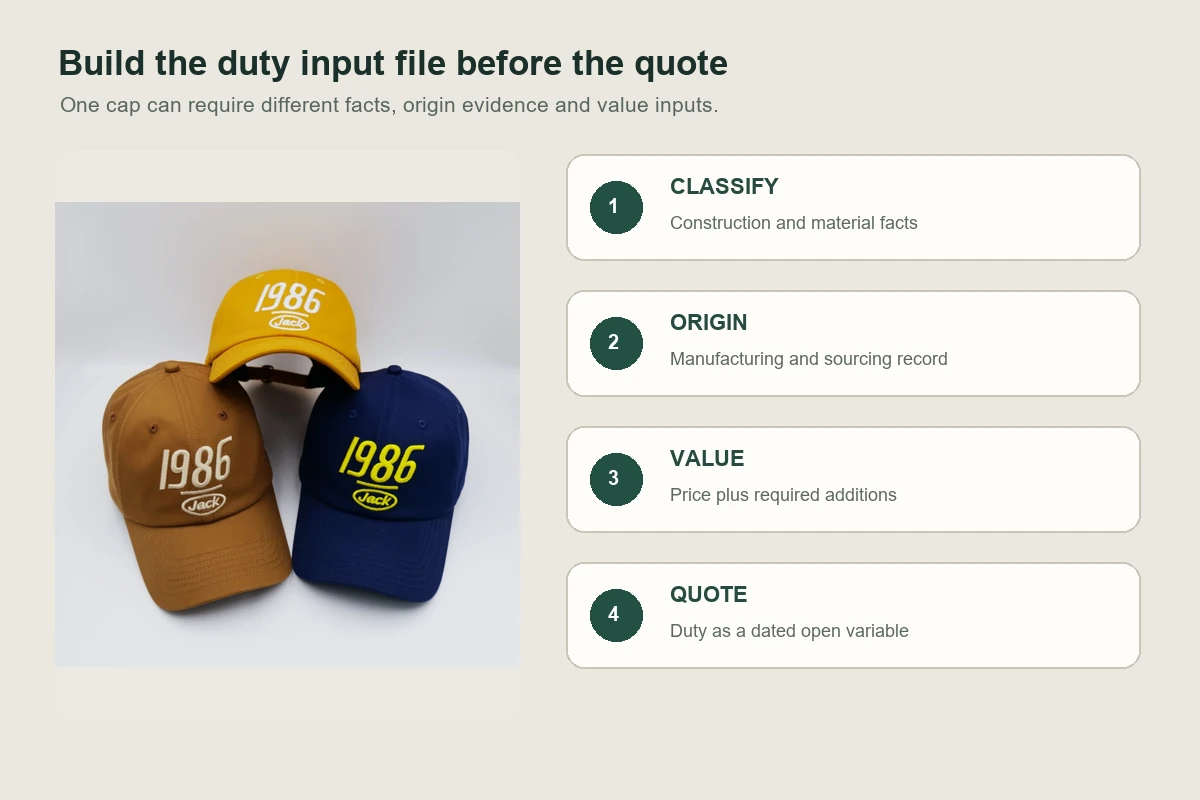
Classification should follow the product, not the buyer’s preferred duty result. Create a classification worksheet from the approved SKU rather than a generic name such as “cap.”
Describe construction and material
Record whether the headwear is knitted, assembled from textile pieces, plaited, molded or made through another construction. Identify the outer material, lining, mesh, visor, closure and any component that changes the product’s essential description. State fiber composition from controlled evidence.
Photograph the relevant facts
Use front, side, rear and interior views. Show crown panels, mesh, closure, brim and labels. Images support the written specification but do not replace it. The product-family specification system helps keep construction terms consistent across related styles.
Separate commercial names from customs descriptions
“Dad hat,” “performance cap” and “streetwear cap” can help buyers understand a range, but customs decisions rely on legal nomenclature and product facts. Keep the marketing title while adding a precise technical description for the importer and broker.
Build a classification decision record
The United States International Trade Commission states that the Harmonized Tariff Schedule sets tariff rates and statistical categories for merchandise imported into the United States and is based on the international Harmonized System. Its current site lists headgear in Chapter 65. That does not mean every cap shares one rate or statistical suffix.
Record the source and date
Save the destination schedule, release or revision, search date, candidate headings and notes reviewed. For a US scenario, link to the current USITC Harmonized Tariff Schedule rather than copying an undated code from a supplier spreadsheet.
Document why alternatives were rejected
A useful record explains which construction, material or product feature supports the chosen path and why nearby alternatives do not fit. This makes later review easier when the material, crown structure or destination changes.
Escalate uncertainty before quoting
If two classifications remain plausible, mark duty as an open variable and ask the importer or broker for a written determination route. Do not hide the higher-cost scenario simply to keep the quote competitive.
Treat origin as a separate decision
Country of shipment, supplier location and customs origin are not automatically identical. Origin depends on the applicable rules and manufacturing facts. Preferential and non-preferential origin can also serve different purposes.
Map manufacturing operations
Record where fabric or components are sourced and where cutting, knitting, sewing, embroidery, washing, finishing and packing occur. The file should show the operation sequence and the entities performing it, including approved subcontractors.
Keep supporting evidence
Retain bills of materials, supplier declarations, production records and purchase documents at the level required for the claimed treatment. A certificate or declaration must be read within its actual scope; the factory-versus-material evidence guide helps prevent overstatement.
Do not assume a trade preference
A product can have a country of origin without qualifying for preferential duty treatment. Confirm the destination agreement, product-specific rule, direct-shipment or documentary conditions and validity period before applying a preference to landed cost.
Create a customs valuation worksheet
Customs value is not a field to copy automatically from the purchase order. The applicable method and adjustments depend on the jurisdiction and transaction. The WTO has described transaction value—the price actually paid or payable—as the primary basis under its customs valuation framework, subject to the agreement’s conditions and adjustments.
Start with the transaction
Identify buyer, seller, relationship, invoice price, currency, payment terms and goods covered. Link rebates, assists, tooling, commissions, royalties, packing or other amounts for professional review when relevant. Do not decide their treatment from a generic checklist alone.
Separate dutiable and non-dutiable assumptions
Create columns for amount, currency, owner, evidence, proposed treatment and reviewer. If an item’s treatment is unresolved, keep it visible in the downside scenario rather than forcing it to zero.
Preserve version history
When the price or scope changes, keep the prior worksheet and explain the revision. The official CBP customs-value publication is one destination-specific source; importers must apply the current rules and reasonable-care obligations for their entries.
Assign responsibility through the Incoterm and contract
An Incoterm allocates delivery tasks, costs and risk at defined points, but it does not by itself determine tariff classification, origin or customs value. Record who acts as importer of record, who appoints the broker, who supplies data and who pays each charge.
Name the data owner
The factory can provide product and production facts. The brand controls commercial agreements and product identity. The importer and broker apply destination rules. Put these responsibilities in the order file so missing data is escalated before shipment.
Align the export handoff
The final invoice, packing list and shipment records must match the approved product and value file. Use the export handover dossier to freeze controlling versions and prevent an old description or quantity from reaching the forwarder.
Build dated duty scenarios
Duty estimates should show their date, destination, code assumption, origin, value basis and included trade measures. Tariff schedules and additional measures can change, so a quote validity period matters.
Use base, downside and review cases
The base case uses the currently supported classification and treatment. The downside case uses a credible higher-cost alternative or excludes an unconfirmed preference. The review case identifies which fact or ruling is needed to close the gap.
Do not publish a universal cap duty rate
Headwear construction, material, origin and destination can change the result. Additional duties or relief can be time-sensitive. A percentage without those inputs is not a reusable fact.
Connect the scenario to market choice
The EU, North America and Gulf market-entry comparison uses landed-cost visibility as one readiness factor. The duty map supplies the evidence beneath that score instead of treating a region as one tariff environment.
Quote the product and the assumptions together
A buyer should be able to see which cost is fixed, which is estimated and which is outside the supplier’s scope. Include a compact assumptions block with every landed-cost comparison.
Label open variables
Mark classification review, preference eligibility, freight, exchange rate, additional measures and destination charges separately. State the source date and quote validity. Never convert uncertainty into an unexplained contingency hidden inside the unit price.
Protect product comparability
Two suppliers may quote different materials, pack methods or Incoterms under the same commercial product name. Reconcile the specification before comparing landed cost. The SKU passport provides the stable product identity needed for that comparison.
Control changes after approval
A substitution can affect more than appearance. Changing fabric composition, construction, trim or manufacturing route can reopen classification, origin, valuation and marking questions.
Trigger re-review from the change log
List customs-impact fields in the engineering or order-change workflow. A buyer-approved aesthetic change should not bypass an import review merely because the factory can produce it without delay.
Keep old decisions attached to old SKUs
Do not reuse a classification memorandum or origin statement after the product facts change. Create a new revision and define the effective purchase orders.
Use a complete duty-input checklist
- Controlled SKU and technical product description.
- Material composition and construction evidence.
- Destination and current tariff-schedule reference.
- Candidate classification and decision rationale.
- Manufacturing route and origin evidence.
- Transaction parties, price and valuation worksheet.
- Incoterm, named place and importer responsibility.
- Base, downside and unresolved duty scenarios.
- Quote date, exchange-rate source and validity period.
- Change triggers and named review authority.
Questions buyers should close before approving a quote
- Which exact SKU and destination does the estimate cover?
- Which product facts support the proposed classification?
- Who confirmed origin and under which rule set?
- Which valuation additions were reviewed?
- Who is importer of record and who appoints the broker?
- Which current tariff release and entry date were assumed?
- Are additional duties or preferences confirmed or provisional?
- What product or transaction change triggers a new review?
Make landed cost a controlled decision
The strongest headwear landed-cost file does not claim certainty where none exists. It connects the physical cap to a dated classification analysis, the manufacturing route to origin evidence, the transaction to a valuation worksheet and the quote to named responsibilities.
Build that map before selecting the cheapest supplier or approving a retail price. It will not eliminate customs risk, but it will expose the variables early enough for the buyer, importer, broker and factory to resolve them with evidence instead of absorbing them after the shipment is committed.