

Japan and South Korea are close on a map, but a first headwear order should not treat them as one Northeast Asia label pack. The same cap construction may travel to both markets while consumer information, local responsible-party data, size expression, sales-channel fields and release evidence require separate approval. Translation at the end of production is too late if the label location, available space or product record was never designed for it.
A practical entry process uses three market-specific release files before bulk: a size file, a label file and an inspection-and-channel file. Each file must identify the finished SKU, owner, open questions and closing evidence. This structure turns a broad “Japan and Korea launch” into decisions a buyer, local partner and factory can verify.
This is an operational sourcing framework, not legal advice. Requirements can depend on product construction, consumer group, claims, distribution role and current local rules. Confirm the final setup with competent Japanese and Korean partners before manufacture or sale.
Start with one finished SKU in two release paths
Do not begin with “one Asia version.” Define the product that is actually entering each market: silhouette, shell and lining materials, brim, sweatband, closure, decoration, labels, packaging, intended wearer and channel. Give every variant a controlled identity.
Keep the physical core and local modules separate
The crown block, brim and decoration may remain global. Consumer labels, importer or seller information, language, size expression, packaging copy and online-listing fields may be local modules. Separating them prevents a regional edit from silently changing the manufacturing baseline.
Assign market-release ownership
Name a buyer-side owner and a local reviewer for Japan and Korea separately. The factory can supply controlled material and construction data, but it should not guess the legal identity, address, translations or channel rules of the business placing the goods on each market.
Reuse evidence, not assumptions
A fibre report or approved sample can support both markets only within its actual scope. The headwear compliance evidence guide explains why factory, material, order and finished-product documents answer different questions.
Build the size file around measurement and fit
A size name such as “free,” “one size” or “adult” is not enough for sourcing. Create a measurement record that connects the consumer-facing expression to the physical adjustment range and the approved sample.
Lock the measurement method
Define how head circumference, internal opening, crown depth, brim width and closure range are measured. State whether the cap is relaxed, fastened or stretched. Use the same tools and reference points at sample approval and final inspection.
Separate head range from closure range
An adjustable strap may physically travel farther than the comfortable fit range. Record the usable range confirmed through fit review, not only the maximum hardware movement. The cap sizing and closure guide shows why fitted, snapback, strapback and elastic systems create different inventory and fit decisions.
Approve the displayed size with the local channel
Ask the Japanese or Korean retailer, distributor or marketplace which size fields it requires and how customers see them. The factory measurement record should remain precise even if the customer-facing format is simplified.
| Size-file field | Factory evidence | Local approval |
|---|---|---|
| Finished SKU and revision | Tech pack and approved sample ID | Correct market listing identity |
| Head-fit range | Defined measurement and fit result | Consumer size expression |
| Closure adjustment | Minimum and maximum usable positions | Channel size field and guidance |
| Inspection method | Tool, points and tolerance | Acceptance wording understood by partner |
Create the Japan label file from the finished cap
Japan’s Consumer Affairs Agency publishes the official Household Goods Quality Labeling Act handbook. Its textile table includes hats made using specified yarns in all or part of the outer fabric and identifies fibre composition, home-care labelling and labeler information as relevant display matters. The handbook also explains that, for imported goods, a Japanese business entity such as the importer, seller or contracted labeler needs to become the labeler.
Calculate composition from controlled components
Map shell, contrast panel, lining and other relevant textile parts to supplier material codes. Japan’s official textile guidance allows whole-product or clearly separated component presentation in specified circumstances. Do not turn a marketing fabric name into the consumer composition statement.
Reserve durable space for care information
The Consumer Affairs Agency guidance states that home-care symbols are displayed using the prescribed JIS system and that the label should be easy for consumers to find, not hidden by seams and attached so it does not come off easily. Approve the location on the finished cap, not on a flat label artwork alone.
Confirm the Japanese labeler block
Keep the final business name and address or phone information under the Japanese partner’s approval. Do not ask the factory to invent or transliterate the accountable business. Photograph the approved label inside the finished sample and connect it to the SKU revision.
Create the Korea label file as a separate controlled version
Korea’s Agency for Technology and Standards describes a safety-standards compliance system for designated consumer products. Its official guidance lists household textile products and explains that covered manufacturers or importers must make products that conform to the applicable safety standard and display the information required by the product-specific standard. The agency also notes that a KC mark is not attached for this compliance category.
Obtain the current product-specific standard
Use the Korean partner and current official text to decide the applicable product category and fields for the actual cap. The KATS page links current household-textile standards and gives an apparel example containing fibre content, manufacturer or importer, country of manufacture, manufacture date, size, handling precautions, and the labeler’s address and telephone number. Treat that example as an illustration, not a universal cap label to copy.
Separate conformity evidence from printed information
A correct Korean-language label does not by itself demonstrate that materials and the finished product meet the applicable safety standard. Keep the evidence route, supplier declarations and any required testing connected to the finished SKU. The component test-booking map helps assign evidence to shell fabric, sweatband, decoration, metal hardware and other parts without assuming one report covers the whole cap.
Approve language and responsible-party details locally
Have the Korean importer or channel partner approve translations, business identity, contact details, date format, size and handling statements. Lock that version before bulk label production. Do not reuse the Japan artwork simply because both fit the same physical label.
Design the label architecture before the sample gate
A cap has limited inside space. Brand labels, composition and care information, local business details, size, origin and batch identification can compete with the sweatband, seam tape and closure. Plan the architecture before sampling rather than shrinking type at the end.
Decide what is sewn, printed or packaged
Assign each field to a permanent label, transfer print, hangtag or package only after the local reviewer confirms the route. Keep critical information visible and durable for the required use. The private-label cap label system provides a method for connecting brand, care, packaging and product identity under one revision.
Keep Japan and Korea artwork as separate files
Use market codes and revision dates in filenames. One master layout can guide spacing, but each market needs its own approved content. A shared filename called “Asia label final” invites the wrong file into production.
Run a physical readability check
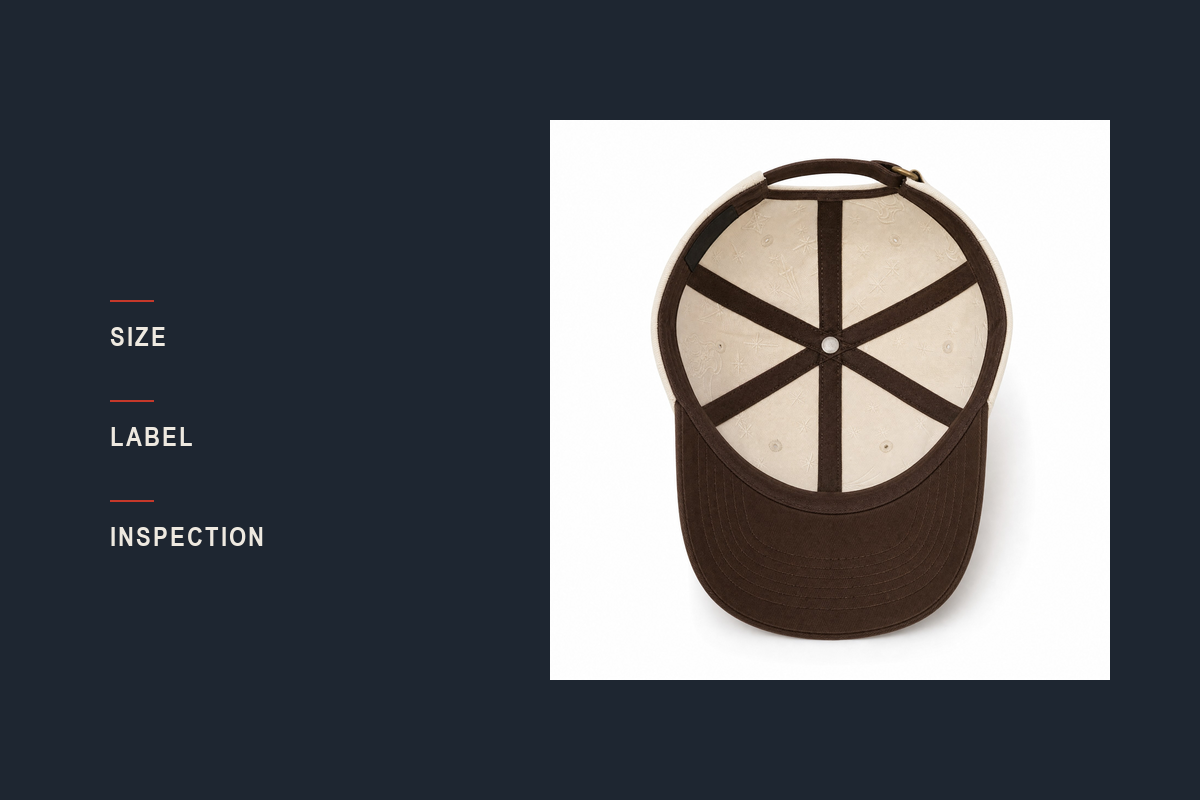
Sew the label into a representative cap, close the sweatband, fasten the closure and inspect it in normal use. Check legibility, edge irritation, seam coverage, print durability and whether the label folds over the text.
Use inspection to verify the released market version
Final inspection can verify what was approved; it cannot decide unresolved legal copy. Convert each market file into observable checks before production is complete.
Inspect product identity first
Confirm SKU, colour, market code, label revision, packaging revision and carton allocation. Mixed Japan and Korea units in one packing area create a high risk of correct caps carrying the wrong information.
Check presence, content and workmanship separately
Presence asks whether the required item exists. Content asks whether it matches the approved market file. Workmanship asks whether it is legible, securely attached and correctly positioned. Record defects in the appropriate class rather than reporting “label issue” without detail.
Define the lot and release authority
The headwear AQL inspection plan explains how lot identity, sampling basis, defect classes and release authority work together. Use market-specific critical criteria where an incorrect label or destination version creates a serious release risk.
Connect the physical label to the sales channel
The product page, retailer data sheet and package should not contradict the cap. Build channel fields from the same released size and label records.
Use the same SKU and colour names
Map factory codes to the customer-facing Japanese or Korean names, then freeze the cross-reference. Do not let merchandising rename a colour without updating the file used for returns, customer service and replenishment.
Prepare images that prove the inside
Store front, side, back, closure, underside and inside-label photographs for each market sample. These views help local partners review product identity and give inspectors a visual reference.
Align packaging with the receiving route
A marketplace fulfilment centre, department-store distributor and corporate-gifting partner may require different unit packs or carton data. The retail carton pack-out guide connects the consumer unit, inner pack and shipping carton to the actual sales route.
Release the first bulk order through three signatures
Do not approve “Japan and Korea” in one email. Close each market through three named decisions.
Size-file approval
The product owner and local channel confirm measurement method, fit range, consumer expression and inspection tolerance for the finished SKU.
Label-file approval
The local accountable business confirms composition, care, language, business identity, country or date fields where applicable, label location and durability for its market.
Inspection-and-channel approval
Quality and operations confirm market code, observable inspection criteria, packaging, listing data, carton allocation and release authority. Open items remain visible; they are not converted into factory assumptions.
Prevent version mixing during production
Separate label inventory, work orders, packing stations and carton marks for Japan and Korea. Issue exact quantities with a controlled allowance, reconcile unused labels and quarantine any bundle whose market identity is uncertain.
Use first-piece verification
Before running bulk labels, produce one complete Japan unit and one complete Korea unit. Compare them with the approved files and photograph the result. Release only after the responsible reviewer confirms the physical implementation.
Control substitutions and corrections
A material, label stock, ink, supplier, contact block or translation change can reopen one or more files. Record the change and determine which local approval must be repeated.
Close the shipment balance
Reconcile ordered units, produced units, inspected units, market allocation, rejects, samples and unused labels. This prevents a leftover local label from entering a later order without review.
Build a reusable Northeast Asia product core
After the first order, keep one global construction file and separate Japan and Korea modules. Preserve approved label artwork, translations, responsible-party fields, photographs, inspection results and channel feedback with the product revision.
A scalable program does not force two markets into one label. It controls what can genuinely transfer and revalidates what cannot. Begin with one finished SKU, close the size file, close each label file, and make inspection verify the correct market version. That creates a repeatable route for future colours and reorders without rebuilding the product from memory.