

Closure type is usually treated as a styling detail chosen near the end of development, somewhere between colourway and label placement. That is the wrong sequence. The closure determines how many sizes you have to produce, how much inventory risk you carry, who can wear the product comfortably, and how the cap behaves during movement. It is a sizing decision wearing the costume of a hardware decision.
This guide covers the four systems used in headwear, what each one costs in inventory and fit accuracy, and how to specify head sizing so that a sample and a bulk run actually match.
Sizing Comes Before Closure
Every fit system is an answer to the same question: how does one manufactured object accommodate a range of human heads? Adult head circumference spans roughly 54 to 62 centimetres across most populations, and no single fixed opening covers that comfortably.
The industry solves this in one of two ways. Either you produce multiple fixed sizes and stock them all, or you produce one size with a mechanism that adapts. Fitted caps take the first route; snapback, strapback and elastic take the second. Everything else about closure choice follows from that fork.
Measure the Head, Not the Cap
Head circumference is measured around the widest part of the skull, above the ears and across the mid forehead. The international reference for how body measurements are defined and taken is ISO 8559-1, published by ISO technical committee TC 133 on clothing sizing systems and reconfirmed as current in 2026. It exists precisely because measurement method, not just measurement value, determines whether two parties are talking about the same thing.
For a factory brief this matters more than it sounds. If your target market is stated as "medium", you have specified nothing. If it is stated as a circumference range in centimetres with a stated tolerance, the factory can build to it and inspect against it.
Crown Depth Is the Forgotten Dimension
Circumference gets all the attention, but depth decides whether a cap sits correctly. Two caps with identical openings can behave completely differently: a shallow crown perches on top of the head and lifts in wind, while an excessively deep one drops onto the ears and blocks peripheral vision.
Specify crown height as a measurement with a tolerance rather than describing it as standard, because standard varies between factories and between markets. Approve it on a worn sample photographed on the same head form each time.
The Four Fit Systems
Each system trades adjustability against fit precision, and each carries a different inventory consequence. There is no universally correct answer, only an answer that suits your channel and your customer.
Fitted
A fitted cap has no adjuster. The crown is manufactured to a specific circumference and the wearer buys their size. This delivers the cleanest silhouette in the category — an unbroken rear panel with nothing interrupting the line — and the most precise fit for the person it was made for.
The cost is inventory. Carrying six or seven sizes across every colourway multiplies SKU count, and demand is not evenly distributed across sizes: middle sizes sell out while extremes sit. For a brand selling direct at volume this is manageable. For a startup or a wholesale programme, it is usually the wrong first choice.
Snapback
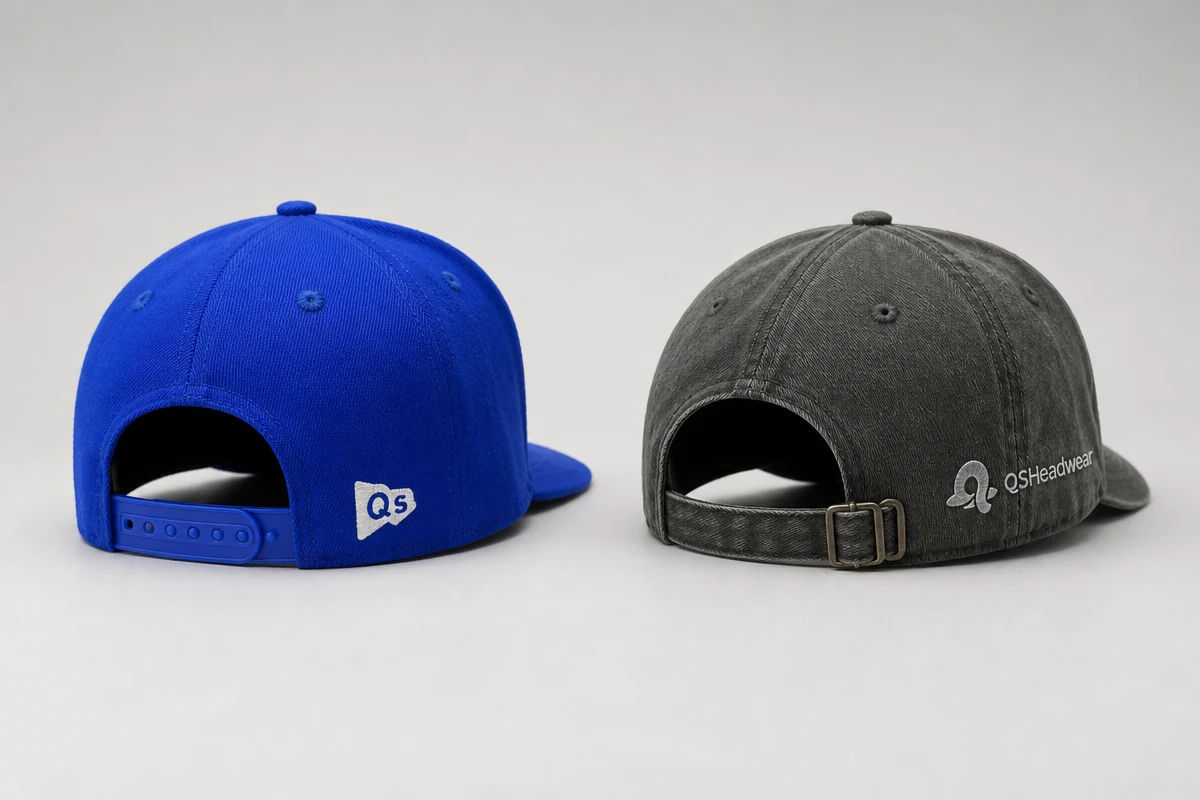
A plastic snap strap with a row of pegs and holes, adjustable in fixed increments. One SKU covers most adult heads, adjustment is fast and obvious, and the flat rear strap suits the structured, flat-brim aesthetic the style grew up with.
The limitations are real but narrow. Adjustment is stepped rather than continuous, so a wearer between two positions has to choose slightly loose or slightly tight, and the plastic is visible and reads as casual. That casualness is exactly what the streetwear market wants — the reason snapback caps remain the canonical silhouette for that audience rather than an accident of history.
Strapback
A fabric, leather or webbing strap fastened with a metal buckle, slider or hook-and-loop. Adjustment is continuous rather than stepped, which produces a more precise fit than a snap, and the materials read as more refined.
Strapbacks pair naturally with unstructured crowns, which is why dad hats almost always use them. The strap tail is a design decision in itself: left long it signals a specific streetwear look, trimmed short it reads cleaner and more premium. Metal hardware also allows a small branding surface that plastic does not.
Elastic and Flexfit
An elasticated band, either as a full stretch-fit sweatband or a concealed elastic rear panel, holds the cap through tension. There is no visible closure, so the silhouette is as clean as a fitted cap while still covering a size range.
This is the correct answer for athletic use, because nothing shifts during movement and there is no hardware to press against the head under a helmet. The trade-offs are that elastic relaxes over time and the sizing is genuinely a range rather than a point, so it usually ships as small/medium and large/extra-large rather than one size.
Choosing by Channel, Not by Preference
The right system depends on how the product will be sold and worn rather than on which looks best in a mood board.
Corporate and Promotional Programmes
One-size adjustable is almost always correct here. A workforce or event audience has an unknown distribution of head sizes and nobody is collecting measurements in advance. Snapback or strapback removes the entire problem, and the small fit compromise is invisible against the alternative of ordering sizes blind. This is why corporate and promotional caps default to adjustable closures across the category.
Retail and Direct-to-Consumer
Adjustable reduces returns, which is the dominant economic factor in online sales. Every size a customer can get wrong is a return you pay for twice. Fitted sizing suits established brands with enough data to forecast size distribution and enough margin to absorb the tail.
Sport and Performance
Elastic wins on function. Where a cap must stay in place through running, cycling or a full working shift, stability outranks silhouette. Reduced hardware also improves comfort under helmets and headsets, which matters in cycling and industrial contexts alike.
Specify Fit So Bulk Matches the Sample
Fit failures in production are rarely caused by an incompetent factory. They are caused by a specification that left room for interpretation.
Write Numbers, Not Adjectives
State head circumference range, crown height, brim length and width, closure type and hardware, and the adjustment range from smallest to largest setting. Include tolerances. A tolerance of plus or minus half a centimetre on circumference is a different product from plus or minus two centimetres, and only one of those can be inspected against.
Then approve a physical sample against those numbers. Sampling runs three to five business days once artwork and specifications are confirmed, so a fit correction round is cheap compared with discovering the problem after bulk approval.
Test at Both Extremes of Adjustment
Most fit reviews check the cap at a comfortable middle setting. Check it at both ends instead. At the tightest setting, does the crown pucker or the strap dig in? At the loosest, does the cap still hold shape and does the strap tail flap? A product that only works in the middle of its range does not really cover the range it claims.
Confirm Consistency Across the Bulk Run
Fit is a dimension like any other and drifts across production. Include crown circumference and depth in the inspection criteria rather than checking only appearance and stitching. Our quality control guide covers how to structure an inspection so measurement is actually verified rather than assumed.
Fit Interacts With Construction
Closure choice is not independent of the rest of the product. Structured and unstructured crowns behave differently under tension, and the fabric changes how much a given adjustment actually moves the fit.
A stiff structured crown holds its circumference regardless of the strap, so adjustment mostly changes how the cap sits front to back. A soft unstructured crown deforms with the adjustment, so tightening changes the whole silhouette. Neither is wrong, but a tech pack that assumes the first while specifying the second will not produce what the designer imagined.
Fabric weight compounds this. Heavier cloth resists deformation and needs a more positive closure; lightweight technical fabric moves easily and pairs naturally with elastic. Our cap fabric guide covers how the main materials behave, and panel geometry matters too — for a five-panel block specifically, our five-panel pattern and fit guide goes deeper into how panel layout shapes the crown.
If the silhouette itself is still undecided, resolve that before locking the closure. Our cap style guide sets out how each construction reads to different markets.
Frequently Asked Questions
Which closure suits a first-time brand?
Adjustable, in most cases. Snapback or strapback covers the adult range with a single SKU, which removes size forecasting from a decision set that is already crowded. Fitted sizing is better introduced once you have real demand data.
What head circumference range should we specify?
State the range in centimetres for your target market with an explicit tolerance, and have the factory confirm the adjustment range achieves it. Descriptive terms such as medium or one size are not specifications and cannot be inspected against.
Does elastic fit loosen over time?
Elastic relaxes with use and washing, which is inherent to the material. Specify the elastic quality and check recovery on a sample after wear and washing rather than assessing it new.
Can one cap design use different closures?
Yes, and it is a common way to serve two channels from one block — for example a strapback for retail and a snapback for promotional volume. Each variant carries its own hardware sourcing and its own sample approval, so treat them as two products for costing purposes.