

A custom hat MOQ purchase ladder helps a buyer choose quantity with evidence instead of asking for the lowest possible unit price first. Minimum order quantity can be driven by fabric rolls, dyeing, embroidery setup, labels, packaging, machine efficiency, carton economics or a supplier's commercial policy. The right ladder shows what each volume unlocks and what risk it creates.
Build the ladder before a quote is finalized. Separate one-time setup from variable product cost, distinguish a true factory minimum from a price-break preference, and show whether colors or sizes can share a material commitment. A small order can be rational when it tests a new market; a larger order can be cheaper per unit and still be wrong if the product has not been approved.
Custom hat MOQ purchase ladder: define the unit being measured
Ask whether the number applies to one style, one color, one logo, one fabric, one size curve, one shipment or the complete order. A 300-piece minimum across a family is different from 300 pieces for every color. Put the unit of measure beside the MOQ so the buyer cannot compare unlike quotes.
A custom hat MOQ purchase ladder should also show whether the minimum is hard, negotiable with a surcharge, or simply the quantity that makes the quoted price efficient.
Separate setup cost from unit cost
| Cost layer | What creates it | Quantity effect | Buyer question |
|---|---|---|---|
| Development | Pattern, digitizing, sample and testing | Mostly one-time or staged | Which approvals are included? |
| Material commitment | Fabric, yarn, trim, dyeing and labels | May create batch minimums | Can unused material be held or shared? |
| Production setup | Cutting, machine, decoration and line change | Spread across more units | What changes at the next tier? |
| Packaging | Printed bags, boxes, inserts and carton mix | Often pack-specific | Can standard packaging lower the floor? |
| Logistics | Carton count, freight and destination | Usually improves with consolidation | Does the price include shipping assumptions? |
Do not bury development or material commitments inside one unit price. When the buyer understands the layers, a small run can be negotiated with a clear surcharge rather than an unrealistic promise.
Build a ladder that matches buying decisions
| Tier | Use | What to confirm | Main risk |
|---|---|---|---|
| Sample | Validate shape, decoration and fit | Sample scope and approval | Treating sample as bulk proof |
| Pilot | Test customers, content and operations | Repeatability, pack-out and defect response | Drawing a market conclusion from too little data |
| Launch | Support a planned release | Material allocation and shipment split | Cash tied to a slow variant |
| Scale | Lower unit cost for proven winners | Capacity, reorder forecast and reserved material | Overbuying the tail |
| Reorder | Repeat accepted SKU | Baseline, lot continuity and updated demand | Assuming old data still applies |
Each tier should have a decision gate. Do not jump from a beautiful sample to a large volume without a reasoned pilot or evidence that the style is already proven. The custom hat MOQ purchase ladder should make that decision visible.
Use family-level material sharing carefully
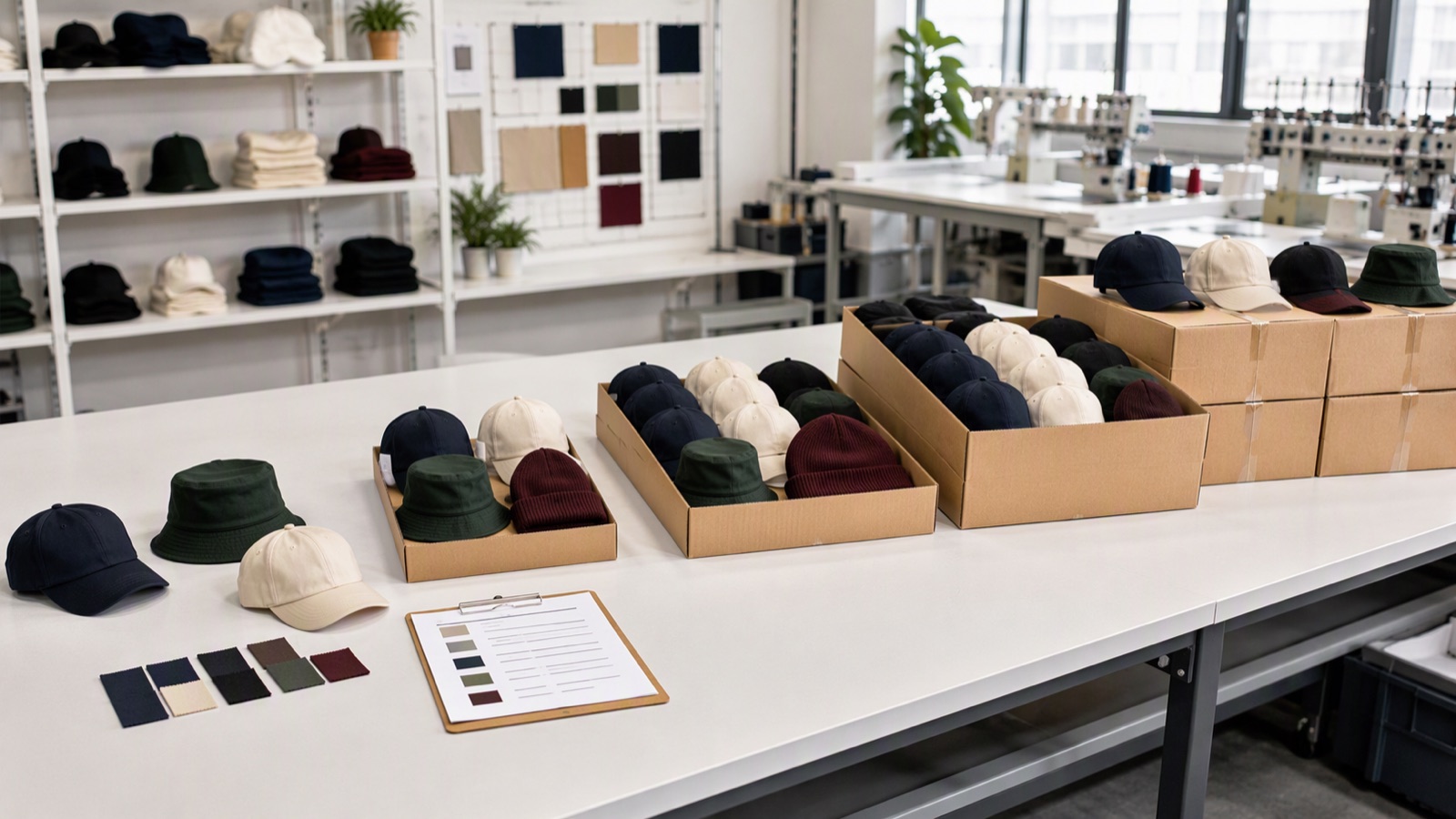
Combining colors or related styles can make fabric, labels or packaging more efficient, but only if the specification and inventory controls allow it. State which components are shared and which remain style-specific. A common black fabric does not make two different crowns interchangeable.
Ask the factory to show the material commitment by color and style. An apparent family MOQ can hide a large commitment to one slow variant.
Price the risk of an unfinished design
At early tiers, the buyer is buying information as well as product. The pilot may reveal that a logo is too small, a visor curve is wrong, a color sells poorly or a pack-out is expensive. Treat that learning as a reason to cap exposure, not as a failure of the pilot.
Keep the approved baseline and record what the pilot changed. Otherwise a larger order may repeat the wrong construction because its lower unit price looked attractive.
Compare inventory and cash, not only unit price
Calculate landed cost, cash tied up, storage, markdown exposure, returns, aging and the value of reserved material. A 10,000-piece quote can beat a 1,000-piece quote on unit price and lose on total contribution if half the colors move slowly.
Use demand bands rather than one optimistic forecast. A custom hat MOQ purchase ladder should show what happens if the base case, downside case or upside case occurs, and who can stop the order before the next tier is committed.
Make setup choices explicit
List embroidery digitizing, patch tooling, custom dyeing, wash development, printed packaging, special labels and carton inserts. Some setup can be amortized across an order; some is paid before the first unit. Confirm whether setup files remain available for reorders and whether a new color or size requires a new setup.
Never assume that one logo file fits every cap construction. A change in size, backing or stitch route can create a new approval even when the artwork is unchanged.
Test the pilot like a future reorder
Use the same specification, inspection method, pack-out and data labels that the scale order will need. Measure lead time, defect types, rework, packaging labor and customer response. The pilot should answer whether the supply system is ready to repeat the product, not only whether one sample looks good.
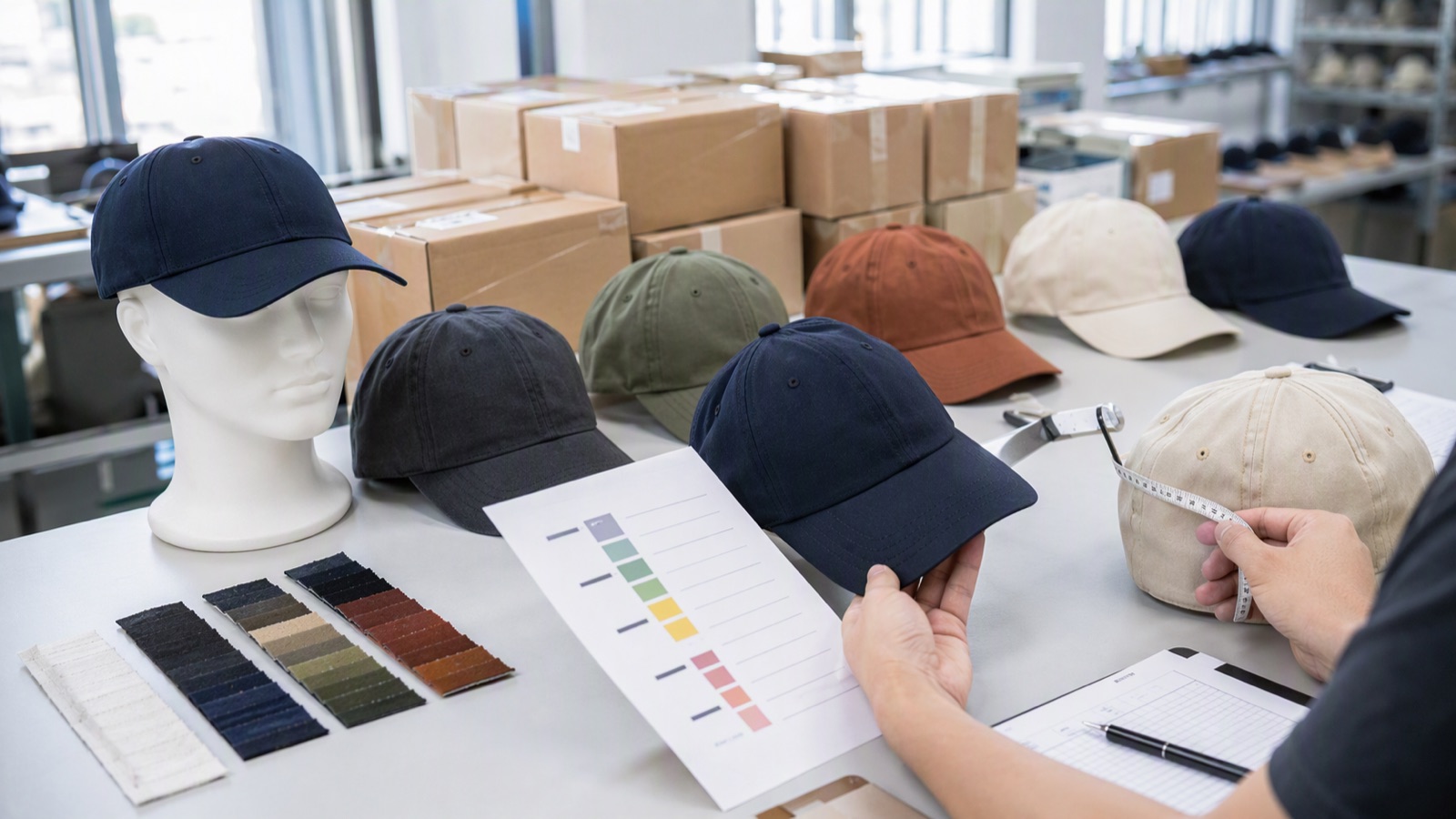
Protect the slow variants
Set a separate quantity decision for colors, sizes and decorations that have uncertain demand. A family-level MOQ should not force equal units across every variant. Ask whether the factory can hold approved fabric or finished components, and state ownership, storage cost and expiry.
Use reorder signals to add winners rather than averaging all variants into one purchase number. The tail should have a clear exit plan.
Negotiate with a decision tree
| Buyer situation | Factory option | Trade-off | Record |
|---|---|---|---|
| Below material minimum | Use stock fabric or combine approved colors | Less customization or larger color family | Material identity and approval |
| Below efficient run | Accept surcharge or longer schedule | Higher unit cost or waiting | Surcharge and date |
| New logo or patch | Charge setup separately | Lower quantity possible | Tool/file ownership |
| Uncertain demand | Pilot then scale | More approvals, lower exposure | Pilot gate and reorder trigger |
| Proven winner | Reserve capacity and material | Cash commitment | Forecast, allocation and expiry |
Negotiation is clearer when the buyer chooses which variable to move: quantity, unit cost, material, schedule, decoration or packaging. Asking for all six at once usually produces a vague quote. Keep the selected trade-off in the custom hat MOQ purchase ladder record.
Set a reorder trigger before launch
Define the sell-through, stock cover, lead time and material reservation that trigger the next order. A reorder trigger is not a purchase order; it is an early decision point that protects capacity and avoids an emergency rush.
For a continuing style, retain the approved sample, material lot information, label map, packaging and inspection record. A low MOQ is valuable only when the next order can repeat the baseline.
How QSHeadwear discusses quantity tiers
QSHeadwear can quote samples, pilot runs and larger programs for caps, beanies, bucket hats, visors and promotional headwear. We review style, material, decoration, colors, packaging and delivery before setting a practical quantity tier. The useful number depends on the operation behind the product, not a generic website minimum.
Sampling commonly takes three to five business days after the brief is clear. Bulk commonly runs fifteen to twenty days and may extend above 5,000 pieces. A staged quantity plan can protect the buyer while the market is being tested.
Request a volume ladder quote
Send the target styles, colors, size curve, decoration, packaging, pilot quantity, forecast range and destination. Ask for each tier's setup, material commitment, unit price, lead time, inspection scope, carton assumptions and reorder conditions.
Compare small-batch cost drivers, review bulk volume tiers, browse products, or contact QSHeadwear. The GS1 GTIN Management Standard helps frame identifier decisions as a product or packaging quantity changes, and the OECD due-diligence guidance provides a broader risk-based sourcing framework.
OECD sourcing principle: The OECD says its guidance helps enterprises “avoid and address the potential negative impacts of their activities and supply chains.” See the OECD garment and footwear guidance.
MOQ questions buyers ask
What does MOQ mean for custom hats?
MOQ is the minimum quantity attached to a defined unit of production, such as one style, color, logo, fabric or shipment. Ask exactly what the number measures and whether it is a hard material minimum, efficient-run target or negotiable quantity.
Can I order below the stated MOQ?
Often the options are a surcharge, stock material, combined approved colors, a longer schedule, a pilot tier or a different construction. The factory should explain the trade-off rather than promise the same price and process below its constraint.
Why is a color MOQ different from a style MOQ?
Dyeing, fabric rolls, labels, packaging and production setup can be color-specific. A family of styles may share some materials while still needing separate decoration files, patterns or inspection records.
Should I start with the largest quantity for the best price?
Not when the product, market or demand is unproven. A pilot can validate fit, color, decoration, pack-out, defect response and customer response before cash is committed to scale inventory.
How should I compare two MOQ quotes?
Normalize setup, material commitment, unit cost, freight assumptions, lead time, inspection, packaging, payment, storage and leftover material. A lower unit price is not comparable if it excludes a major fixed cost or increases inventory risk.
Can different colors count toward one MOQ?
Sometimes when they share an approved material or run. Ask for the exact allocation by color and style, plus any minimum per color. Do not assume a family minimum removes slow-color exposure.
What is a pilot quantity?
It is a deliberately limited production tier used to test a product and supply process before launch or scale. It should use realistic materials, decoration, inspection and packaging so the learning transfers to the next order.
What happens to leftover material after a small order?
Clarify whether it is held, returned, consumed by another approved style or charged to the buyer. Record material identity, quantity, storage condition, ownership and expiry so it does not become an invisible cost.
When should a reorder be triggered?
Set a trigger before launch using stock cover, sell-through, lead time, capacity and reserved material. It is an early planning signal, not an automatic purchase order, and should be reviewed against current demand.
Does a lower MOQ always mean a higher unit price?
Not always, but lower quantities often spread fixed setup, material and handling costs over fewer units. A family program, stock component or separate setup charge may change the relationship. Ask what actually drives each tier.