

A wholesale caps manufacturer should help a buyer plan an assortment that can sell, ship and replenish without confusion. The question is not simply how many caps a factory can produce. It is whether the supplier can keep style, color, decoration, packaging, minimums and delivery assumptions visible across the whole range. A clean assortment file gives a retailer more control over cash, shelf space and the next order.
This guide is aimed at retailers, distributors, online stores and promotional buyers. It does not forecast demand or promise a margin. It offers a practical way to compare cap suppliers on the commercial details that decide whether a wholesale program remains manageable after launch.
Start with the job each SKU must do
Give every cap a role: traffic driver, core replenishment, seasonal color, premium statement, event option or test item. The role affects fabric, decoration, price, quantity and how quickly the buyer expects to reorder. A core black cap may deserve deeper inventory than a fashion color even when both use the same pattern.
Write the role beside the SKU, then record the evidence that will change the next decision. For a new item, that may be sell-through, returns, customer feedback or account commitments. For an established item, it may be weeks of cover, stock-out risk or a confirmed retailer booking.
| SKU role | Typical buyer question | Useful planning signal | Common mistake |
|---|---|---|---|
| Core replenishment | Can the style return on a reliable cadence? | Weeks of cover and reorder point | Buying too shallow for a proven item |
| Seasonal color | When does the color need to arrive and exit? | Launch and markdown dates | Treating a short season like a core SKU |
| Premium statement | What feature justifies the higher price? | Margin and customer feedback | Adding costly trims without a clear role |
| Test item | What must this first run prove? | Defined review date and gate | Calling untested demand a forecast |
| Promotion or account | Which quantity belongs to each destination? | Confirmed allocation and ship-to list | Mixing account stock with open inventory |
Ask the wholesale caps manufacturer for a SKU matrix
A supplier quote becomes easier to compare when each row shows cap construction, fabric, color, closure, decoration, label, packing, quantity and destination. Add the primary minimum and the component minimum. If several colors share a style minimum, mark the exact combination the factory has confirmed.
Use a separate row for every sellable version. Do not combine a navy embroidered cap and a black patch cap simply because both use the same crown. Their setup, inspection and packing requirements may differ.
A practical wholesale caps manufacturer can use this matrix to show which variants share a run and which require a separate setup.
Balance depth, breadth and material risk
Breadth gives a wholesale collection variety. Depth protects the styles that already have a sales path. Material risk appears when a new color or fabric requires a larger purchase than the finished caps. Ask whether the fabric is in stock, reserved for the order or bought after approval. Record leftover ownership and the storage period.
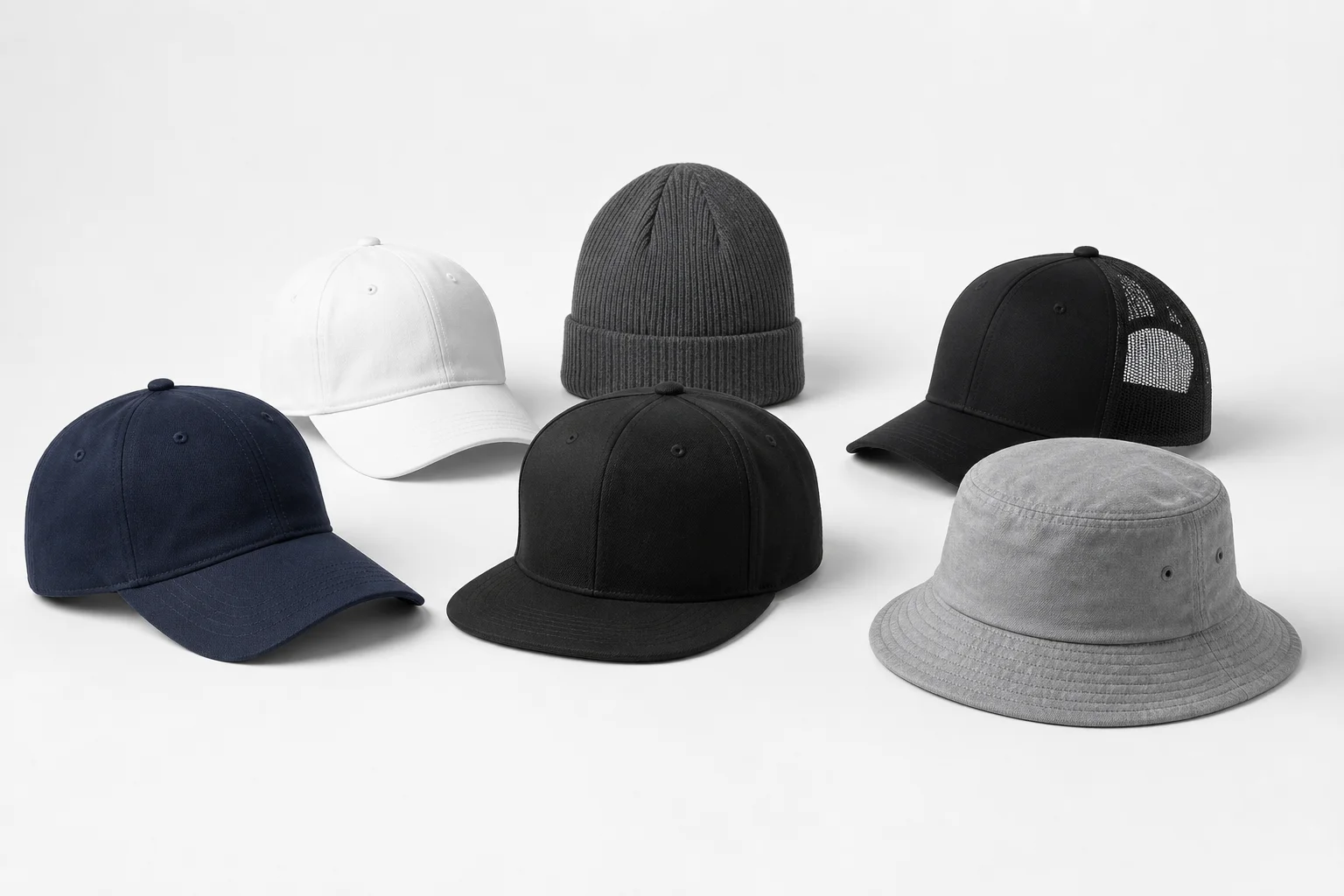
QSHeadwear presents baseball caps, beanies, denim bucket hats, dad hats, snapbacks, trucker hats and visors in its public product center. Use the QSHeadwear product range to build a shortlist, then confirm the actual material, decoration and minimum for each wholesale SKU.
Compare decoration by shelf role
Wholesale caps can use flat embroidery, 3D embroidery, patches, screen print, heat transfer or washing effects. The choice should match the price point, customer use and repeatability. A detailed patch may attract attention on a premium item but add a component minimum and a longer approval path. A small flat logo may suit a core replenishment style if it remains legible on the selected fabric.
Ask for actual-size proofs and a complete decorated sample. Record the artwork revision and placement landmarks. A supplier that can explain what changes between the prototype and bulk gives the buyer a more dependable reordering base.
Make landed cost visible
Unit price is only one line in a wholesale plan. Add sample fees, artwork or digitizing, labels, bags, cartons, inspection, freight, duties where relevant and destination handling. Compare the same pack-out and ship-to assumptions across suppliers. A low ex-factory number can lose its advantage when the carton count or delivery split changes.
Ask for a price ladder at the pilot quantity, planned launch quantity and reorder quantity. The ladder helps the buyer decide whether an extra depth is worth the cash and storage risk.
Design cartons for receiving, not just shipping
Warehouse staff need to identify the cap, color, SKU and destination quickly. Agree on carton marks, carton sequence, units per carton, inner bags, separators and the treatment of mixed cartons. For multi-account wholesale orders, keep the allocation file next to the carton map.
Run a complete pack-out sample. Compression can flatten a brim or mark an embroidered panel. A correct carton count does not prove that the cap arrives in a saleable condition.
Quality control should match the selling promise
Define the defects that would affect a retailer's decision: wrong color, crooked brim, closure failure, logo shift, visible puckering, loose thread, incorrect label or mixed SKU. Check materials before cutting, the first complete cap before the line repeats it, and packed units before shipment.
QSHeadwear describes raw-material checks, pre-production samples, in-line monitoring and AQL 2.5 final inspection. Ask the team to map those stages to your product requirements. ISO 2859-1 helps buyers and suppliers discuss sampling consistently, but it does not determine your product tolerances.
| Wholesale control | What to define | Evidence for release |
|---|---|---|
| SKU identity | Style, color, decoration, label and destination | Approved matrix and carton map |
| Appearance | Fabric shade, shape, logo position and workmanship | Measured sample and inspection photographs |
| Function | Closure operation, comfort and shape recovery | Functional check and approved sample |
| Packing | Bag, count, carton marks and stack method | Complete pack-out sample |
| Reorder record | Revision, lot, defects, sell-through and balance | Post-receiving report |
Ask about capacity as a collection
A broad wholesale range may compete for the same sewing, decoration or packing capacity. Ask whether your core styles and seasonal colors can be scheduled together, which material or decoration is the bottleneck, and whether the factory reserves capacity for repeat orders. A published monthly capacity figure is useful context, but the style mix and approval timing determine the actual calendar.
The wholesale caps manufacturer should separate sample timing, component preparation, bulk production, inspection, packing and transport. That makes a delayed color or late artwork decision visible before it moves the whole shipment.
Ask the wholesale caps manufacturer to show the first production gate and the reorder window for every core style.
Use OEM or ODM for the right assortment problem
OEM suits a retailer with a defined product file and a clear SKU matrix. ODM can help when the buyer wants proposed silhouettes, seasonal ideas or a base range before adding its own branding. Review the QSHeadwear OEM/ODM information to decide which inputs your team owns and which proposals you want from the factory.
Set a reorder gate
Choose the evidence that triggers a reorder: weeks of cover, confirmed account demand, a seasonal date, a minimum viable run or a material balance. Archive the approved sample, artwork, labels, packing, inspection result and receiving notes. The next purchase should compare against the same reference, not a new interpretation.
With a documented gate, the wholesale caps manufacturer receives a quantity decision tied to evidence rather than a last-minute guess.
Send an assortment-ready inquiry
Share the product roles, SKU matrix, target quantity, materials, decoration, labels, packaging, destinations and launch dates. Use the QSHeadwear contact page to ask for a quote that separates minimums, sample steps, production timing and shipping assumptions. For factory background, the QSHeadwear company profile provides context on the Dongguan production operation.
A clear brief gives the wholesale caps manufacturer enough detail to discuss the range as one production plan.
A dependable wholesale caps manufacturer helps a buyer make the collection legible. Define each SKU's job, compare the complete cost, test the carton and keep the evidence that makes replenishment predictable.
Wholesale caps manufacturer questions
What should a wholesale cap assortment include?
Include SKU role, style, color, fabric, decoration, label, packaging, quantity, destination and the evidence that will guide the next buy.
How many colors should I order?
Use the commercial role of each color, expected sell-through, minimums, material availability and seasonal timing rather than treating every color equally.
Can one style minimum cover several colors?
Sometimes. Ask the factory to state exactly which colors, materials and decoration versions can share the minimum.
What is the difference between wholesale and bulk pricing?
Wholesale describes a resale-oriented purchase. Bulk pricing should still be compared with the same quantity, components, packing and destination assumptions.
Should I test a wholesale SKU before a deep order?
For a new or uncertain item, define a pilot objective and review gate before committing to deeper inventory.
What should a carton map show?
Show SKU, color, destination, carton sequence, units, mixed-carton rules and any account allocation reference.
How can I compare suppliers fairly?
Use one SKU matrix and compare product, decoration, labels, packing, inspection, freight, minimums and lead time on the same basis.
Does AQL 2.5 cover all wholesale cap defects?
No. It supports sampling language. Product-specific defects, measurements, appearance and functional checks still need to be defined.
When should I trigger a reorder?
Use a documented gate such as weeks of cover, confirmed demand, seasonal date, minimum run or component balance.
What should I send QSHeadwear?
Send the assortment roles, SKU matrix, references, materials, decoration, quantities, packing, destinations, dates and questions about the production calendar.