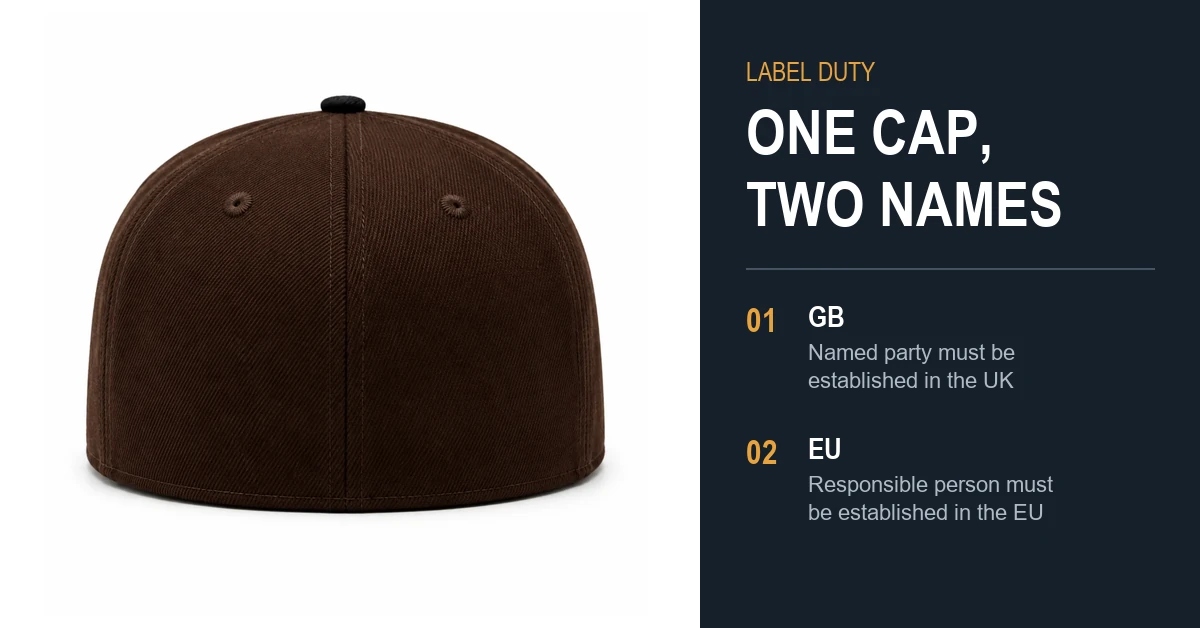


No. An EU responsible person does not, by itself, satisfy the name-and-address duty that applies to a cap placed on the market in Great Britain. Great Britain's General Product Safety Regulations 2005 decide who counts as the "producer" by reference to establishment in the United Kingdom, then require an indication of that producer's name and address by means of the product or its packaging. A cap labelled only with an EU-established party's details leaves the GB indication duty unaddressed.
This guide is for buying teams and brand owners shipping consumer headwear into Great Britain: what the instrument requires, how the producer test resolves for an imported cap, where the indication can sit, and how Northern Ireland differs. It is a decision aid, not legal advice, and it does not cover product-specific regimes such as personal protective equipment.
What the Great Britain instrument requires
Regulation 7(1) requires a producer, within the limits of its activities, to give consumers the information they need to assess risks and take precautions. Regulation 7(3) requires measures proportionate to the product so the producer can be informed of risks and can withdraw, warn or recall. Regulation 7(4) lists what those measures include, and the identity point sits in regulation 7(4)(a): except where it is not reasonable to do so, an indication by means of the product or its packaging of the name and address of the producer, and of the product reference or, where applicable, the batch of products to which it belongs. The full wording is in regulation 7 of the General Product Safety Regulations 2005.
Note the qualifier. "Except where it is not reasonable to do so" is a practical threshold, not an exemption for inconvenient products. A cap has a sweatband, an inner band and a carton, so arguing that indication is unreasonable is a hard case to run for headwear.
Who counts as the producer of a cap in Great Britain
The producer test is where cross-border cap programmes come unstuck, because the term does not mean "the factory" and it does not mean "whoever holds the brand". In the Great Britain version of the interpretation provision, "producer" has three limbs and "the market" means the market of Great Britain. The text is in regulation 2 of the same instrument.
Limb one: the manufacturer established in the United Kingdom
The first limb covers the manufacturer of the product when it is established in the United Kingdom, plus any other person presenting itself as the manufacturer by affixing its name, trade mark or other distinctive mark to the product, and the person who reconditions the product. For a cap, the branding hook matters: a company that puts its own mark on the cap can fall inside this limb on that basis alone.
Limb two: manufacturer not established in the United Kingdom
Where the manufacturer is not established in the United Kingdom, the provision moves outward in two steps. If the manufacturer has a representative established in the United Kingdom, that representative is the producer. In any other case, the producer is the person established in the United Kingdom that places a product from a country outside the United Kingdom on the market. That second step captures most imported headwear: caps cut and sewn abroad, placed on the GB market by a UK-established importer or brand entity, point at that UK entity.
Limb three: other professionals in the supply chain
The third limb brings in other professionals in the supply chain only so far as their activities may affect the safety properties of the product. It is not an invitation to name whoever is convenient; branding, reconditioning and safety-affecting activity are the hooks.
Why an EU responsible person does not carry across
"Responsible person" belongs to the EU regime. The Great Britain instrument does not use the phrase; it uses "producer" and resolves it with UK establishment tests. The real question is therefore not "do we already have a responsible person" but "does the party named on this cap fall inside one of the three limbs".
An entity established in an EU member state answers the EU question. It does not answer the GB question unless it separately satisfies a GB limb, which for a pure EU entity it usually will not: it is not a manufacturer established in the United Kingdom, it is not a UK-established representative of the manufacturer, and it is not itself the UK-established person placing the imported product on the GB market. An EU address alone is the wrong identity for Great Britain even where the same line is correct for the EU.
Two consequences follow for artwork. One cap sold in both markets may need two identities rather than one identity with two addresses bolted together. And the GB identity belongs on the approval sheet as a decision, not a printer's default, because it changes when the placing-on-market structure changes.
Where the indication can sit on a cap
The regulation points to the product or its packaging. For headwear that leaves several carriers, and they are not equivalent in practice.
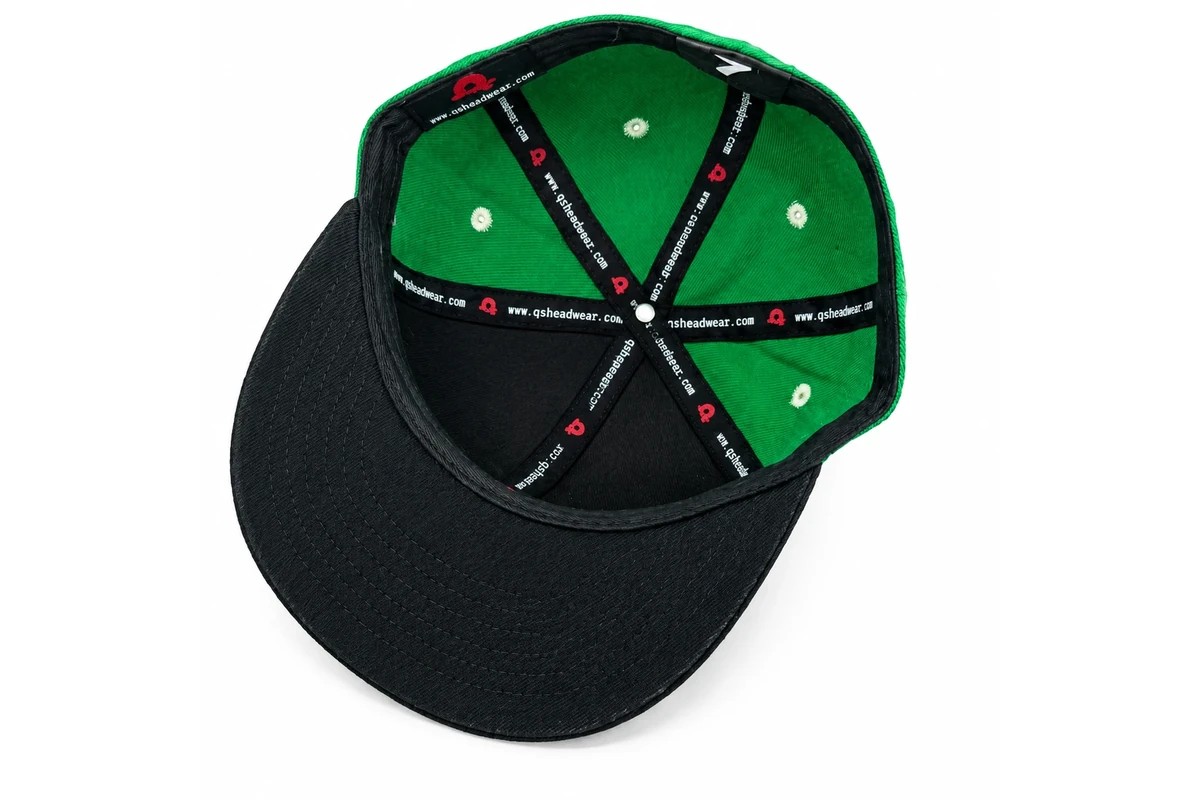
| Carrier | Practical strength | Practical risk |
|---|---|---|
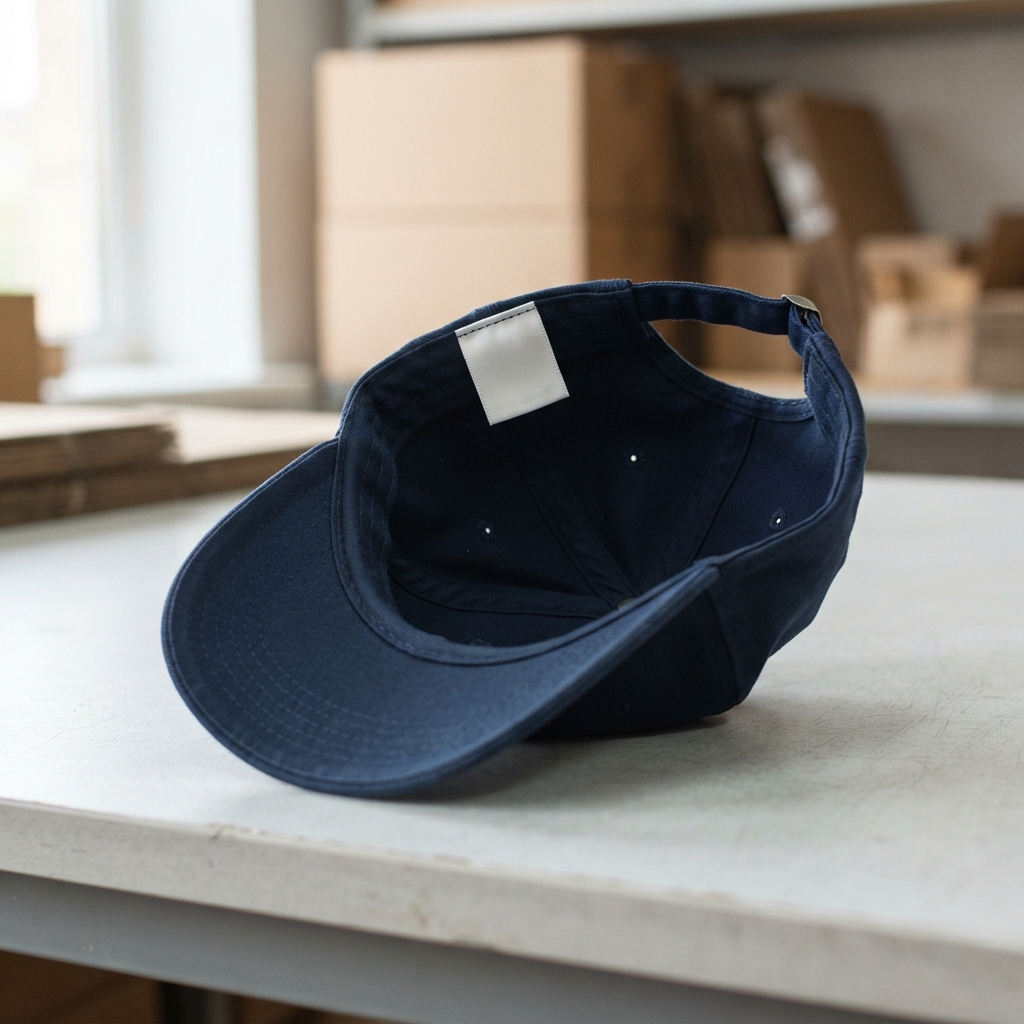
| Inner centre seam label | Read with the sweatband; standard retail expectation | Seam distortion can clip address text |
| Inner side seam label | Discreet on unstructured crowns | Easy to miss at inspection |
| Printed inner band tape | No extra component to sew; sits flat | Print quality and rub resistance must be verified |
| Removable swing tag | Useful for size, barcode and retail data | Weakest reading of "the product or its packaging" |
For a GB-bound retail cap the inner centre seam label is usually the most defensible carrier: it travels with the product and is inspected at the same point as the sweatband. If the same label carries other statements, keep the identity readable as a block rather than spreading fragments across the cap. How trim and seam tape behave when a label is sewn through them is covered in our guide to cap trim as one finish system.
Packaging is the fallback carrier, not a free pass. Where the identity sits on the carton instead of the cap, the carton becomes part of the compliance evidence, and carton marking that disagrees with the inner label is worse than none. The link between carton mark, pack-out and freight is set out in our cap carton packing and container loading guide.
The Northern Ireland boundary
Great Britain and Northern Ireland do not share the same establishment test. The Northern Ireland version of the provision uses "relevant state", defined as Northern Ireland or any EEA state, and builds the limbs on that basis: the manufacturer established in a relevant state; failing that, a representative established in a relevant state; failing that, the importer of the product from a state that is not a relevant state into a relevant state.
The effect is narrow but important: an EEA-established party can answer the Northern Ireland test while failing the Great Britain test. If one SKU ships to both, decide the identity per destination, and accept that the same cap may legitimately carry different identity details for each.
What this duty is not
Three neighbouring obligations get confused with the identity indication. Regulation 8 places duties on distributors, including due care, not supplying a product they know or should presume to be dangerous, and keeping documentation needed to trace origin. Regulation 9 sets a notification route to an enforcement authority when a producer or distributor knows a product poses risks incompatible with the general safety requirement. Regulations 11 and 12 are enforcement instruments: a suspension notice and a requirement to mark. None of them is the regulation 7(4)(a) indication, and compliance with one does not evidence the others.
It is also not an origin statement. Origin answers where the goods were made; producer identity answers who stands behind them. Our guide to country of origin marking on hats for US imports covers the origin side for a different market, and the two must not collapse into one line. Nor is it a fiber or care statement, which is addressed separately in care labels and fiber content for caps in the US. Where a substance-related claim sits on the cap, the evidence route is closer to the component file described in our PFAS and water-repellent cap compliance guide, and the exposure logic behind a state chemical warning is set out in the Prop 65 decision guide for caps.
A decision sheet to run before the PP sample
- Map the placing-on-market chain for Great Britain. Name the manufacturer, exporter, importer and the entity first placing the cap on the GB market. If the map has a gap, the identity decision cannot be made yet.
- Resolve the producer under the three limbs. Decide in writing which limb applies and which legal entity it points to, with the registered name and full address as they will be printed.
- Choose the carrier. Decide between centre seam label, side seam label, printed band tape or packaging, and state the reason. Inspect the chosen position on the PP sample, not on a flat drawing.
- Freeze the wording and the reference. Approve the exact identity block plus the product reference or batch identifier required alongside it. Address spelling is a print item, not a proofreading afterthought.
- Photograph what was actually made. A flat, raking-light photo of the sewn identity is the only durable evidence that approved wording reached production.
Evidence to keep in the order file
The indication is easy to get right once and easy to lose on a reorder, because labels are among the first components substituted when a factory changes supplier. Keep four items with the order: approved identity artwork, a placement photograph from the PP or first production, a component record naming the label supplier and lot, and a written statement of which entity placed the product on the GB market. Those four answer the question an enforcement officer or a retailer's compliance team asks second: not what the label says, but how you know it says that.
Common mistakes
- Treating an EU responsible person's address as sufficient for Great Britain without checking the three limbs.
- Naming the overseas factory while it is not established in the United Kingdom and has no UK representative.
- Printing an identity block that names a brand owner who is not the entity placing the product on the GB market.
- Relying on a removable swing tag as the only carrier of the identity.
- Omitting the product reference or batch that regulation 7(4)(a) asks for alongside the name and address.
Frequently Asked Questions
Does an EU responsible person satisfy the Great Britain duty?
Not automatically. The GB instrument asks whether the named party falls inside one of the producer limbs, each built on establishment in the United Kingdom. An EU-established entity normally falls outside all three, so a separate GB identity is required.
Can the name and address go on the packaging instead of the cap?
The provision allows indication by means of the product or its packaging, subject to the reasonableness qualifier. Packaging-only indication makes the carton part of the compliance evidence and it must stay consistent with any inner label.
Is a country of origin label the same thing?
No. Origin states where the goods were made; producer identity states who stands behind the product and must be traceable to an address. The two can sit on one label, but neither substitutes for the other.
What must accompany the name and address?
Regulation 7(4)(a) pairs the identity with the product reference or, where applicable, the batch. For a cap programme that means a reference identifying a specific run, not a generic style name shared across seasons.
Does this apply if the caps are sold only to businesses?
The definition of "product" covers products intended for consumers or likely to be used by consumers even if not intended for them, so a business-channel cap still needs a scope check rather than an assumption that consumer rules are irrelevant.
What changes for Northern Ireland?
The Northern Ireland version uses "relevant state", covering Northern Ireland and EEA states, so an EEA-established party can answer that test where it would not answer the Great Britain one. Shipments to both need the identity decided per destination.
Conclusion
The Great Britain question is narrower than it first appears and easier to get wrong than it should be: one identity line, tied to one establishment test, carried by the product or its packaging, with a reference that makes the batch traceable. An EU responsible person is the right answer to a different question. Before the PP sample is approved, resolve which entity the GB producer test points to, print that entity's name and address where a buyer or an inspector will actually read it, and photograph the result so the next reorder can be checked against something real.
If you are building a GB-bound cap programme and want identity, origin and care statements specified together rather than patched at the label stage, send your label requirements through our contact page before sampling.