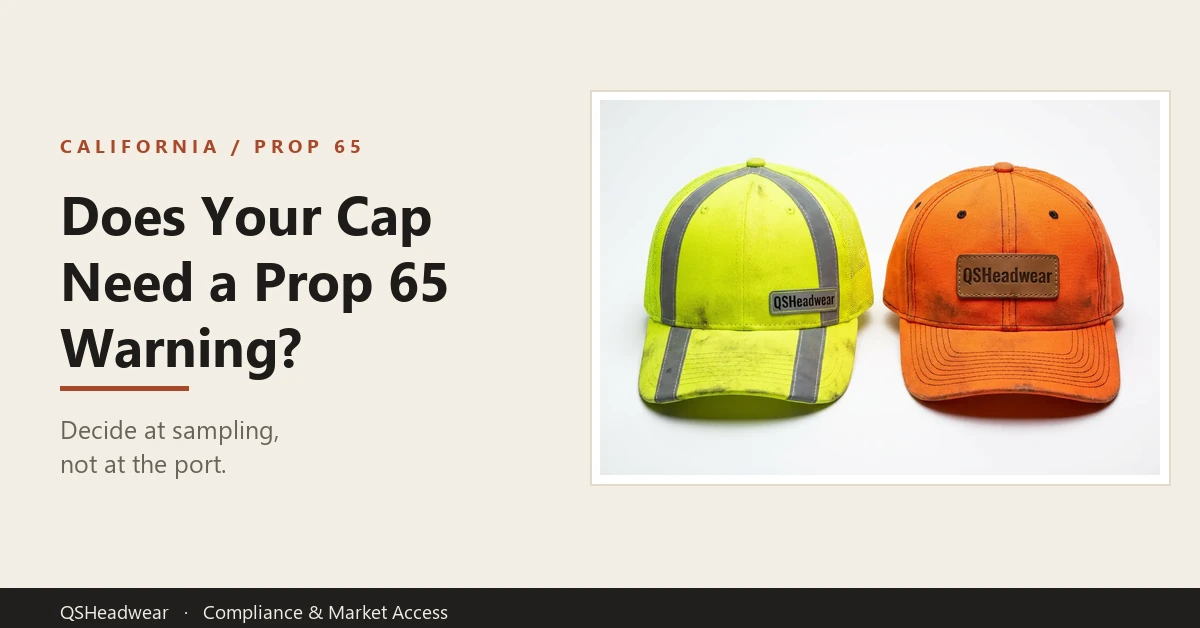


A cap program that ships into California inherits a second question on top of federal labeling: does this SKU need a Proposition 65 warning, and if it does, which warning goes where? The answer is not a product-category fact. Proposition 65 attaches to exposure to a listed chemical, which means the decision belongs to the component list, not to the words "hat" or "cap". This guide gives buyers and brand owners the decision route to run at sampling, before the artwork, the hangtag and the bulk order are locked.
The short answer: caps are neither exempt nor automatically warned
California's Safe Drinking Water and Toxic Enforcement Act of 1986, still known as Proposition 65, requires the state to publish a list of chemicals known to cause cancer, birth defects or other reproductive harm, and requires businesses to give a clear and reasonable warning before knowingly and intentionally exposing anyone to a listed chemical. The list has grown past 800 entries; the version published by the Office of Environmental Health Hazard Assessment for July 31, 2026 runs to 879 entries. Nothing in the programme creates a headwear carve-out, and nothing in it says a cap must carry a warning.
Two boundaries do most of the work in practice. The first is exposure: a warning is required unless the exposure is low enough to create no significant risk of cancer or to sit far below the level shown to cause reproductive harm. OEHHA publishes those thresholds as safe harbor numbers. The second is business size: businesses with fewer than ten employees, and government agencies, are exempt from the warning requirement. A brand selling a few hundred caps a season through its own store may sit inside that exemption; the importer supplying a national retail chain almost never does. Write the answer per SKU and per channel, and write down which boundary you used.
Which cap components put the warning question in scope
Prop 65 exposure cases for apparel and accessories cluster around a small number of material families. On a cap, those families map onto specific parts you already list in a bill of materials, which is why the decision is easier to make than it looks, provided the bill of materials is real.
Plastisol ink and heat-transfer film
Plastisol is a PVC dispersion, and PVC needs plasticisers. Di(2-ethylhexyl)phthalate (DEHP) is the classic example: listed for cancer since 01/01/1988 and for developmental and male reproductive toxicity since 10/24/2003. Many print shops have moved to DINP, DOTP or phthalate-free systems, but substitution only counts if it is documented per ink line and per lot. A factory statement reading "eco-friendly ink" is not documentation. When a program changes ink supplier between seasons, the old conclusion does not transfer to the new print, even when the pantone number is identical. The ink and artwork controls that keep a screen print repeatable are covered in our screen printed caps guide, which is also the point where the ink brand gets named.
PVC patches and moulded trim
A PVC patch is the highest-loading plasticised component on most caps: soft, thick, and often the part a wearer touches. Ask for the plasticiser system in writing, and treat a patch supplier change as a new Prop 65 decision rather than a purchasing swap. Butyl benzyl phthalate, for example, carries an oral maximum allowable dose level of 1,200 micrograms per day in the state's own table. Our PVC patch mould and attachment guide sets out the mould, thickness and stitch questions that sit alongside the chemistry question.
Metal eyelets, grommets and brass hardware
Lead is the second recurring family. "Lead and lead compounds" has been listed for cancer since 10/01/1992, with an oral no significant risk level of 15 micrograms per day and a reproductive maximum allowable dose level of 0.5 micrograms per day. Eyelets, ventilation grommets, snap caps, buckle sliders and cord ends are exactly the small metal parts where free-machining alloys and plating chemistry enter the product. A nickel release test does not answer this question: nickel under EN 1811 is a European skin-sensitisation requirement with its own method, covered in our metal trim and nickel release article. Lead content and lead migration are separate measurements, and a brass eyelet can pass one while failing the other.
Dyed fabric, cord and coated trim
Cadmium and lead appear in some pigment systems; cadmium is listed for developmental and male reproductive toxicity with an oral maximum allowable dose level of 4.1 micrograms per day, plus a cancer listing with a 0.05 microgram per day inhalation level. Cords, elastic, drawcord tips and coated fabrics also bring plasticisers back into the picture. The component-by-component test booking map in our headwear chemical tests article is the right place to attach a Prop 65 column, because it already forces one line per physical part rather than one line per style.
What the safe harbor numbers actually measure
The figures above are daily exposure levels, not content limits. That distinction decides how you read supplier paperwork. A laboratory report stating "lead: 40 mg/kg" answers a content question; Prop 65 asks what a person is exposed to, by which route, over what period. For a cap, the relevant routes are dermal contact with skin on the brow band and inner crown, and oral exposure where a child mouths a cord end, a patch or a brim edge. Turning a content result into an exposure estimate requires surface area, migration testing and assumptions about contact time, which is why OEHHA advises businesses that cannot perform that evaluation to consider a warning rather than to guess.
OEHHA also makes the opposite point clearly: a business is discouraged from giving a warning that is not necessary. There is no filing system behind any of this. Businesses do not report warnings to OEHHA, so no state database will tell a buyer whether a competitor's cap was assessed or simply stamped. The reasoning has to live in your own file, dated, per SKU, with the component list attached. Enforcement sits with the California Attorney General, district attorneys, city attorneys in cities over 750,000 people, and private parties acting in the public interest, with penalties that can reach $2,500 per violation per day. That structure explains why retail compliance teams ask for the file rather than the sentence on the hangtag.
Warning content and placement
Where a warning is required, the regulation controls the words, the symbol and the method. The long-form consumer product warning names the chemical and the toxicity endpoint and points to the state's warning website; the short-form version exists for products where label space is genuinely constrained and carries its own strict conditions. Three practical rules keep cap programs out of trouble. First, the same chemical must be named the same way across label, hangtag and any online statement. Second, the warning must be attached to the product the consumer receives, not only to the carton the retailer opens. Third, the placement decision belongs in the label artwork file, so that a later SKU gets the same treatment instead of a volunteer's memory.
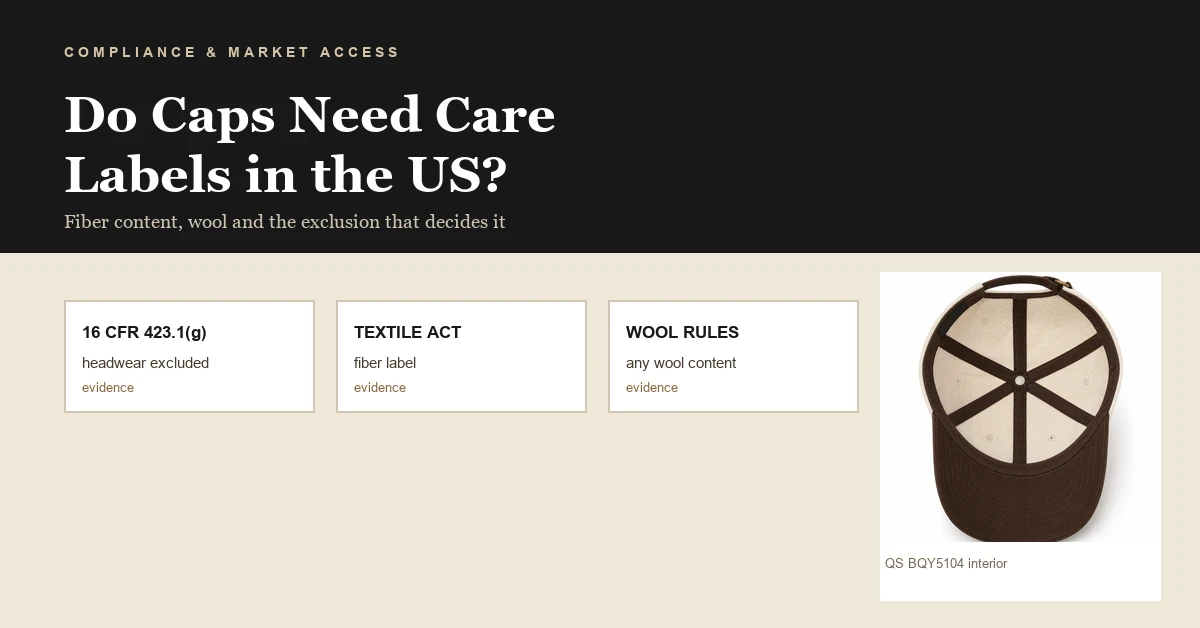
This is where the label system and the warning system have to meet. Our private label cap label system guide treats the woven label, printed necktape, hangtag and polybag sticker as one artwork family with one approval path. A Prop 65 warning is one more element in that family, and it should carry a version number like any other. For the federal side of the same label, including the fibre-content and care-label exclusions that apply to most caps, our US cap care label article covers the boundary conditions that decide whether a cap carries a care label at all.
Who carries the duty, and what the factory owes you
The duty sits with the business that exposes the consumer in California: typically the brand, the importer of record, or the retailer selling into the state. A Chinese factory cannot absorb that duty by making a promise, and a clause in a purchase order that says "seller shall comply with all applicable laws" moves the legal argument without moving the exposure. What the factory can do is supply the component facts that make the decision auditable. Ask for four things per component: material and supplier identity, the plasticiser or alloy system in writing, any migration or content test reports with the method and the laboratory named, and a declaration that the component did not change since the last approved lot.
Two documents make this practical on a busy program. The first is a component declaration per lot, signed by the factory, referencing the ink line, the patch formula and the metal part specification. The second is a change log: any substitution in ink, patch, cord or eyelet triggers a re-check before the next shipment. Caps are assembled from many small parts sourced in parallel, so a substitution can happen without anyone telling the brand. Putting the Prop 65 line into the existing inspection and release discipline is cheaper than retro-fitting a warning to inventory that is already on the water; our AQL inspection and shipment release plan shows where that gate already exists.
The five-line decision sheet to complete at sampling
Run this on the PP sample, not on the bulk order. It takes a buyer about 20 minutes per SKU and replaces an argument later.
- Destination and channel. Which SKUs ship into California, through which channel, and who is the business making the exposure (brand, importer, retailer).
- Component list in scope. Print, patch, metal hardware, cord and tips, coated trim, each with its supplier and lot reference.
- Listed chemical presence. For each component: confirmed present, confirmed absent, or unknown, with the evidence type named (declaration, content test, migration test).
- Exposure judgement. Route, contact area, population (adult or child), and whether safe harbor can be demonstrated or the exposure is treated as significant.
- Decision and owner. Warn or no warning, exact warning text, placement, artwork version, reviewer and date.
Keep the sheet with the tech pack, and give the factory only the two lines it needs: which components are declared, and which documents are due before shipment. Everything else is the brand's reasoning, and it is exactly the part a factory cannot write for you.
Where the decision usually goes wrong
Four failures account for most of the trouble. Inheriting a supplier's blanket "Prop 65 compliant" certificate that names no chemical, no component and no date. Changing a patch supplier or ink line mid-program and assuming the earlier conclusion still holds. Reading a nickel release report as if it answered the lead question, or a content report as if it answered the exposure question. And attaching a warning to the carton only, so the consumer who receives the cap never sees it. Each of these is cheap to prevent at sampling and expensive to unwind after the goods have shipped.
Questions buyers ask before the first order
Does every cap sold in California need a warning?
No. A warning is required only where a person is exposed to a listed chemical above the applicable threshold, or where the business cannot show the exposure is below it. A cap with documented, low-risk components may need no warning at all, and OEHHA discourages warnings that are not necessary.
Can the factory's certificate settle it?
It can supply evidence, not the decision. The duty belongs to the business exposing the consumer, and the file has to show how each component was assessed. Treat a factory certificate as one input with a date and a scope.
Does a Prop 65 warning replace federal labeling?
No, it is a separate California requirement layered on top of federal rules. A cap program usually deals with fibre content, care claims and origin marking on the same label, and the warning decision adds one more element to the same artwork.
Next step
Add a Prop 65 column to the component list before the PP sample is approved, and ask for the plasticiser and alloy declarations in the same email that carries the size spec. If you are starting a program and want the decision made against real component data rather than a template certificate, review the custom logo caps range and the adjustable snapback build we quote most often, then send the tech pack with the destination state named. The earlier the component facts arrive, the fewer decisions have to be re-made at the port.
Official references used for this article: OEHHA's Proposition 65 in Plain Language, the current Proposition 65 list, and the chemical entries for DEHP and lead and lead compounds. This article is operational guidance for buyers and is not legal advice; confirm the warning decision for each SKU with your compliance counsel.