

Cap trim is the collective name for the narrow components that finish a cap's raw edges: piping in a seam, binding around a brim or crown edge, and tape along an inner seam. Trim is usually the cheapest material in the bill of materials and the fastest thing to change when a program is under cost pressure, which is exactly why it decides whether a cap looks finished or looks cheap.
This guide treats cap trim as one system rather than three unrelated add-ons. It covers what each component does, how the three interact at a seam, how to specify widths and stitch types in a tech pack, and what to inspect before a bulk run ships.
What Cap Trim Actually Does
Trim does three jobs at once, and a specification that only addresses one of them will produce a cap that fails on the other two.
- It closes a raw edge. Cut fabric frays. Binding or folding encloses the edge so it cannot unravel in wear or washing.
- It holds shape. A bound brim edge stiffens the perimeter and stops the brim from curling unevenly; a taped inner seam keeps a curved seam from opening under tension.
- It carries the design. Contrast piping, a coloured binding or a printed inner tape is often the only decorative line on an otherwise plain cap.
Those three jobs pull in different directions. A stiffer binding holds shape better but can pucker a curved edge; a softer binding lies flat but sags. The right answer depends on the panel curvature and the fabric weight, not on a generic preference for "good quality", which is why cap trim decisions belong in the sample review rather than in a price negotiation.
The Trim Families on a Cap
| Trim | Where it sits | Main job | Typical failure |
|---|---|---|---|
| Piping | Inside a seam, usually between panels or at a brim edge | Decorative line plus edge definition | Cord shift, wavy seam, bulk at a curve |
| Binding | Wrapped over a cut edge such as a brim perimeter | Encloses the edge and stiffens the perimeter | Twist, uneven width, skipped stitches |
| Inner seam tape | Over an inside seam allowance | Covers the seam, reduces abrasion on the head | Lifting, discoloration, visible adhesive line |
| Fold-over elastic | Around a soft edge or a stretch panel | Clean finish with stretch recovery | Over-stretch during sewing, wavy recovery |
| Bias strip | Curved edges and neck flaps | Follows a curve without buckling | Cut on the wrong grain, so it will not lie flat |
Piping: Where It Helps and Where It Fails
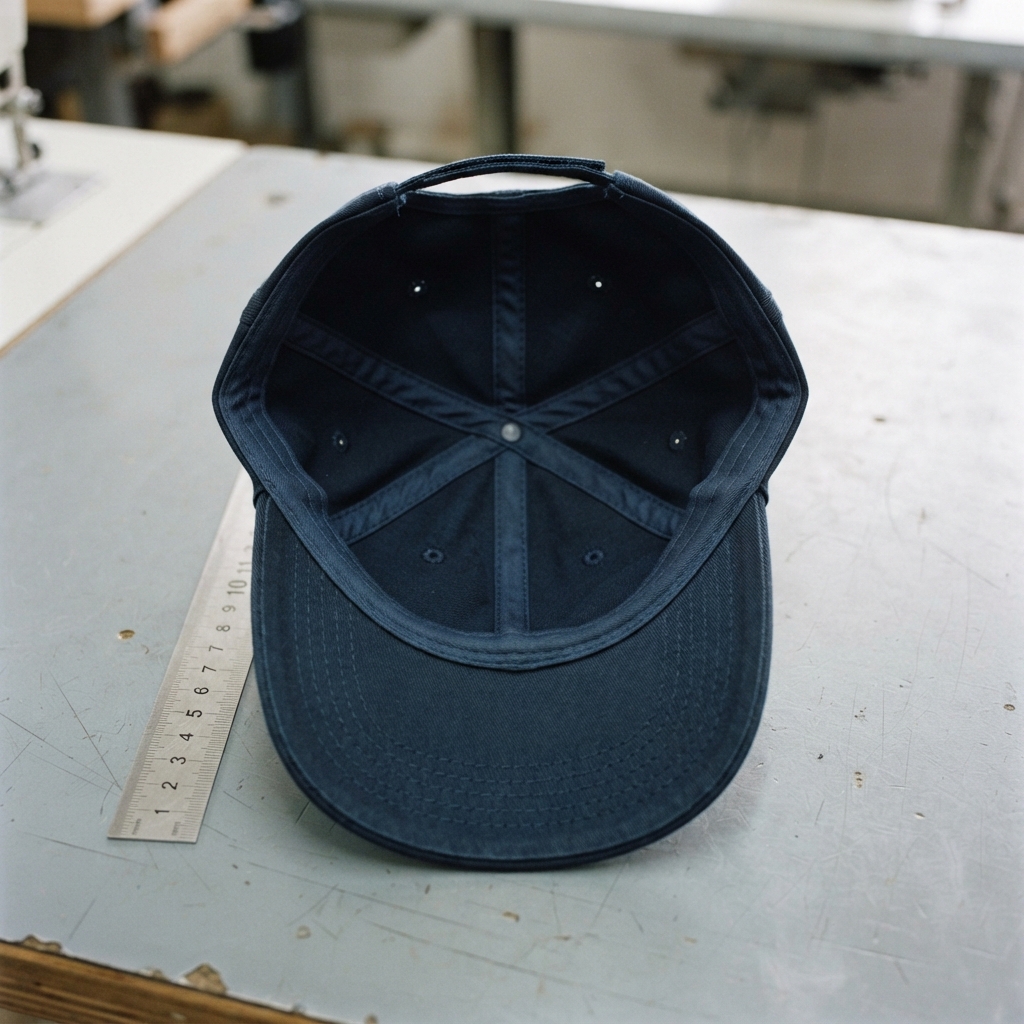
Piping is a narrow strip of fabric folded over a cord and sewn into a seam. It reads as a crisp line and it protects a seam that takes abrasion, which is why it appears so often along a brim edge and between a crown and a visor.
Cap piping fails at the cord far more often than at the fabric. A cord that is too thick for the seam allowance produces a lumpy line; a cord that is too thin collapses and the piping looks like a crease. On a tightly curved brim, the piping must be cut and joined on the bias — usually as bias tape rather than a straight strip — or it will pucker on the outside of the curve and ripple on the inside.
What to specify
Give the trim supplier the cord diameter, the finished piping width, the fabric and the seam allowance in one line. A common arrangement is a cord around three millimetres with a finished visible piping of about five millimetres, but the number that matters is the one that matches the seam allowance on the pattern, not the number a supplier happens to stock.
Binding: Tape Around Brim and Crown Edges
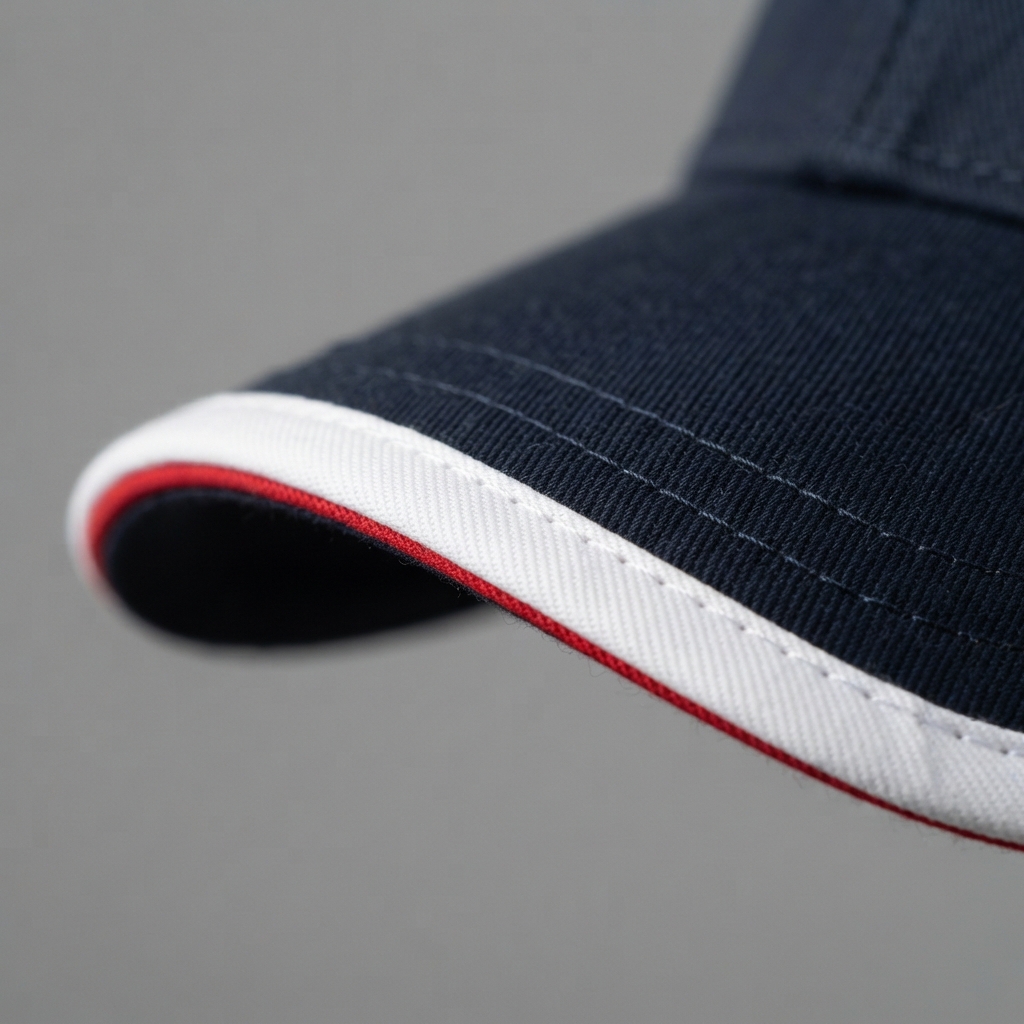
Binding wraps a strip of tape over a cut edge and stitches through all layers. It is the standard finish on a brim perimeter and on soft unstructured edges where a folded hem would be too bulky.
Two numbers decide the result: the tape width and the fold. Tape must be wide enough to wrap the edge and catch both sides with the same stitch line, and the fold must be even along the whole perimeter. A tape that is one or two millimetres narrow will run out of coverage at the tightest part of the curve; a tape that is too wide will bunch.
Cap binding is judged on the finished bound width, not on the roll width, because the flat number hides how much is consumed by the fold. Then check the stitch: a binding stitched only through the front layer looks correct on the bench and opens in wear.
Taping: Inner Seams and What They Reveal
Inner seam tape covers the seam allowance inside the crown. It is partly comfort — a bare overlocked seam against the forehead is a complaint — and partly structure, because it spreads load across the seam.
Tape is also the most visible evidence of factory discipline on a cap. A taped seam that lifts at the curve, shows a glue line, or changes colour against the shell tells a buyer that the finishing step was rushed. On light-coloured caps, tape that is not colour-matched to the shell is immediately obvious the moment the cap is turned inside out.
Stitch Types and Seam Performance
Trim only performs if the stitch that attaches it is right. Stitch types are classified internationally, and two classes dominate headwear: the lockstitch used for topstitching and the overedge stitch used to contain a seam allowance before it is taped or bound.
The classification itself is standardised. ISO 4915 classifies, designates and illustrates stitch types, which is why a tech pack can ask for a specific stitch class instead of describing it in words. In that notation the common three-thread overedge used on cap seams is stitch type 504, while topstitching through a binding is normally a 301 lockstitch. The practical value is in inspection: if the tech pack names a stitch class and a stitch density, an inspector can count and compare rather than judge by eye.
Stitch density is commonly quoted in stitches per inch. Too few and the seam is weak and the trim drifts; too many and the needle perforates the tape so it tears along the stitch line. The right density depends on the tape and the fabric, which is why it belongs in the approved sample rather than in a general rule.
Width, Colour and Shrinkage Compatibility
Trim fails most often at the interface with the shell, and the cause is usually a mismatch that only shows after washing.
- Shrinkage. A cotton binding on a polyester shell can shrink at a different rate, so the edge ripples after the first wash. Ask for the trim's shrinkage and match it to the shell.
- Colour. Trim is dyed in a different lot from the shell. A close match on the bench can separate in daylight, so approve trim and shell together under the same light.
- Hand. A stiff tape on a soft crown makes the cap feel like it has a wire in it. Hand matters as much as width on unstructured styles.
- Heat. Adhesive tape and heat transfer trim react to fusing temperature; a change in the fusing setting can lift an edge that passed the sample.
Specifying Cap Trim in the Tech Pack
| Weak wording | Testable wording |
|---|---|
| "Contrast piping" | Piping at brim seam: 3 mm cord, 5 mm finished width, bias-joined at the curve, shell fabric, stitch class 301 |
| "Bound edge" | Brim binding: 20 mm flat tape, 8 mm finished bound width, both layers caught, colour matched to shell |
| "Taped seams" | Inner crown seams taped, tape 15 mm, colour matched, no visible adhesive line, checked inside out |
| "Good quality trim" | Trim shrinkage within the shell's tolerance, approved as a set with the shell under D65 light |
Add the trim to the approved sample as a set. A program that approves a shell swatch and a trim card separately has approved two things that have never met, and the first assembled cap is where the argument starts. A cap trim specification that cannot be measured on a finished cap is not yet a specification.
Inspection Points for Trim
- Line. Is the piping or binding line straight along straight sections and evenly curved at corners, with no wave?
- Coverage. Does the binding catch both layers along the entire perimeter, including the tightest curve?
- Join. Are piping joins on the bias and placed away from the most visible point of the brim?
- Inside. Is the inner tape flat, colour matched and free of adhesive bleed?
- Stitch. Does the stitch count match the approved sample, and is the density consistent at curves?
- After wash. Does the trim still lie flat on the washed sample, or has it puckered against the shell?
These six checks take a few minutes per cap and catch nearly every trim complaint that reaches a brand after delivery. They belong in the same inspection pass as the seam and label checks, not in a separate audit.
Common Mistakes
- Specifying trim width as flat tape width instead of finished visible width.
- Approving trim separately from the shell, then discovering a colour or shrinkage mismatch.
- Using a straight-cut strip on a curved edge, so the binding will not lie flat.
- Letting a factory substitute a tape of the same colour but a different hand or shrinkage.
- Accepting a binding stitched through one layer only.
- Never checking the cap inside out during inspection.
How We Handle Trim and Finishing
QSHeadwear has produced OEM and ODM headwear for 15 years from Dongguan, with more than 100 skilled workers and monthly capacity of roughly 120,000 to 150,000 units. Development samples are typically ready in 3 to 5 working days after artwork confirmation, and production runs through incoming material checks, a pre-production sample, in-line inspection and an AQL 2.5 final inspection.
Trim decisions are made against the assembled sample rather than a trim card, because width, hand and colour only mean something next to the shell they will sit on. Buyers who want a specific piping or binding standard written into the order can include it in the tech pack, and it is then checked at the same inspection point as the seams. You can see the current range on the custom cap product pages or send a specification through the contact page.
For the construction context around these details, our flat brim build guide walks through the cap part by part, the ventilation and sweatband guide explains how openings and interior components interact, and the AQL inspection plan shows how a trim defect becomes a shipment decision. If your program uses technical fabrics, the performance cap fabric guide covers how those shells behave at a bound edge.
Frequently Asked Questions
What is cap trim?
Cap trim is the narrow finishing material on a cap: piping set into a seam, binding wrapped over a cut edge, and tape covering an inner seam. It closes raw edges, holds shape and often carries the only contrast line on the cap.
Is piping the same as binding?
No. Piping is folded fabric over a cord and is sewn into a seam so a raised line shows. Binding wraps tape over a cut edge to enclose it, covering both sides of the edge.
Why does a bound brim go wavy?
Usually because the tape is slightly narrow for the perimeter, the fold is uneven, or the tape shrinks differently from the shell. Checking finished width and shrinkage together prevents most of it.
What stitch should attach trim?
A 301 lockstitch is typical for topstitching and binding, with a stitch type 504 overedge used to contain seam allowances before taping. Naming the stitch class and density in the tech pack makes the requirement inspectable.
Should trim be colour matched to the shell?
For a tonal look, yes, and it should be approved next to the shell under the same light. Trim is dyed in a different lot, so a match on a trim card can separate once the two are side by side.
Does inner seam tape matter if nobody sees it?
It does. It reduces abrasion on the forehead, spreads load across the seam, and is the first place a buyer looks when they turn a cap inside out to judge finishing.
How wide should binding tape be?
Wide enough to wrap the edge and catch both layers on the same stitch line. Specify the finished bound width, because the flat tape width hides how much the fold consumes.
Can trim cause a wash complaint?
Yes. A binding or tape that shrinks more than the shell will pucker after washing even if it looked flat on the sample, so ask for the trim's shrinkage and match it to the shell.
Conclusion
Cap trim is a small system with three jobs, and it works when width, hand and shrinkage are specified together with the seam that carries them. Most trim complaints are not material failures; they are approvals that never put the trim and the shell in the same room.
If you are finalising a headwear specification and want the piping, binding and taping standard written into the production file, send your tech pack through our contact page and we will confirm it against a sample.