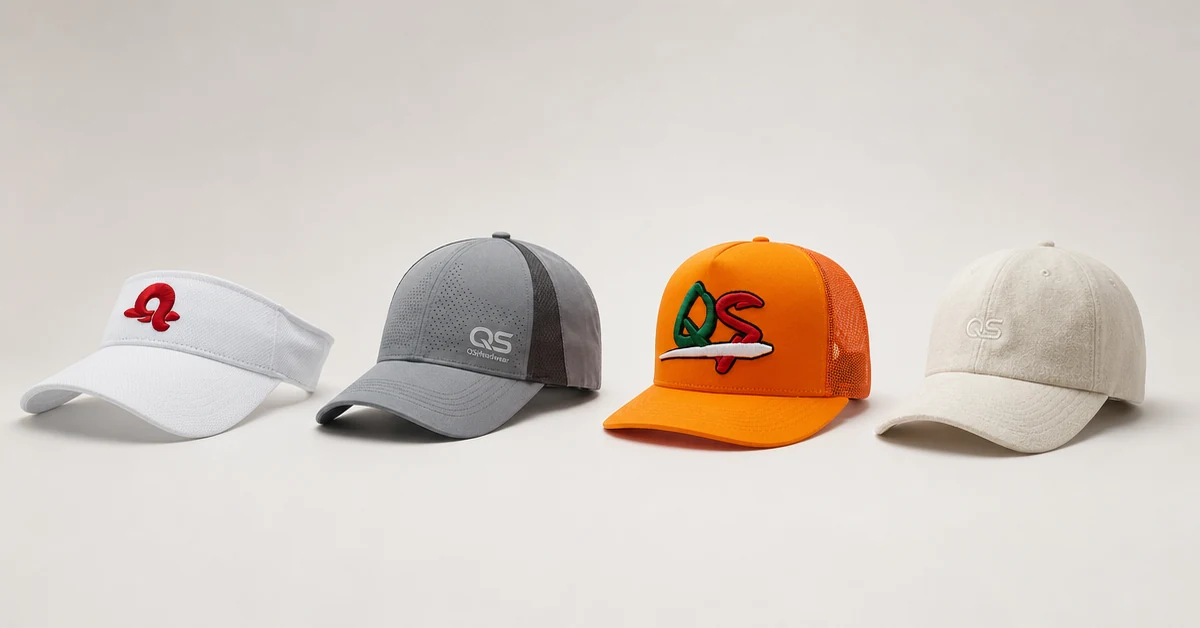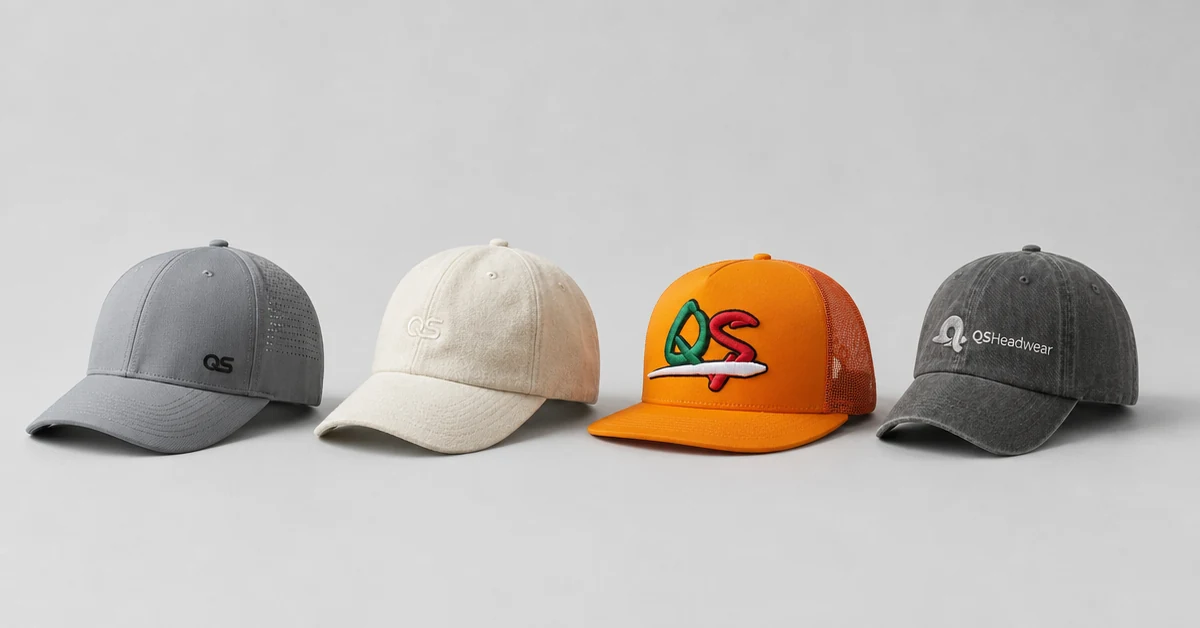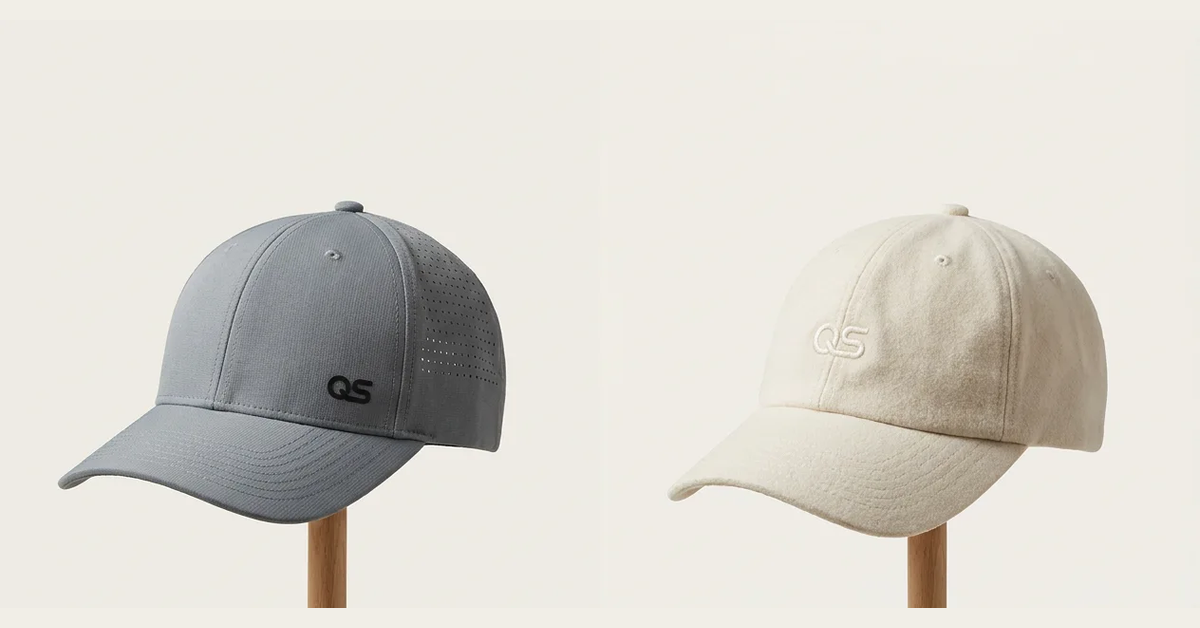


To compare custom curved brim hats fairly, keep the crown, fabric, closure and brim length unchanged while sampling different curves. Otherwise a cap may feel better because its crown is deeper, not because the curve is better. The useful question is which profile fits the wearer and the product's intended appearance on an otherwise consistent base.
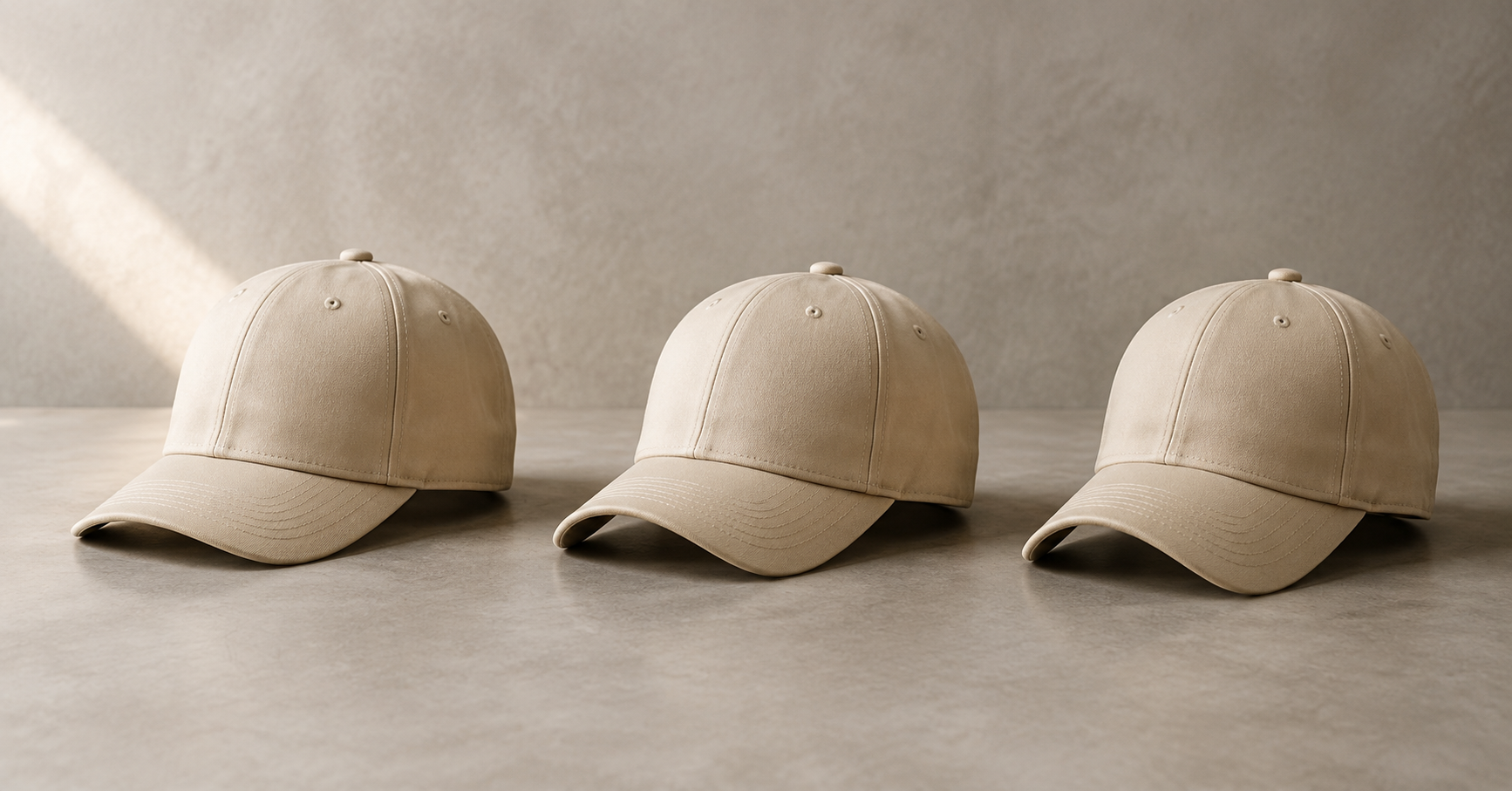
This comparison is for adult baseball caps, dad hats and similar brand collections. It is not a universal sizing formula. The three profiles below are development alternatives, not named QSHeadwear models or published performance results. Ask the factory to identify what can be sampled consistently on the chosen construction.
Set up the comparison before discussing the favorite
Request a shallow curve, a middle reference and a more pronounced curve. Give each a sample code rather than a vague name such as classic or premium. Keep the wearer group and photography setup the same. If the factory must change the insert to achieve a profile, record that change because the comparison is no longer about curvature alone.
Place the samples side by side on the same form, then review them worn. A curve that looks attractive from above may change how the cap frames the face. Take front, side and three-quarter views. Do not let the most flattering camera angle stand in for a complete product decision.
Profile A: the shallow curve
A shallow curve may suit a collection that wants a broad front view without a completely flat brim. Examine the brim tips and how they relate to the wearer's face. Check whether the hat's overall silhouette still matches the design brief when the wearer tightens the closure to the intended fit.
The shallow option is not automatically the easiest to pack or the most comfortable. Ask the wearer to move normally and note any contact with eyewear or other clothing. Look at the cap from below too. The underside fabric and stitching become more visible in some profiles and should be part of approval.
Profile B: the middle reference
Use the middle sample as a comparison point, not the presumed winner. It can help the team explain what they want changed in either direction. Record the same landmarks and photograph it in the same position. If a buyer writes slightly more curved, the factory needs to know which physical sample that comment refers to.
For custom curved brim hats, the language of preference should eventually become a physical reference and a measurement method. A curved brim is a three-dimensional object. One number rarely captures its full shape, especially if the profile changes from the center toward the tips.
Profile C: the more pronounced curve
A stronger curve can change the front opening and the apparent width of the brim. Assess whether it crowds the face, contacts glasses or creates pressure when the cap is worn at the intended depth. Do not ask the wearer to change the cap's position merely to make the sample pass.
Check the profile after handling and packing, not only immediately after shaping. The buyer should know which shape is being approved: the freshly finished cap or the one that arrives after storage and transit. Ask what packing support, if any, is needed to preserve the selected appearance.
| Candidate | Keep unchanged | Compare explicitly |
|---|---|---|
| A: shallow curve | Crown, fabric, length and closure | Face framing, tip position and underside visibility |
| B: middle reference | The same base specification | Balance of appearance, clearance and fit |
| C: pronounced curve | The same base unless a change is documented | Front opening, eyewear contact and recovery |
Measuring custom curved brim hats needs a drawing
State where each dimension begins and ends. Brim length measured along the surface is not the same as a straight projected distance. Width taken at the seam is not the same as width between the tips. Attach a drawing or annotated photograph so the factory and inspector use the same method.
For a curvature reference, agree the position of the cap, the measuring surface and any gauge or template used. If a template is used, identify its revision and who retains it. For custom curved brim hats, inconsistent measuring positions can create apparent production variation even when the caps are similar.
| Item | Specification should state | Why the detail matters |
|---|---|---|
| Brim length | Landmarks and whether measurement follows the surface | Prevents unlike lengths being compared |
| Brim width | Position across the brim and measurement method | Separates seam width from tip spacing |
| Curve reference | Approved sample or identified template and orientation | Makes a shape request reproducible |
| Left-right symmetry | Center line and agreed assessment method | Reveals twist rather than intended curvature |
| Insert and covering | Material references and approved construction | Connects the shape to the actual build |
A curve and a twist are not the same thing
View the brim from the front with the crown positioned consistently. If one tip sits differently from the other, check whether the cap is level before calling it a defect. Then inspect the attachment seam and brim profile. A crooked crown position in a photograph can make a symmetrical brim look uneven.
Agree acceptable variation with physical examples and measurements appropriate to the product. Do not create a tolerance after seeing an unsatisfactory shipment. Ask the supplier how the shaping and inspection process will preserve symmetry, and record the action required when a unit falls outside the agreed limit.
Material, stitching and shaping belong in the same conversation
The insert, covering fabric, stitching and shaping route together produce the brim you approve. A change in one component may justify another sample even when the visible color and outline seem unchanged. Request the material and construction references, including any intended care restrictions, rather than selecting only from a silhouette photograph.
QSHeadwear's customization page includes brim options alongside fabric, sweatband, closure and decoration choices. Ask for a proposal that keeps those decisions connected. If an ODM base is used, state which construction is retained and which details are being modified for your brand.
Check eyewear with the cap at its real wearing depth
Invite the intended adult wearers to try the samples with representative eyewear. Look for contact at the temples and above the frame, then ask them to look down and turn their head. This is a fit comparison, not a protective-eyewear compatibility certification. Specialized equipment requires its own assessment.
In custom curved brim hats, crown depth can affect these results as much as the brim itself. That is why the first comparison holds the crown constant. If no profile works, the next development round can change crown depth deliberately instead of forcing a curve to solve a problem elsewhere in the cap.
The logo should not distract from the base decision
Approve the underlying fit and shape before choosing among elaborate front decorations. Then put the intended embroidery, patch or print on the selected base and review the whole cap again. A heavy decoration can alter the appearance or behavior of a soft front, so the final decorated sample remains necessary.
Check the relationship between the logo and brim from the same viewpoints used earlier. Keep placement coordinates tied to stable seams. A logo may appear visually higher or lower when the camera or brim profile changes, even when the stitching is in the same place.
Make recovery a defined comparison
Agree a packing orientation, carton quantity and storage period with the supplier. Unpack the candidates, photograph them immediately and again after a stated rest period. The procedure should reflect the planned delivery rather than an arbitrary crushing exercise. Keep a control cap outside the carton to distinguish packing effects from handling differences.
Do not promise customers that every brim can be reshaped at home. Care advice needs to reflect the complete construction. GINETEX's textile care information provides a reference for care communication; the approved method for this cap still requires appropriate product evidence.
Release one profile, not a folder of favorites
Once the buyer selects a sample, archive the rejected alternatives separately. The order for custom curved brim hats should identify one approved profile, material set, logo, closure, packing method and revision date. Request a price and calendar for that exact version, including any new insert, shaping setup or packaging support.
Use ISO 2859-1 for lot acceptance-sampling terminology where appropriate, and define the cap-specific checks separately. A sampling framework does not choose your shape tolerances. Keep the reference cap and inspection method available to whoever checks the final units.
Request custom curved brim hats as a controlled comparison
Browse the cap collection, review the QSHeadwear profile and send a three-profile sample request. Include the crown reference, brim length, material, logo, fit requirements, quantities and destination. Custom curved brim hats are easier to approve when the team can explain what changed between samples and why one was selected.
Questions from a brim comparison review
Does more curve mean better fit?
No. Compare the intended wearer, crown depth, eyewear clearance and product appearance on complete samples.
What should stay fixed during the first comparison?
Keep crown, fabric, brim length, closure and other construction unchanged unless a necessary difference is recorded.
How should brim length be measured?
State the landmarks and whether the measurement follows the surface or uses a straight projected distance.
Can a photograph define the curve?
It helps, but retain a physical reference and an agreed measurement or template method.
What is the difference between curve and twist?
An intended profile can be symmetrical; twist creates an unwanted left-right difference when the cap is positioned consistently.
Should glasses be included in the fitting?
Use representative eyewear where relevant, without turning an informal fitting into a certification claim.
Can the insert change without resampling?
A changed component may affect shape or care, so request a new construction review rather than assuming equivalence.
When should decoration be added?
Resolve the base comparison first, then approve the complete decorated cap before production.
What does a packing test need?
Agree orientation, quantity, storage duration, rest period and the profile checks that determine acceptance.
What goes into the final order file?
Retain one approved sample, dimensions, material references, profile method, artwork, closure, packing and inspection criteria.