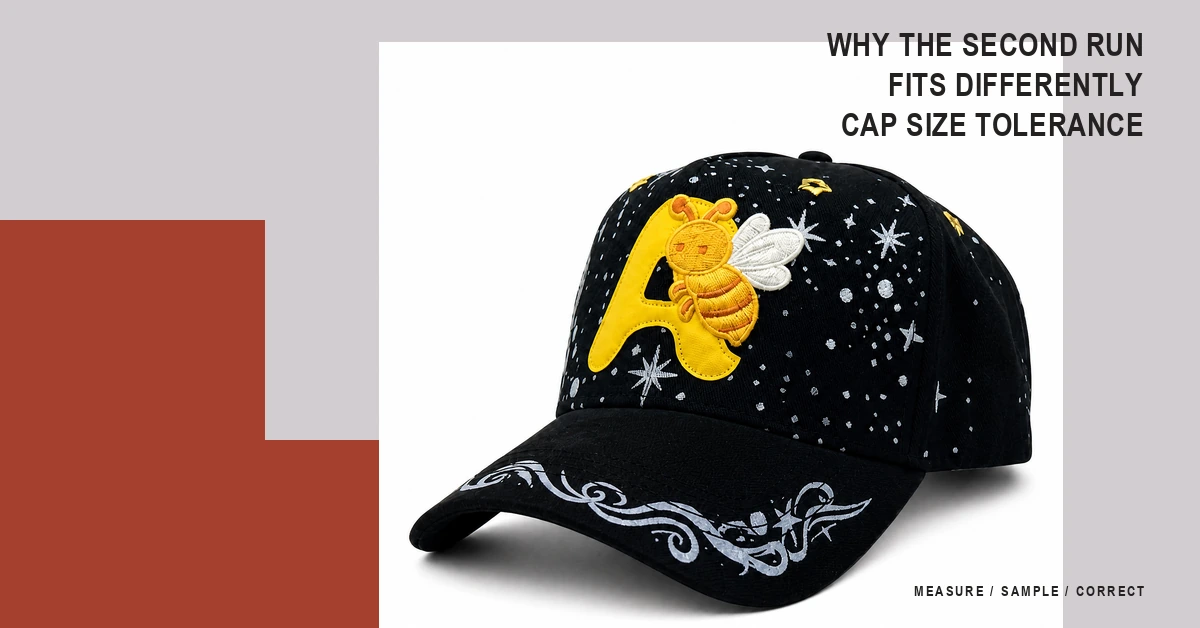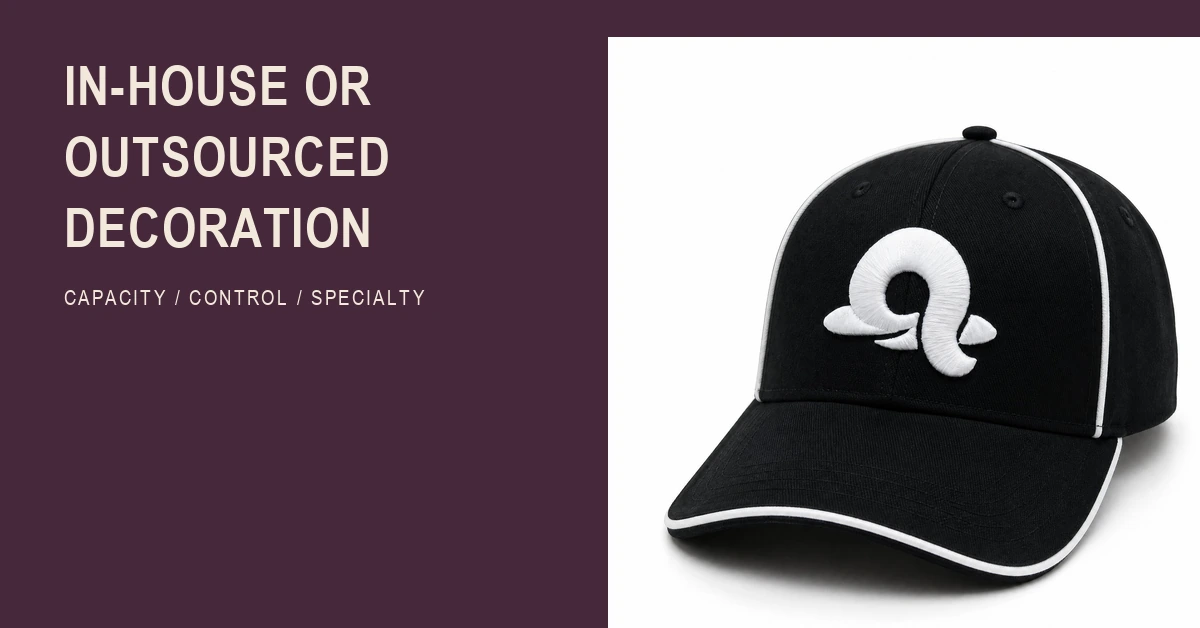


A cap programme may look vertically integrated because samples, embroidery, packing and final inspection happen under one commercial roof. The actual decoration route can be more complex. Flat embroidery may run on the factory floor, 3D puff may need a specialist operator, woven patches may come from a separate mill, and a limited print technique may be booked only when an order requires it.
The useful question is not whether in-house decoration is always better than outsourcing. It is which work must stay close to development, which work needs scalable repeatability, which specialist process should remain external, and how the programme will preserve one approved result across every handoff.
This guide gives headwear buyers a commercial way to make that choice. It does not assume a universal machine count, utilisation target, stitch rate, capital payback period or outsourcing margin. Those inputs must come from the actual product mix, equipment, labour, order pattern and supplier quotation.
Start with the decision you are actually making
Separate ownership from machine location
A buyer can retain ownership of artwork, digitising rules, colour standards and approval evidence even when a specialist performs the decoration. Conversely, a machine located inside a factory does not guarantee control if files, settings and first-piece decisions are informal. Define who owns the specification before comparing locations.
Separate development speed from bulk capacity
The best route for a ten-piece development run may not be the best route for ten thousand units. Keeping sample embroidery close to the cap development team can shorten adjustments, while external bulk capacity can absorb a temporary peak. Treat development response and bulk throughput as different decisions.
Separate core methods from occasional techniques
Flat embroidery, 3D puff, appliqué, screen print, transfer, laser work and specialist patches require different equipment and skill. A method used every week may justify an internal route. A technique ordered twice a year may be more sensible through a qualified specialist, provided the control interface is strong.
Measure demand before discussing equipment
Use real order mix, not annual totals alone
Annual volume can hide severe peaks. Break demand by month, decoration method, logo size, colour count, cap construction and required delivery window. A large annual total spread evenly is easier to support internally than the same total concentrated around launches or event seasons.
Count changeovers and approvals
Short runs with frequent artwork changes consume digitising, setup, thread change, first-piece review and operator attention. Machine hours alone understate the burden. Connect the analysis to the programme's SKU and launch planning so the team can see how many unique approvals the range creates.
Identify the true bottleneck
The constrained resource may be digitising, hooping, skilled inspection, backing preparation or cap-body availability rather than the embroidery heads. Adding equipment does not solve a constraint upstream or downstream. Observe the whole decoration route before assigning the problem to machine capacity.
Decide what capability must remain close
Keep fast learning near product development
When crown shape, seam position and material response are still changing, rapid feedback matters more than headline unit cost. An internal sampling route can let the cap developer, digitiser and operator review the same physical result without a long transfer loop.
Protect details that carry brand recognition
Small lettering, negative space and raised outlines can lose clarity at production scale. The small-logo legibility guide explains why the artwork and cap body must be treated together. If those details are commercially critical, retain direct approval authority even when production is external.
Map capability by construction, not method name
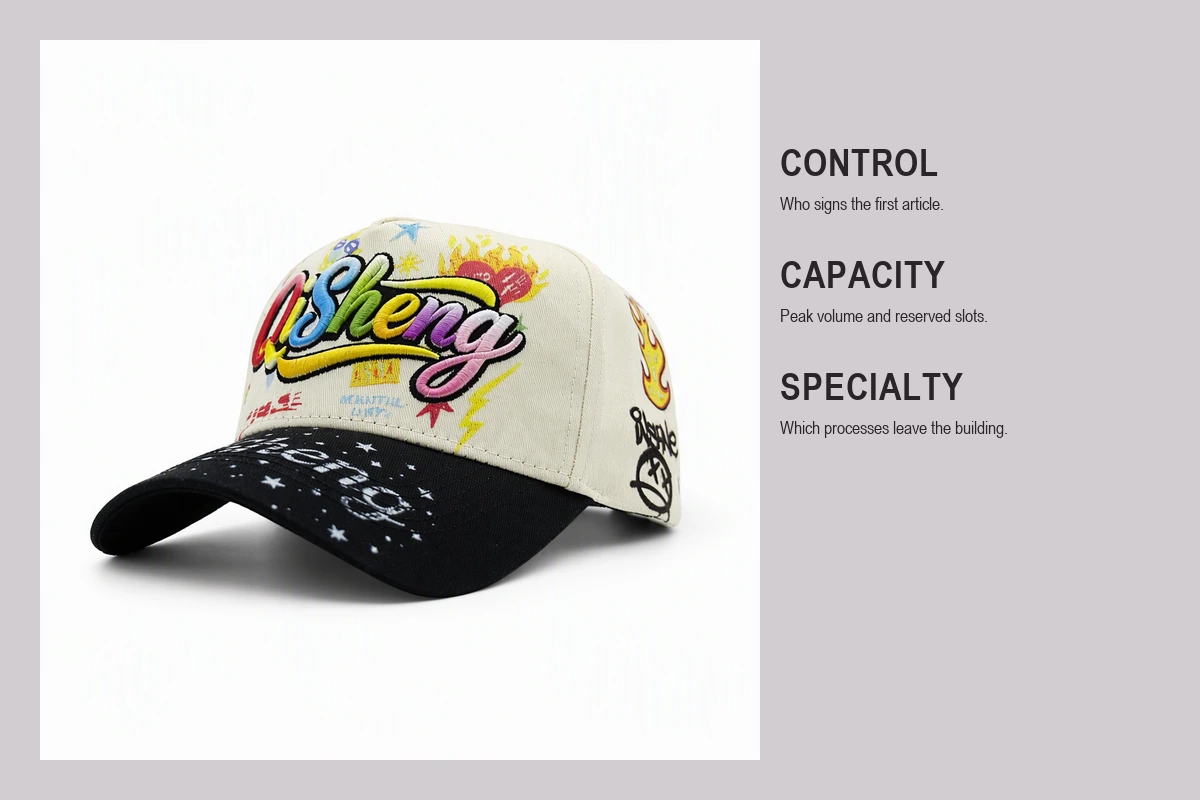
“Embroidery” is too broad for a make-or-buy decision. A supplier may perform clean flat embroidery on unstructured cotton but struggle with thick seam crossings, foam fronts or large 3D puff elements. Define capability against the actual cap, placement and finish.
Build the internal cost picture honestly
Include capital and supporting resources
Equipment price is only the visible entry cost. Include floor space, power, ventilation where applicable, software, digitising, fixtures, maintenance, spare parts, thread and backing stock, training, supervision, quality checks and downtime. Use actual local data rather than a generic percentage.
Cost idle capacity and peak overflow
An internal line sized for the annual average may still fail during a launch peak; a line sized for the peak may sit underused for much of the year. Model both states. The make-or-buy decision should show what happens when demand is below plan and when it exceeds practical capacity.
Price correction speed
Internal work may reduce the time to re-sew a sample or correct the first piece, but only if authorised staff and material are available. External specialists may have deeper method expertise but a longer booking and transport loop. Put a value on response time where a missed launch carries commercial cost.
Evaluate external capability without outsourcing accountability
Confirm the exact production site
Ask whether the named supplier performs the work or sends it to another workshop. The vendor-consolidation audit shows why process visibility matters when one commercial contact coordinates several production sources. Approval should identify the actual method, site and responsible operator.
Check repeatability evidence
Review comparable caps, not only attractive samples on flat fabric. Ask how the specialist controls digitising revision, thread equivalence, backing, placement, first-piece release and changeovers. A low price is not meaningful if every reorder must rediscover the setup.
Define communication and escalation
State who can stop production, who approves a deviation and how quickly evidence must move between the cap factory, decoration specialist and buyer. A hybrid route fails when each party assumes another party owns the decision.
Use a hybrid route when the product mix demands it
Keep sampling inside and scale bulk outside
This route can work when development speed is critical but bulk demand is volatile. The internal team creates a representative approved result, then transfers the controlled inputs to an external line. The transfer must include the exact cap construction and production evidence, not only a photograph.
Keep repeat volume inside and buy specialist methods
A stable core method may support internal investment, while uncommon patches, printing or finishing stay external. This avoids forcing one line to imitate a specialist process poorly. The external method still needs the same product identity and approval discipline.
Reserve overflow before the peak
Overflow should not be improvised after the internal line is late. Qualify the backup route on the actual cap and decoration before demand rises. Compare the first pieces from both routes so the brand understands any visible or tactile difference.
Create one approval interface for every route
Use the same artwork identity
Internal and external work should reference the same artwork revision, digitising file or approved conversion, thread reference, dimensions and placement landmarks. File names alone are weak evidence; connect each item to the style, colour and order.
Approve a physical result
The sew-out approval process explains why a digital mock-up cannot prove density, backing feel, seam interaction or puckering. Use an actual cap construction and retain an approved sample or clearly linked physical reference.
Define defect language once
Internal and external inspectors need the same view of logo drift, open coverage, loose tails, backing exposure, distortion and colour mismatch. Connect decoration-specific examples to the broader cap quality-control definitions so a defect does not change category when it crosses a workshop boundary.
Plan information and material handoffs
Control cap-body release
External decoration adds movement of blank or partly finished caps. Define quantities, shade lots, protection, handover condition, return count and responsibility for transit damage. Keep hold samples before the goods leave the main factory.
Protect artwork and production files
Commercial terms should state authorised use, retention, return or deletion of artwork and production files. Restrict access to the programme and prevent files from becoming untracked copies across several workshops.
Reconcile quantities before packing
Decoration rejects, setup pieces and replacement caps affect the final assortment. Reconcile issued, decorated, rejected, reworked and returned quantities before final packing. If decoration changes stack height or protection needs, update the carton-load calculation rather than reusing a blank-cap pack count.
Judge both routes through business performance
Track first-pass approval
Measure how often a representative first piece passes without file, placement or construction changes. Separate buyer artwork changes from production failures so the metric identifies the real source of rework.
Track response and recovery
Compare approval lead time, changeover response, rework turnaround and peak recovery. The faster route is the one that restores an approved result with controlled evidence, not merely the one that begins stitching first.
Track total delivered cost
Include administration, transport, extra inspection, rejects, delay exposure, idle capacity and capital use. Do not compare an external piece price with only internal thread and labour. The two options must be evaluated on equivalent scope.
Use current quality principles without copying a certification claim
Treat the route as a controlled operation
The official ISO 9001:2026 overview describes a quality-management system that plans, implements and controls operations, evaluates performance and improves the system. A cap programme can apply those principles whether decoration is internal, external or hybrid. This article does not claim certification or quote requirements that were not available in the public overview.
Seek capability support where it adds value
The U.S. National Institute of Standards and Technology describes its Manufacturing Extension Partnership as helping small and medium-sized manufacturers make operational improvements, reduce risk, access expertise and strengthen supplier connections. The practical lesson is to use qualified technical support when the decision exceeds the team's own equipment or process knowledge.
Make the decision by programme, not by ideology
Choose internal work when learning and repetition justify it
Internal decoration is strongest when the programme has repeat demand, skilled staff, manageable changeovers and a need for close development feedback. It is weakest when investment is justified by optimistic volume alone or when specialised methods exceed the team's capability.
Choose external work when specialisation and flexibility dominate
Outsourcing is strongest when the provider has proven capability, the method is occasional, peak demand is volatile or capital would sit idle. It is weakest when the actual site is unknown, approvals are informal or the programme cannot trace files and materials.
Choose hybrid when the boundary is explicit
A hybrid route can preserve development control while buying specialist or overflow capacity. It works only when both routes use the same product identity, physical approval, defect language and reconciliation process.
Keep the capability that protects the programme
The make-or-buy choice should follow the programme's order mix, learning speed, specialist needs, peak volatility, quality evidence and total delivered cost. Keep the work that protects brand-critical learning and repeatability close. Buy external capability where specialisation or flexibility is stronger. Connect both through one approval interface.
For a real project, share expected monthly and peak volumes, decoration methods, artwork count, cap constructions, launch timing and required evidence. QSHeadwear can review the likely internal, external or hybrid route against the actual product rather than forcing every order through one model. The referenced contrast-piping embroidered cap and broader custom snapback programme show why construction and decoration should be considered together.