

Country of origin marking is a legal statement, not a branding element: it tells the ultimate purchaser in the United States which country made the article, and for an imported cap it must appear on the goods themselves in a way that survives handling. Under 19 CFR 134, every article of foreign origin imported into the United States must be marked with its country of origin unless a specific exception applies.
Caps are rarely excepted, and the label is usually the smallest line item in a purchase order and the fastest way to hold a shipment at the border or at a retailer's receiving dock. This guide explains who the marking is for, what it must say, where it goes on a cap, and how to build evidence that survives an audit of your US import marking.
What Country of Origin Marking Is For
The purpose is disclosure, not marketing. Country of origin marking exists so that the last buyer in the United States knows where the article was made before they buy it. That framing explains most of the rules that follow: the mark has to be where a buyer can see it, it has to be readable, and it has to stay attached for as long as the article is in use.
Two consequences matter for headwear. First, a mark hidden inside a sealed polybag that the customer never opens is not doing the job the rule intends. Second, a mark that falls off in the wash fails the durability requirement even if it was correct on the day it was sewn.
Who the "Ultimate Purchaser" Is
The rule is written around the ultimate purchaser: the last person in the United States who receives the article in the form in which it was imported. When an imported cap is sold at retail without being changed, the retail customer is the ultimate purchaser, so the cap or its retail packaging must carry the mark.
When the importer further processes the goods so that the article loses its identity — for example, a cap that becomes a component of a different finished product — the processor can become the ultimate purchaser, and marking may move to the outer container instead. Decoration is the grey area most cap programs run into: embroidering a logo on an imported blank does not normally change the article's identity, so the country of origin does not disappear because a brand added its mark on top of it.
What the Mark Must Say
The mark must state the country of origin in English, in a form a buyer understands, using the country's name. A sewn-in Made in label that names the country is the simplest compliant form. An abbreviation, a city, a region or a flag is not a substitute for the country name.
Marking must be conspicuous, legible, indelible and permanent for the intended life of the article. Country of origin marking is judged by what a buyer can actually read on the finished cap, not by what the artwork file says, which is why the label size and contrast belong in the approved sample. In practice that means a sewn-in woven or printed label, a printed inner tape, or a heat transfer that survives washing and wear — not a sticker on a polybag and not a hangtag on its own.
Where the Mark Goes on a Cap
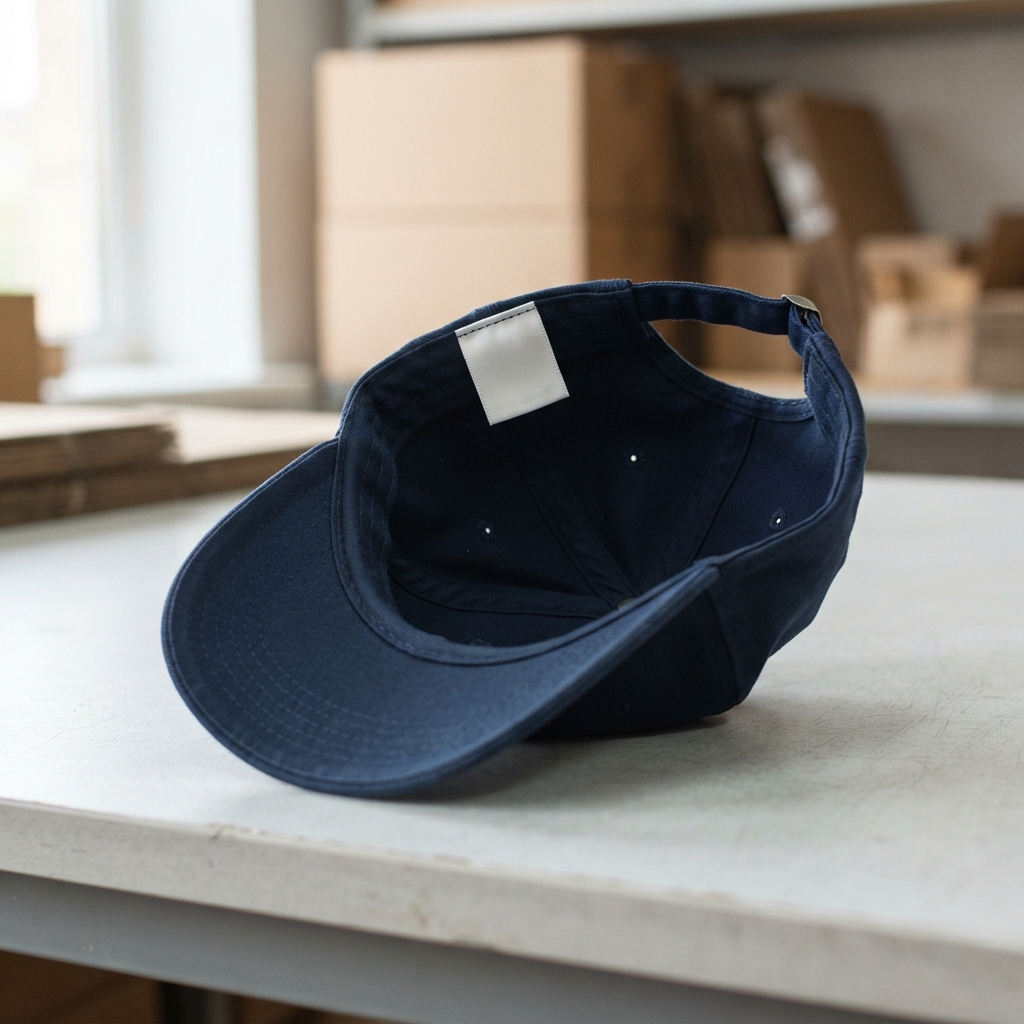
Cap label placement is a construction decision, not a packaging detail. A cap has four practical options, and they are not equivalent; the choice usually comes down to construction, cost and how the cap is packed.
| Placement | How it is applied | Strengths | Risks |
|---|---|---|---|
| Inner centre seam label | Woven or printed label sewn into the sweatband seam | Permanent, visible when the cap is handled, standard retail expectation | Must be positioned so the seam does not distort the text |
| Inner side seam label | Small label sewn at a side seam | Discreet, good for small caps and unstructured crowns | Easier to miss during inspection |
| Printed inner tape | Direct print on the inner band tape | No extra label to sew, sits flat | Print quality and wash durability must be verified |
| Heat transfer | Transfer applied inside the crown or on the band | Clean look on technical fabrics | Adhesion on coated or mesh fabrics is prone to lifting |
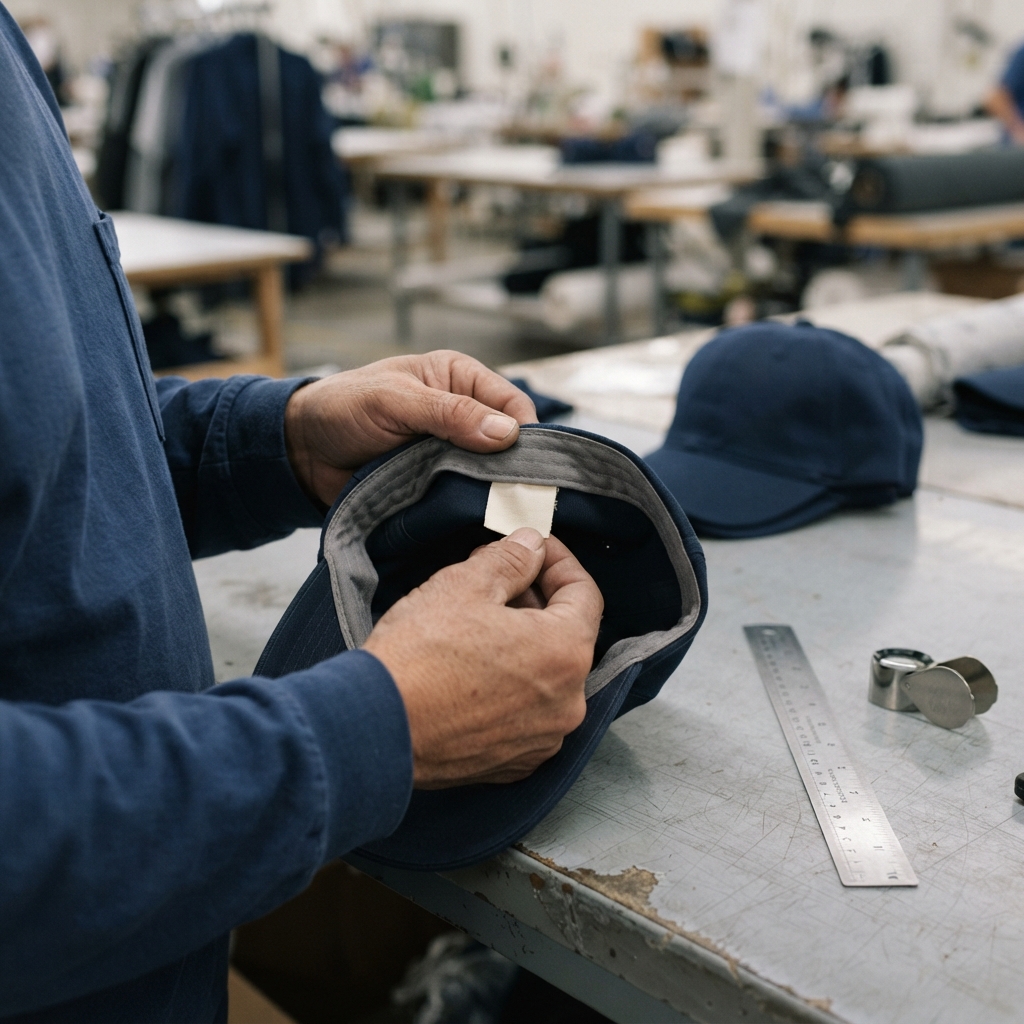
The centre seam label remains the safest default for a retail cap because it is permanent, it is inspected in the same motion as the sweatband, and it does not depend on print adhesion to a coated surface. Where the label is combined with fiber content and care information, keep the country line on the same label or on an equally permanent neighbour, so a buyer reads one block rather than hunting for two.
Why Country of Origin Marking Is Not a Hangtag
Hangtags are removable by design, which is exactly why they do not satisfy a permanence requirement on their own. They are useful for size, price, barcode and marketing, and they are the right place for retail-specific data such as a GTIN, but they are a poor home for the legal origin statement.
The exception is narrow: where an article cannot be marked without injury, marking may move to the container or packaging. A soft cap can almost always be marked, so that exception rarely helps a headwear program. If your only origin statement is on a hangtag, treat that as a finding to fix before the next run.
Substantial Transformation: When the Origin Is Not Where It Was Sewn
Country of origin is not simply the country where the last operation happened, and it is not automatically the country where the fabric was woven. The origin of an imported article is generally the country in which it was substantially transformed into the article being imported — a change in name, character or use.
For headwear, cutting and sewing panels into a finished cap is normally treated as that kind of change, which is why a cap made from imported fabric but cut and sewn in one country is usually marked with the sewing country. That is a working rule, not a guarantee: chain-specific questions — a knit crown imported and finished elsewhere, a cap assembled from pre-shaped components, a hat body blocked and trimmed in a second country — turn on the facts of that supply chain. A binding ruling from US Customs and Border Protection is the only way to settle a genuinely uncertain case before printing labels.
Because country of origin marking follows the article rather than the component, a program that sources fabric in one country and sews in another has to settle its label decision before the sample is approved, not after bulk has been cut.
Marking Is Not the Same as Care and Fiber Labeling
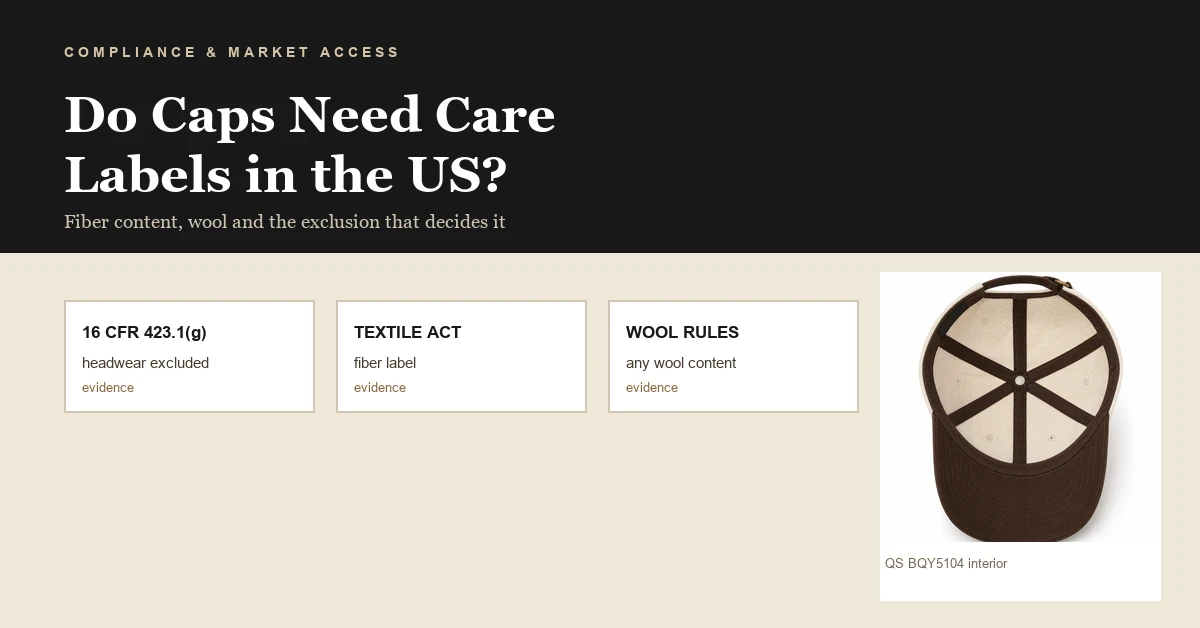
Three labeling regimes get confused in the same tech pack, and each has its own rule and its own enforcement. Origin marking answers "where was this made". Fiber content and care instructions answer "what is it made of" and "how do I clean it". Retailer-specific requirements — carton labels, vendor manuals, routing guides — sit on top of both and are contractual rather than legal.
Because the rules differ, a single "labeling" line in a purchase order is not enough. Specify each label separately: origin label content, fiber and care label content, size label, and any retailer-required data, then approve a physical label set rather than a text list.
Building the Evidence File
Country of origin marking is easy to get right once and easy to lose on a reorder, because the label is often the first component substituted when a factory changes supplier. The 19 CFR 134 marking rules are written around informing the ultimate purchaser, which is why evidence of what was actually sewn matters as much as the artwork. Keep four items with the order file.
- Approved label artwork. The exact text, spelling and country name, signed off before production.
- Placement photograph. A clear photo of the label as sewn, showing position and seam condition.
- Component record. Which label supplier and which lot, so a substitution is visible rather than silent.
- Declaration from the production site. A written statement of where the goods were cut and sewn, matching the marking on the label.
These four items also answer the question a customs broker or a retailer's compliance team will ask first: not "what does the label say" but "how do you know". A label photograph without a component record cannot distinguish a correct label from a correct-looking one.
Common Mistakes in US Import Marking
- Relying on a hangtag or polybag sticker as the only origin statement.
- Printing the country name in a font size that disappears at inspection distance.
- Marking the fabric origin when the cap was cut and sewn elsewhere, or the reverse.
- Treating decoration as a change of origin without checking the specific facts.
- Letting a factory substitute a label without re-approving the artwork.
- Filing the label design but not a photograph of how it was actually sewn.
How We Handle Labeling in Production
QSHeadwear has produced OEM and ODM headwear for 15 years from Dongguan, with more than 100 skilled workers and monthly capacity of roughly 120,000 to 150,000 units. Development samples are typically ready in 3 to 5 working days after artwork confirmation, and orders run through incoming material checks, a pre-production sample, in-line inspection and an AQL 2.5 final inspection.
Label sets are handled as part of the order file rather than as an afterthought: the approved artwork, the placement and the component supplier stay together, so a reorder can be checked against what was actually approved. Country of origin marking sits at the front of that file, because it is the one line that cannot be corrected once the container has sailed. If you are importing into the United States and want the origin and care labels specified together, send the label requirements with your tech pack through our contact page, and you can review the current range on the custom cap product pages.
For the adjacent paperwork, our guide to US care and fiber labeling for caps explains which labeling rules do and do not reach headwear, the compliance document guide separates factory-level from material-level evidence, and the retail vendor compliance guide covers the routing and chargeback side that starts where labeling ends. If your retailer needs barcode and hangtag data, the GTIN and hangtag guide covers that file, and the carton pack-out guide shows how the shipping carton label ties into the same system.
Frequently Asked Questions
Does every imported cap need a country of origin label?
Yes, in almost every case. Under 19 CFR 134, articles of foreign origin imported into the United States must be marked with their country of origin unless a specific regulatory exception applies, and finished caps rarely qualify for one.
Can the country of origin be printed on the hangtag only?
Not as the only marking. A hangtag is removable, so it does not meet a permanence requirement. The origin statement belongs on a sewn-in or permanently applied label on the cap itself.
What exactly should the label say?
The country name in English, normally in the form "Made in" followed by the country. A flag, city, region or abbreviation is not a substitute for the country name.
Which country is the origin if the fabric and the sewing are in different countries?
Generally the country where the article was substantially transformed — for caps, usually where the panels were cut and sewn into a finished cap. Genuinely uncertain supply chains should be settled with a binding ruling before labels are printed.
Does adding our logo change the country of origin?
Normally no. Decorating an imported cap does not usually change its name, character or use, so the original origin still applies and still has to be marked.
Is a sticker on the polybag acceptable?
No, not as the marking for the article. A polybag sticker can support warehouse handling, but the cap itself must carry the origin in a permanent form.
What happens if the marking is wrong?
The goods can be held or redelivered for marking, and a marking duty can be assessed in addition to other remedies, with the cost and delay falling on the importer of record.
Who is responsible for the label, the factory or the brand?
The importer of record carries the legal responsibility. In practice that means the brand must specify the label, approve the artwork and keep the evidence, even when the factory sews it in.
Conclusion
Country of origin marking is a small label with a narrow legal job, and it stays compliant only when the artwork, the placement and the production record are treated as one item. The programs that get into trouble are rarely the ones that disagreed with the rule; they are the ones that approved a label once and never looked at it again.
If you are building a US-bound cap program and want the origin label specified alongside fiber, care and retailer data, send your label requirements through our contact page and we will confirm them before sampling.