

A retailer can accept the product design and still reject the shipment process. The caps may match the approved sample, yet the order can arrive with an expired routing instruction, an unreadable carton label, a late advance ship notice or no evidence explaining a delivery exception. Those failures create receiving delays, deductions and disputes after the physical product has already passed quality control.
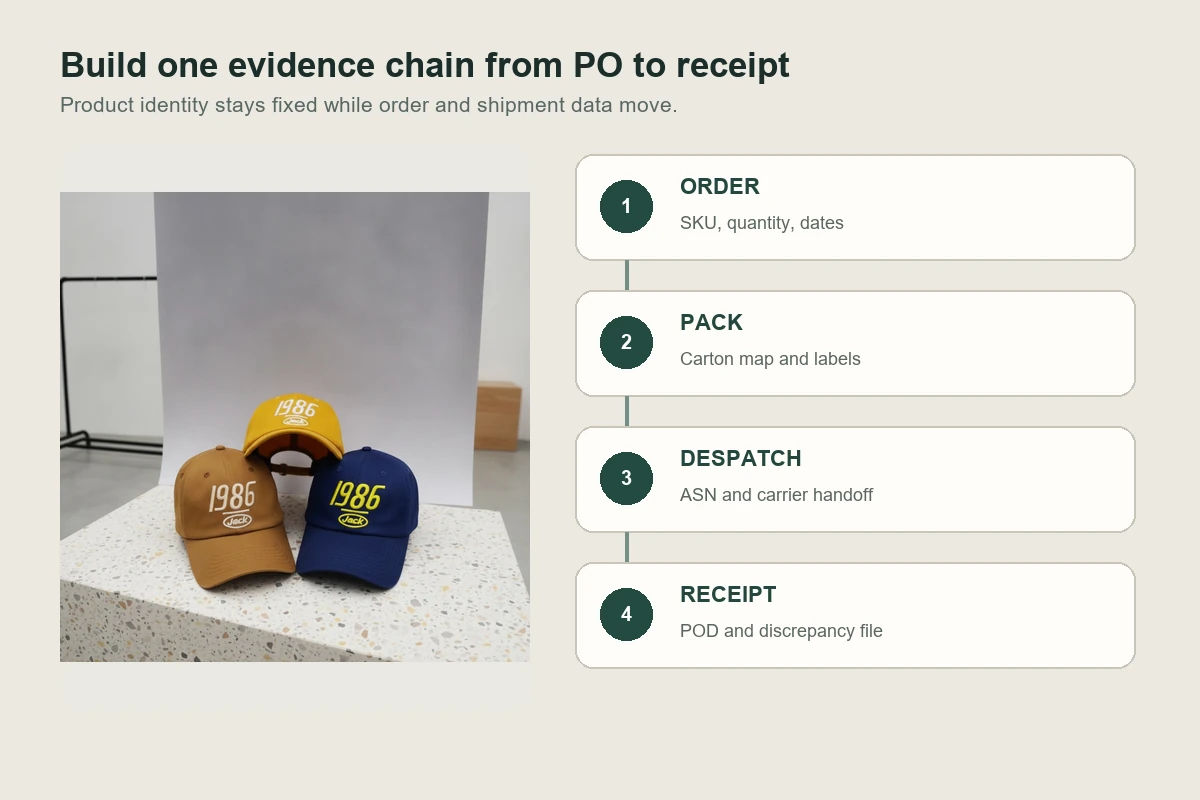
A practical retail vendor compliance headwear file connects four movements: the purchase order, the physical cartons, the electronic shipment record and the retailer’s receipt. Its purpose is not to promise that every retailer uses the same rule. It makes the current customer-specific rule visible, assigns an owner and preserves evidence from order acknowledgement through dispute closeout.
This guide is an operational framework for headwear brands and suppliers. Retail contracts, routing guides, EDI specifications, delivery windows and deduction rules differ by customer and program. Use the retailer’s current controlled documents and obtain qualified legal, tax or technical advice where required.
Separate product approval from channel compliance
Product approval confirms what should be made. Vendor compliance controls how the order is identified, packed, communicated, routed and received. A passed inspection does not prove that the correct carrier was booked or that the ASN matched the cartons.
Keep three baselines
Maintain a product baseline, an order baseline and a channel baseline. The product baseline holds the approved specification and sample. The order baseline holds the purchase order, quantities, dates and destinations. The channel baseline holds the current routing guide, label format, EDI map and receiving rules. Every shipment should point to one approved version of each.
Do not merge unlike controls
The AQL shipment release gate decides whether the inspected production lot can move forward. Retail vendor compliance decides whether that released lot is handed to the customer in the required operational form. Both gates matter, but they answer different questions.
Build a controlled routing-guide register
A routing guide is a customer instruction set, not a permanent company policy. Record the retailer, program, region, effective date, received date, owner and superseded version. Link the guide to the purchase orders it governs.
Extract executable fields
Turn the guide into a shipment checklist: approved carrier or booking route, ship-from location, consolidation rule, appointment process, delivery location, label placement, document timing and exception contact. Do not rely on a merchandiser remembering a long PDF at booking time.
Control changes after order acknowledgement
If the retailer changes a route, destination or date, keep the original instruction, the change notice and the acknowledgement. Identify which cartons or bookings were affected. A forwarded email without a PO reference is weak evidence during a later deduction review.
Map the order before production finishes
Compliance starts when the purchase order arrives, not when cartons reach the loading area. Parse the retailer’s item identifiers, supplier identifiers, ship-to code, quantities, not-before date, cancel date and any split-shipment restrictions. Compare them with the internal sales order.
Resolve identity differences early
A factory style number, brand SKU and retailer item number may describe the same cap. Keep a controlled cross-reference rather than replacing one identifier with another. The private-label headwear SKU passport provides a stable product record; the retail order adds customer-specific item and location data.
Record acceptance and exceptions
Confirm what was accepted and flag quantities, dates or pack instructions that cannot be met. An unrecorded verbal exception can later look like supplier non-compliance. If the order changes, retain the revision and the person who accepted it.
Connect the pack hierarchy to retail data
Each physical level should have a data owner: sellable unit, inner pack, shipping carton and pallet or logistic unit. The correct label depends on what the retailer scans and receives at that level.
Lock unit and carton content
Define the SKU, color, size, quantity and assortment for every pack level. The existing retail carton pack-out framework controls protection and physical hierarchy. Vendor compliance adds the customer’s identifiers, routing marks and electronic data link.
Manage mixed and partial cartons
If the customer permits mixed cartons, specify the content map and label rule. If a partial carton is unavoidable, show the exact quantity and update the packing list and electronic shipment data. Do not let a full-case label remain on a partial case.
Create a label data map before printing
Build one table showing each required label element, its source system, format, print location, owner and validation method. Typical fields can include purchase order, retailer item, supplier, destination, carton sequence, quantity and a logistics identifier. Use only the fields required by the current customer specification.
Test data, placement and readability
Approval should cover more than visual artwork. Scan production labels using the expected equipment where possible. Confirm that human-readable text agrees with encoded data, that label placement survives taping and handling, and that reprints do not create two active identities on one carton.
Use standards without overriding the retailer
The GS1 Logistic Label Guideline describes identification of logistics units and the use of SSCC for unique unit identification. A retailer may implement GS1 standards through its own data, layout and placement rules. Follow both the applicable standard and the trading partner’s current specification rather than copying a label from another program.
Make ASN data mirror the physical shipment
An advance ship notice is useful when it describes what actually left, how it is grouped and where it is going. GS1 states that its Despatch Advice message enables a shipper to provide shipment-content information to a receiver. That purpose should guide the control: electronic quantities and identities must reconcile to sealed cartons.
Build the shipment hierarchy
Map purchase order to shipment, shipment to logistic units, logistic units to cartons and cartons to item quantities. If the implementation uses a different hierarchy, document it. The electronic record should let the receiving party connect a scanned logistics unit to expected contents.
Freeze data at the correct event
Define when the ASN is generated, who confirms final carton count and when transmission occurs. A notice created from an early packing estimate can disagree with the loaded shipment. If the load changes after transmission, follow the customer’s correction or cancellation procedure and preserve the message history.
Keep acknowledgements
Store the outbound message, transmission time, technical acknowledgement and any business response. The GS1 Despatch Advice standard page confirms the message’s shipment-content purpose; the retailer’s implementation guide defines the required version, fields, timing and response.
Control delivery windows as dated commitments
OTIF controls usually combine timing and quantity, but definitions and tolerances are customer-specific. Do not publish one universal formula in the supplier manual. Record the contract definition, the applicable dates and the evidence source for each milestone.
Build backwards from receipt
Start with the retailer’s appointment or receipt window, then map carrier booking, pickup, factory release, inspection and packing completion. The custom cap critical-path method helps connect approvals and production dependencies to the external delivery commitment.
Separate controllable and external events
Record when goods were ready, when routing instructions were requested, when the carrier accepted the booking, actual pickup, appointment confirmation and proof of delivery. This does not automatically remove liability. It creates an evidence chain for applying the contract fairly.
Define exception and escalation rules
A compliance system must explain what to do when the perfect route is no longer possible. Define who may request a routing exception, who may approve it and which identifiers must appear in the approval.
Use a decision ladder
Typical decision states are: proceed under the guide, hold for clarification, request a date change, request a carrier or routing exception, split only with approval, or stop shipment. The factory should not choose a commercial exception merely to clear finished cartons from the floor.
Preserve the approved deviation
Attach the exception to the PO, shipment and affected cartons. Save the request, approval, date, scope and any replacement instruction. When verbal urgency is unavoidable, obtain written confirmation before dispatch whenever possible.
Build a chargeback defence file before a deduction arrives
A strong file is not an argument assembled months later. It is a timestamped record of what the parties instructed and what occurred. Store documents in a consistent folder or system index while the shipment is active.
Capture the minimum evidence set
Retain the controlling purchase order and revisions, routing-guide version, booking and appointment records, label approval, packing list, ASN payload and acknowledgements, pickup evidence, proof of delivery, discrepancy notices and approved exceptions. Add photographs only when they show a relevant fact and can be linked to the shipment.
Reconcile before disputing
Compare the deduction reason with the contract rule and shipment evidence. Identify the exact PO, carton, item, date and message involved. Some deductions will be valid; the same file should support corrective action instead of forcing every case into a dispute.
Connect receiving feedback to supplier governance
Retail compliance problems often repeat because they sit between merchandising, factory packing, logistics and data teams. Assign an owner for closure, not only for response.
Classify the root cause
Separate master-data error, order-entry error, pack execution, label generation, EDI mapping, transmission, carrier performance and receiving discrepancy. The category determines whether to correct a specification, train an operator, change system validation or renegotiate a commercial rule.
Measure recurrence and closure
Feed recurring deductions, rejected messages and late bookings into the quarterly supplier scorecard. Track value and frequency, but also containment speed, evidence completeness and whether the corrective action prevented recurrence.
Keep the export dossier aligned
Retail compliance does not replace export and import documentation. The commercial invoice, packing list, transport booking and customs data must still describe the same goods and quantities.
Use one final shipment identity
The export handover dossier controls which version travels to the forwarder, broker and importer. Link that dossier to the retail shipment ID and final carton map so channel and cross-border records do not diverge.
Separate evidence by purpose
A product certificate, retailer routing guide and proof of delivery support different decisions. The headwear compliance evidence framework helps prevent a document from being presented beyond its scope.
Use a vendor-compliance release checklist
- Current purchase order and accepted revisions are indexed.
- Retail item numbers map to controlled internal SKUs.
- Routing-guide version and effective date are recorded.
- Pack hierarchy and carton contents are reconciled.
- Labels pass data, placement and readability checks.
- ASN quantities and hierarchy match sealed cartons.
- Carrier, appointment and delivery-window evidence is retained.
- Exceptions carry written scope and approval.
- Shipment, export and receiving records share one identity.
- Discrepancies have an owner and corrective-action route.
Questions to ask before accepting a retail program
- Where is the current routing guide and who receives updates?
- Which identifiers apply at unit, carton and logistic-unit level?
- What EDI or portal messages are required, and at what events?
- How does the retailer define on-time and in-full performance?
- Which date or receipt record controls the decision?
- What approvals are required for splits, substitutions or route changes?
- How are deductions notified, supported and disputed?
- How long must shipment evidence be retained?
Turn retailer rules into an executable handoff
The strongest retail vendor compliance system does not depend on a single coordinator reading every email. It converts the current customer rule into controlled fields, validation steps, event evidence and named authority.
For a headwear program, that means the approved product remains identifiable from the PO through the carton, ASN, carrier handoff and receipt. When those records agree, receiving becomes faster and exceptions become easier to investigate. When they disagree, the same chain shows where the process broke and what must change before the next shipment.