

Wholesale sun visors are decided by five things that never appear in a catalog photograph: where the brim puts the shade, whether the band twists under load, how the visor behaves with the sunglasses your customer actually wears, how much logo detail survives on a narrow band, and what the packing does to the brim. Approve those five on a worn sample and a reorder becomes the repeat of a document. Skip them and the problems land in week three, as club complaints, online returns, or a shelf photo of a brim that has taken a permanent set. This guide is written for buyers placing 500 to 50,000 visors a year.
This was written for promotional distributors, golf and racquet clubs, resorts, running and cycling clubs, sport retailers, apparel brands building a headwear line, and e-commerce sellers who need wholesale sun visors that survive a season. This is not a styling article or a route for one-off personalized pieces.
Why visor programs fail before the reorder
Every row below pairs a complaint buyers report after delivery with the cause a factory can trace, the specification line that prevents it, and the evidence worth keeping. A catalog image is not evidence; a measured sample, a named approval and a dated record are.
| Complaint after delivery | Root cause | Specification line that prevents it | Evidence to keep |
|---|---|---|---|
| "The shade falls in the wrong place" | Brim length and curve were picked from a photo, never judged on a head | Brim length in mm, curve category and a shape-recovery target | Measured sample photos next to the written dimensions |
| "The band twists or slides during play" | Band build and closure travel were tested in the middle position only | Band construction, closure type and adjustment range in mm | Wear notes from at least two head sizes, with the closure setting |
| "My sunglasses and the visor fight each other" | Temple, bridge and brim-edge clearance were never checked with the intended eyewear | Brim edge clearance and band contour along the temple line | Front and side photos taken with the eyewear in place |
| "The logo lost detail, or it pulled the band" | Artwork footprint was assumed rather than proved on a band this narrow | Decoration method, artwork footprint and stitch or print limits | An actual-size sew-out or print proof on the approved shell |
| "The brims arrived flat or bent" | Pack method was chosen to cut freight cost and never tested through handling | Flat or folded pack, units per carton and brim protection | A packed sample pushed through a real handling and transit cycle |
Failure one: the brim shades the wrong place
Brim length is the choice buyers discuss, but curve is the one they regret. A long brim with a low curve and a short brim with a strong curve neither shade nor read alike on a wearer. Ask for one sample per candidate curve instead of one sample photographed from two angles.
Three checks settle it while the sample is worn: the brim edge stays outside the wearer's line of sight, it clears the eyewear, and it returns to shape after a few hours in a packed carton. A visor that recovers slowly looks tired on a retail peg long before it fails structurally. Write the brim length in millimeters and the curve as a named category, then keep the measurement sheet with the approved sample.
Failure two: the band twists under load
Most fit complaints on a visor begin at the band, not the brim. A soft single-layer band feels light and packs small, but it can twist and creep during activity. A supported band holds its shape and presents a logo better, at the cost of warmth and a bulkier fold.
Let the use case decide. Running, tennis and triathlon programs usually want a light, low-profile band with an elastic or hook-and-loop closure. Golf, resort, club and promotional programs often choose a supported band because it carries a badge or an embroidered panel cleanly. Confirm the adjustment range in millimeters and test the closure at both ends. Hardware matters too: a buckle adjusts fast but presses, while a strap lies flat but collects lint.
Failure three: the visor fights the sunglasses
Eyewear conflicts are the failure buyers find last, because an office fit check will not reveal them. They show up on the third tee or on a long ride.
Test the visor with the frame your customer is most likely to wear, not an arbitrary pair. Check three contact points: the temple where the band meets the frame arm, the bridge where the brim edge passes over the glasses, and the brim underside where a taller frame can press. Sweatband width belongs in the same test, since a narrow band concentrates pressure and feels lighter while a wider one spreads pressure and dries more slowly. Record the frame type, the contact point and what the wearer did about it, then fold those notes into the specification.
Failure four: the logo loses its detail on a narrow band
A visor offers less canvas than a cap: a band, a front panel and sometimes a small side area. Those limits are practical rather than artistic, and they decide the decoration method.
3D puff embroidery gives a front panel dimension and suits a bold single letter or a compact mark. It needs enough band height and stitch area to hold the foam, and a fine-detail logo will lose its interior definition. Flat embroidery handles small lettering and multi-color marks more reliably and is the safer route for thin strokes. Patches add a different surface and a shape embroidery cannot reproduce, at the cost of an extra attachment step. Printing and heat transfer cover gradients and fine typography, and they behave differently on mesh and coated nylon. A stitch crossing open mesh can distort the panel, so review the artwork footprint before approving a sew-out, and ask for every proof on the approved shell fabric rather than on paper.
Failure five: the carton flattens what the fitting sold
A visor is close to flat, which makes it efficient to ship and easy to damage. Decide early whether the visor travels flat, lightly folded or nested, and test that decision before the bulk run rather than at your warehouse.
Ask for a packed sample, push it through the handling you expect in your own facility, then open it at the center and at the edge of the carton. Record the rest time before judging the brim: one that looks flat on arrival may recover within the hour, while one that stays flat has taken a permanent set. Carton marks, units per carton, mixed-size rules and SKU labels belong in the same document as the pack method, so the receiving team can identify a shipment without opening every box.
A wear test you can run in one afternoon
You do not need a lab to catch the expensive failures. Five observations, taken in one session with two people of different head sizes, separate a workable visor from a return.
| Moment | What to watch | What to ask the wearer | What to record |
|---|---|---|---|
| Initial fit | Band placement, adjustment access, hair contact | Could you tighten it without a mirror? | Closure setting and first placement |
| Movement | Band twist, brim bounce, forward creep | Did you want to adjust it mid-session? | Every readjustment, with the activity |
| With eyewear | Contact at temple, bridge and brim underside | Did either item move because of the other? | Frame type and the contact point |
| Warm activity | Sweatband feel, moisture, pressure points | Where did discomfort start, and after how long? | Elapsed time, activity and conditions |
| Remove and pack | Hair catching, brim shape, band memory | Would you pack it this way yourself? | Pack method and the resulting profile |
The specification sheet to attach to every RFQ
Two suppliers quoting the same unit price are frequently quoting different products. Fill in this sheet and attach it to every request for quotation; if a factory cannot answer a line, treat that as a finding rather than a rounding error.
| Specification line | Typical options | Why it changes the order |
|---|---|---|
| Shell fabric | Polyester twill, cotton twill, nylon, mesh panel, recycled polyester | Weight, drape, print behavior and available minimums |
| Brim length | Short athletic through wide golf coverage | Shade, visual balance and carton volume |
| Brim curve | Low, medium or strongly curved | Coverage, eyewear clearance and shape recovery after packing |
| Brim insert | Thin board, foam or laminated construction | Stiffness and behavior when wet |
| Band construction | Soft single layer or supported panel | Structure, heat build-up and fit stability |
| Sweatband | Brushed polyester, terry or moisture-management knit | Comfort, drying speed, washing behavior and cost |
| Closure | Hook-and-loop strap, elastic, plastic buckle, metal slider | Adjustment range, hair contact and hardware cost |
| Size range | One adjustable size or a two-size curve | SKU count, inventory and minimums per color |
| Decoration | 3D puff, flat embroidery, patch, print, heat transfer | Setup, artwork limits and unit cost |
| Packing | Poly bag, hang tag, flat or folded pack, carton marks | Warehouse handling, freight volume and retail readiness |
Color, shade and trim control across a mixed order
Visor programs usually ship in several colors, and shade variation is the hardest complaint to argue after delivery. Fix the reference before production: keep an approved swatch per color, state whether a color may be split across lots, and say what happens if a fabric is discontinued between the pilot and the reorder.
Two rules help. Approve colors as a group under one light source, because a color that looks correct alone can look wrong beside the rest of the range. Then treat trim as part of the color decision, since a strap or buckle in a slightly different tone is far more visible on a light shell than on a dark one.
What actually moves the unit price
The unit price of wholesale sun visors is the sum of a few visible and invisible decisions. Fabric and weight set the base. Band construction and sweatband type add labor. Closure hardware adds a component cost. Decoration adds setup plus unit cost, and the setup is where small orders feel it most. Packing, carton configuration and destination terms move the landed number more than most buyers expect on a light product.
Quantity interacts with all of them. A minimum order quantity is not one factory number: it is the highest of the minimums created by the fabric, the color count, the decoration setup and the packaging. Ask a supplier to name which of those is binding for your specification. Buyers who ask usually discover that dropping one color or accepting a stocked fabric lowers the minimum far more than negotiating the unit price does.
Inspection points that belong in a visor order
Ask where each defect can be caught, then confirm the inspection plan covers that point. Fabric shade and hardware color are cheapest to challenge before cutting. Band symmetry and brim alignment are easiest to correct at the start of a line. Decoration placement should be judged on the first decorated pieces, not only at final audit.
QSHeadwear publishes its inspection sequence for custom headwear: material inspection, pre-production sample approval, in-line monitoring and a final AQL inspection before shipment from its Dongguan workshop. The written checklist for wholesale sun visors should name brim length and curve consistency, band height, stitch line position, sweatband attachment, closure function at both ends, decoration position within tolerance, and cleanliness. ISO 2859-1 gives buyers and factories a shared sampling vocabulary, but it cannot set your brim tolerance or your acceptable shade difference.
Labels and fiber content on export-bound visor orders
Labeling is a specification line, not an afterthought. For orders shipping to the European Union, the fiber composition of a textile product has to be described using the harmonized fiber names and the percentage rules set out in Regulation (EU) No 1007/2011. That regulation does not decide whether your visor also needs a brand, size or care label; your destination market and your retail customer do.
Before the first bulk run, agree who supplies each label, who attaches it, and how label position is inspected. If the visor carries a sustainability or performance claim, keep the wording inside the evidence you can show for that material and lot. Buyers selling into both North America and the EU often need two label versions on one order, so writing both into the specification avoids a late rework charge.
Match the visor build to the selling channel
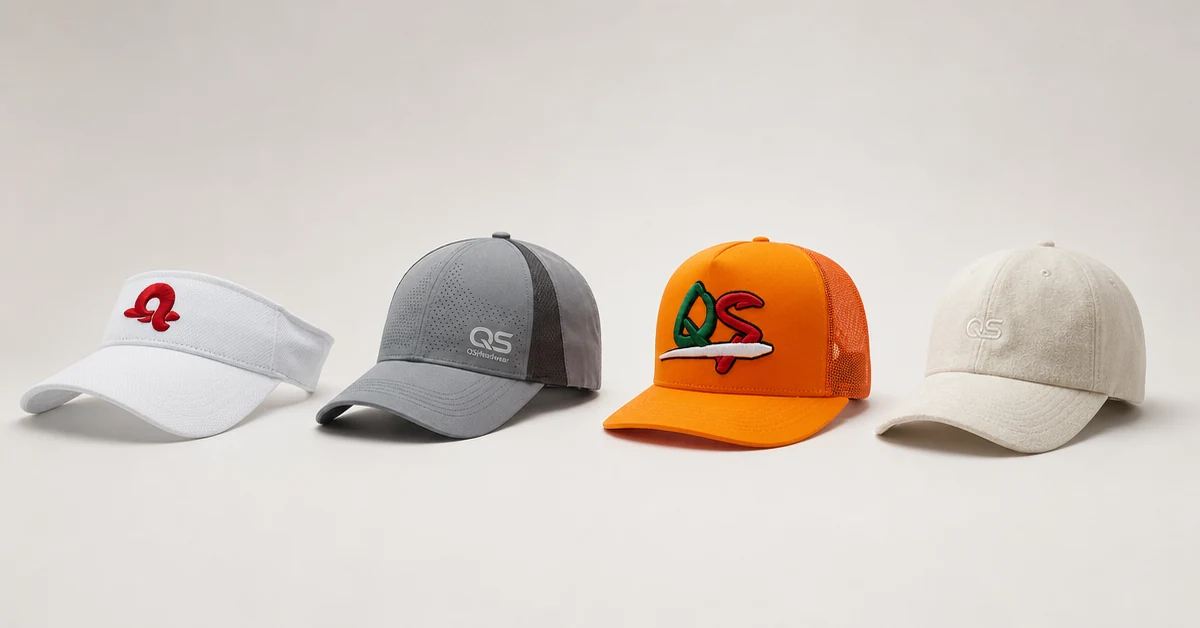
| Visor build | Typical characteristics | Suits | Watch out for |
|---|---|---|---|
| Light athletic visor | Soft band, elastic or hook-and-loop closure, short curved brim | Running, tennis, triathlon, event giveaways | Limited decoration area and less shelf presence |
| Performance mesh visor | Mesh side panels, moisture-management sweatband | Golf, outdoor training, warm-climate retail | Mesh restricts embroidery size and fine detail |
| Structured front panel visor | Supported band, taller panel, firm brim insert | Resort, corporate, golf club and premium retail | Warmer to wear and bulkier to pack |
| Wide-coverage golf visor | Longer brim with a controlled curve | Golf clubs, tournaments, high sun-exposure ranges | Needs a firmer insert and a shape-recovery test |
| Promotional value visor | Stock shell, one-color mark, simple strap | Volume campaigns and distributor catalogs | Small color or decoration changes raise the minimum |
Sampling, capacity and the reorder rhythm at QSHeadwear
Dongguan Qisheng Cap & Bag Co., Ltd. builds headwear under the QSHeadwear brand for overseas brands, retailers and distributors, with 15 years focused on custom cap and visor production. The company publishes a profile of 100+ skilled staff, a 4,000+ square meter workshop, and 30+ embroidery machines covering flat, high-density 3D and patch decoration.
That profile turns into numbers you can put in a calendar: sample development is quoted at roughly 3 to 5 business days, and monthly capacity of 120,000 to 150,000 pieces supports a regular bulk window of 15 to 20 days, extending to about 25 to 30 days above 5,000 pieces. Wholesale sun visors can be produced from a tech pack, AI or PDF artwork, or a physical sample, under either an OEM or an ODM model, and orders can be prepared for DHL, FedEx, UPS, air freight, sea freight, port delivery, or Europe and North America DDP terms.
Confirm every figure against your own specification and decoration, then hold the approved sample, the measurement sheet, the color references, the artwork version and the pack method in one file. That file is what makes the reorder a repeat instead of a renegotiation. For more on the surrounding process, see the visor fit and performance checks, the sample approval guide, the QC defect checklist, and the wholesale SKU and margin board.
Send a visor brief that can actually be quoted
A brief for wholesale sun visors answers ten questions: the channel, the wearer and the season; brim length and curve; band construction and closure; sweatband type; size range; shell fabric; decoration method with artwork; quantities by color and size; packing and carton requirements; destination and the date you need the goods. With that in front of them, a factory can quote a product instead of a placeholder.
Use the QSHeadwear contact page for an order-specific quotation, review the OEM and ODM services page if the visor needs development work, and compare reference silhouettes in the QSHeadwear product center. For channel detail, continue with the golf and racquet sports headwear requirements.
Buying wholesale sun visors well is mostly a matter of ordering the decisions correctly: define the product, wear it under the conditions your customer will meet, write the specification and the inspection criteria down, and keep the approved sample. Everything after that repeats.
Wholesale sun visors: the questions that reach our inbox
What should I verify first when buying wholesale sun visors?
Confirm brim length and curve, band construction, sweatband type and closure travel on a worn sample. Comparing price before those four are fixed compares different products.
How much do wholesale sun visors cost?
Price is driven by shell fabric, band construction, sweatband, closure hardware, decoration setup, packing and destination terms. Ask which requirement is setting your minimum.
What is a typical MOQ for wholesale sun visors?
The minimum is the highest of several minimums created by fabric, color count, decoration setup and packaging. A stocked fabric with one color and a simple mark gives the lowest start.
How long does a sun visor sample take?
QSHeadwear quotes roughly 3 to 5 business days for sample development. A plain visor moves fastest; a first-time 3D puff program or a new patch takes longer.
What is the bulk production lead time for wholesale sun visors?
Published capacity supports a regular 15 to 20 day bulk window, extending to about 25 to 30 days above 5,000 pieces. Confirm the timing for your specification.
Which decoration method suits a visor band?
Flat embroidery handles small lettering, 3D puff suits a bold compact mark, patches add a different surface, and print or heat transfer cover gradients and fine type. Mesh restricts embroidery size.
How do I prevent sweatband complaints?
Test sweatband width and material during warm activity rather than in a short fit check. A wider band spreads pressure and dries slowly; a narrow one concentrates pressure.
Can a visor be packed flat without losing its shape?
Usually, if the brim insert and curve are approved for flat packing and a packed sample is tested through real handling. Record the rest time before judging the brim.
What labeling does an export visor order need?
EU-bound textile products must describe fiber composition using the harmonized fiber names in Regulation (EU) No 1007/2011. Brand, size and care labels depend on your market and customer.
Does AQL 2.5 define visor quality?
No. AQL 2.5 sets a sampling approach and ISO 2859-1 gives both sides a shared vocabulary, but the measurements and appearance criteria still have to be written into the order.