

Wholesale knit beanies are sold in a window, not across the calendar. A beanie program that lands in October sells through by January; the same program landing in December sells at a discount in February. The reason is rarely the factory. It is that the decisions which take the longest, yarn selection, color approval and freight mode, get made last. Plan the range backwards from the shelf date and the schedule stops being a gamble.
This calendar is written for apparel brands, outdoor and ski retailers, promotional distributors, campus and team buyers, and e-commerce sellers ordering knit headwear in the hundreds or the tens of thousands. It assumes you already know roughly what you want to sell. What it fixes is the order in which those decisions have to happen, and how much slack each one needs.
Wholesale knit beanies: what changes between the brief and the shelf
A knit beanie is a small product with an unusually long tail of dependencies. The yarn has to be available in the shade you approved. The knit has to be tensioned the same way across every color in the run, because the same yarn knitted tighter in one colorway changes the size. A logo applied after knitting stretches with the fabric, which is a different problem from a logo applied to woven twill. And a bulky finished good takes more carton volume per unit than almost anything else in a headwear line, which changes your freight math right at the point where the calendar is tightest.
None of that is difficult. It is only difficult if two of those things are being decided in the same week.
The reverse calendar: five windows between brief and shelf
Work backwards from the week the goods need to be on a shelf or in a warehouse. The exact dates move with your market, but the windows and their order do not. The table shows what each window has to close and what it costs when the window is missed.
| Window | Typical timing | What has to close | Cost of missing it |
|---|---|---|---|
| One: design lock | Shelf week minus 20 to 16 weeks | Yarn, knit weight, cuff depth, logo method, color direction | Late color changes push the whole run into the freight peak |
| Two: sampling | Shelf week minus 16 to 12 weeks | Approved knit sample, sew-out or patch proof, size proof on heads | A sample round repeated in December eats the bulk window |
| Three: bulk run | Shelf week minus 12 to 6 weeks | Yarn receipt, knitting, finishing, decoration, inspection | Compressed production raises the rework rate and the price |
| Four: freight | Shelf week minus 6 to 2 weeks | Mode choice, carton count, documents, delivery appointment | Air freight on a bulky knit is the most expensive mistake in the plan |
| Five: shelf | Shelf week | Pack-out, hangtags, size and color split, replenishment plan | Full-price sell-through is lost before it starts |
Two things break this calendar more often than anything else: a fabric or yarn that has to be ordered after the sample is approved, and a color that gets revised after the sample has been signed. Both can be prevented by treating window one as a real deadline rather than a conversation.
Window one, design lock: settle yarn and knit weight before color
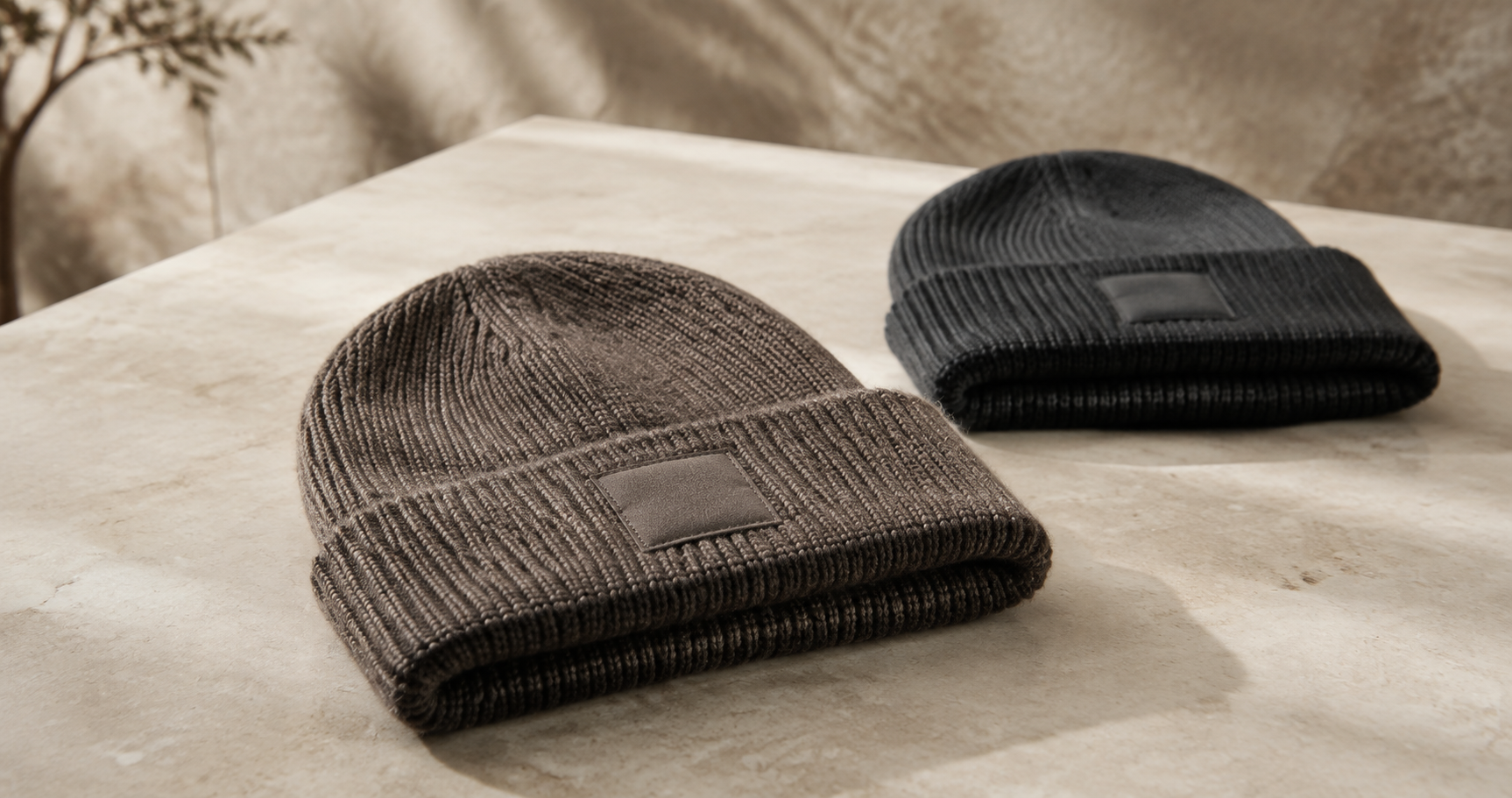
Knit weight drives everything downstream, including how much the beanie weighs and how much carton space it takes. A fine-gauge knit sits close to the head, packs small and takes finer logo work. A mid-weight ribbed knit is the workhorse of a winter range: warm, forgiving on size, cheap enough for volume. A heavy, loose gauge reads more premium and more casual at the same time, but it weighs more, takes far more volume, and can be difficult to decorate with fine detail.
Ask any supplier of wholesale knit beanies for the yarn composition and the finished weight per piece, then ask for the knit tension as a stated gauge rather than a description. If a wool-rich or recycled yarn is part of the story, request the fiber documentation with the sample, because paperwork tends to arrive after the goods when nobody asks early. The Woolmark Company is the reference most buyers cite for wool fiber claims, and naming the standard in the brief is easier than defending the label afterwards.
Window one continues: cuff depth, crown height and the fold
The cuff does more for how a beanie looks than the crown does. A shallow cuff of 5 cm reads as a basic beanie and sits higher on the head. A deeper cuff of 7 to 9 cm gives a fuller, more branded look and gives you room for a woven label or a patch. A double-layer cuff holds its shape better and adds warmth at the ears, but it also adds weight and yarn consumption.
Test cuff depth on heads rather than on a table, because the fold behaves differently on a 55 cm head and a 61 cm head. If the beanie is meant to be worn with the cuff folded twice, say so and photograph the sample that way. Buyers who approve a single-fold sample and then shoot a double-fold catalog image usually end up adjusting the crown height after the bulk run has started.
Window two, sampling: what a beanie sample has to prove
A sample of wholesale knit beanies proves four things and no more. It proves the shade against the approved reference. It proves the finished dimensions after knitting, because a knit relaxes and a flat measurement is not the same as a worn one. It proves how the logo behaves once the fabric stretches. And it proves recovery, which is the test most buyers skip.
Ask for two units of the same sample where possible, so one can be worn and one can stay clean as the reference. Photograph the clean one on a measuring surface with a ruler in frame. That photograph prevents an enormous number of arguments in the bulk stage, because it shows the size, the stitch density and the shade in one image.
Window two: logo methods ranked by how they behave under stretch
A knit moves. Every decoration decision follows from that, and the method that looks best on a flat swatch is not always the method that survives a season.
| Logo method | How it behaves on knit | Best used for | Watch out for |
|---|---|---|---|
| Flat embroidery | Stretches with the fabric if the backing is matched to the knit | Wordmarks and simple marks on mid and heavy gauge | Dense fills on fine gauge distort the cuff and stiffen the fold |
| 3D puff embroidery | Needs a firm, dense knit to hold height | Bold single letters on heavy gauge beanies | On loose gauge the foam edge lifts and frays |
| Woven label | Sewn at the corners, so the knit still moves underneath | Brand labels, small wordmarks, care and origin labels | Label stiffness changes how the cuff folds at the seam |
| Leather or suede patch | Sits on the surface and does not stretch | Premium positioning on folded cuffs | Adds weight, needs a minimum size and a clean stitch line |
| PVC or rubber patch | Rigid against a soft base | Streetwear drops and sport collaborations | Bond or stitch quality decides whether the edge lifts |
| Heat transfer | Bonds to the yarn surface | Fine type and gradients on synthetic-rich knits | Can crack if the knit is heavily stretched when worn |
| Silicone print | Flexible and low profile | Small accents and tonal branding | Limited color build and a soft edge on textured knit |
Whichever method you choose, approve it on the finished knit rather than on a swatch. A patch proof looks identical on paper and completely different on a ribbed cuff.
Window three, bulk: shade and tension control across a color run
Yarn shade variation on wholesale knit beanies is the hardest complaint to answer after delivery, because the knit has no large flat surface where an acceptable difference disappears. Fix the references before production: one approved yarn sample per color, a stated rule for how a lot may be split, and a written answer for a discontinued yarn.
Control the tension at the same time. Knitting the same yarn on a slightly different machine setting changes the finished circumference, so a colorway produced in a second pass can arrive measurably larger or smaller than the first. Ask how the factory controls the machine setting between colors, and ask for the finished measurement per color on the inspection report rather than a single number for the whole order.
Window three: recovery testing, the test that matters most
Recovery is what separates a beanie that still fits in February from one that hangs off the wearer's ears. It is also inexpensive to check. Five observations are enough.
| Test | How to run it | What a pass looks like |
|---|---|---|
| Fit range | Wear the sample on the smallest and largest head in the target range | The cuff grips without leaving a deep crease on the forehead |
| Stretch recovery | Stretch the cuff to roughly double its resting width for ten seconds, then release | The cuff returns to within a few millimetres of its original width within a minute |
| Repeat wear | Wear the sample three days in a row with a normal laundry routine between wears | No permanent bagging at the cuff and no shine on the knit surface |
| Logo behaviour | Stretch the decorated area and release it five times | The mark returns flat with no lift at the patch edge or cracked print |
| Pilling | Rub the side panel against a jacket collar or a wool coat for a minute | No visible fuzz ball forms on the surface |
Record every result with the wearer's head size and the hours worn. A recovery note with a size attached is usable evidence; a comment about feeling loose is not. ASTM publishes standard test methods for knit fabric stretch and recovery if you need a formal protocol to hand to a lab.
Window four, freight: why a bulky knit changes the carton math
A knit beanie is light and large, which is the worst combination for air freight and the best argument for planning early. Ask for the packed dimensions of your wholesale knit beanies and the units per carton before the bulk run, not after. Then calculate the volumetric weight, because a carton full of knitwear is usually charged on volume rather than on scale weight.
Flat-packed and cuffed presentation also matter here. A beanie pressed flat and stacked takes far less volume than one packed around a form. If your retail presentation needs the cuff shape preserved, find out what that costs in carton volume while there is still time to change the mode or the quantity per carton.
Window five, shelf: what retail presentation asks of the fold
The last two weeks belong to presentation, and presentation is usually specified far too late. Decide how the wholesale knit beanies hang or stack, whether each piece carries a hangtag through the knit or a woven label inside the cuff, and whether the cuff is folded once or twice in the pack. Then check that the fold survives the shipment: a cuff pressed for three weeks in a carton tends to stay folded the way it was packed.
Size and color splits belong in the same conversation. A winter range that ships as a single mixed carton is easy to receive and hard to distribute. If you sell through several doors, pre-pack to each door and label the carton accordingly, which costs a little at the factory and saves considerably at the warehouse.
Pom, label and trims: the small items with long lead times
Poms are a schedule risk disguised as a detail. A pom is usually sourced separately and attached in finishing, so it has to be approved before the bulk run and matched to the yarn shade. A removable pom, secured with a snap or a loop, sells as a two-way product but adds a component and a step.
Labels behave the same way. Woven, care and origin labels each need artwork, a size and a placement decided in window one. If the label is sewn into the cuff seam, the seam allowance has to take it without twisting the fold. Settle the fiber wording for the destination market now, because it is not something to improvise after the knit is finished.
Sizing a knit range without multiplying your SKUs
Knit headwear forgives size in a way that a fitted woven cap does not, which is why most ranges of wholesale knit beanies run one size and rely on the knit's stretch. The exception appears when a yarn is dense and a cuff is shallow: then the same beanie can feel tight on one head and loose on another within a few centimetres.
Test the extremes before you accept the one-size assumption. If the range does need two sizes, keep the split in the knit specification rather than in the label, so the SKU count stays manageable and the retail shelf stays simple. Where a pom or a patch defines the product, size the decoration once and reuse it across every colorway to protect the setup cost.
Building a knitwear line with QSHeadwear
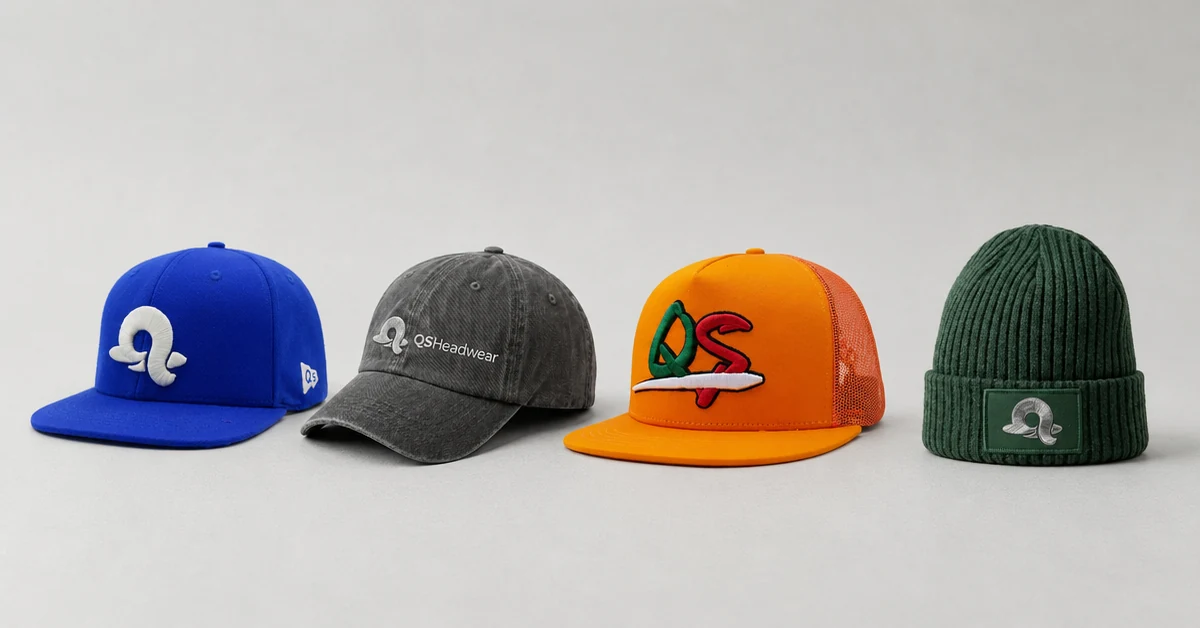
Dongguan Qisheng Cap & Bag Co., Ltd. produces headwear under the QSHeadwear brand for overseas brands, retailers and distributors, with 15 years focused on custom cap and knit headwear. The published profile covers 100+ skilled staff, a workshop above 4,000 square metres and 30+ embroidery machines, with monthly capacity of 120,000 to 150,000 pieces.
Translated into a winter calendar: sample development is quoted at roughly 3 to 5 business days, bulk production usually runs 15 to 20 days and extends to about 25 to 30 days above 5,000 pieces. Wholesale knit beanies can be developed from a tech pack, an AI or PDF artwork file, or a physical sample, under OEM or ODM terms, and shipped by DHL, FedEx, UPS, air, sea, port delivery or Europe and North America DDP. Confirm each number against your own yarn and decoration, then file the approved sample, the yarn reference per color, the label artwork and the pack method together.
More detail on the surrounding decisions: the beanie sourcing guide, the cuffed beanie logo and pressure tests, the OEM knit headwear guide, and the wool and fabric care questions.
The order to write a beanie brief in
Write the brief in the order the calendar runs: yarn and weight, cuff depth and crown height, logo method, color references, quantities by color, label and pom decisions, packing and fold, destination and shelf date. Ten lines in that order let a factory answer with a schedule instead of a set of questions.
Use the QSHeadwear contact page for an order-specific quote, review the OEM and ODM services if the knit needs development, and compare silhouettes in the product center. Ordering wholesale knit beanies well is a scheduling problem before it is a design problem. Solve the calendar and the design has room to be interesting.
Wholesale knit beanies: questions we answer every season
When should I place a wholesale knit beanies order?
Work backwards from the shelf week. Lock yarn and design about 20 to 16 weeks out, approve samples 16 to 12 weeks out, run bulk 12 to 6 weeks out and finish freight 6 to 2 weeks out.
What knit weight should I choose?
Fine gauge packs small and takes detail, mid-weight rib is the volume workhorse, and heavy loose gauge reads premium but costs more in yarn and carton volume. Choose by channel, not by photograph.
How deep should the cuff be?
About 5 cm reads as a basic beanie; 7 to 9 cm gives a fuller branded look and room for a label or patch. Approve the depth on two head sizes and photograph the fold you intend to sell.
Which logo method survives wear best on a beanie?
A woven label sewn at the corners moves with the knit and survives longest. Embroidery works on mid and heavy gauge, patches suit folded cuffs, and heat transfer suits fine synthetic knits with small type.
How do I test whether a beanie will stay in shape?
Stretch the cuff to roughly double its resting width for ten seconds, release it, and check that it returns within a few millimetres in about a minute. Repeat after three days of wear.
Why is a beanie so expensive to air freight?
It is light and bulky, so carriers charge volumetric weight rather than scale weight. Ask for packed carton dimensions before the bulk run and compare modes while there is still time to change the pack.
Can I run a one-size beanie range?
Usually yes, because the knit stretches. Test the smallest and largest head in your target market with the actual yarn and cuff depth; if either extreme fails, split the size in the knit specification rather than the label.
Do poms add lead time?
They can. A pom is often sourced separately and matched to the yarn shade, then attached in finishing. Approve it in window one so it does not become a late bottleneck.
What fiber information should a beanie label carry?
At minimum, the fiber composition and care instructions for the destination market. Wool blends and recycled yarns need documentation, and the wording has to be settled before the labels are woven.
How long does a knit sample take?
QSHeadwear quotes roughly 3 to 5 business days for sample development. A new yarn, a first-time patch shape or a recycled fiber with documentation takes longer.