

Most caps sold into the United States never touch the clothing flammability standard, and the reason sits in the regulation, not a test report. Title 16 of the Code of Federal Regulations, Part 1610 states in § 1610.1(c) that the standard "shall not apply to: (1) Hats, provided they do not constitute or form part of a covering for the neck, face, or shoulders when worn by individuals." For a normal six-panel cap, that sentence ends the question.
The condition is the part buyers skip. A hat leaves the exception the moment its construction covers the neck, face or shoulders — a sample-room decision made months before anyone opens a regulation. This guide reads the coverage condition against real headwear construction, sets out what the exception still leaves you responsible for, and shows how to write the decision into a tech pack so a later colourway or a smaller size does not move the product across the line.
Two boundaries. This is a specification framework, not legal advice: the responsible party for a market and channel must confirm the applicable rules, and vendor manuals are often stricter than the federal text. The reading is limited to what was actually read on 14 November 2026 — the current eCFR text of 16 CFR Part 1610 (title 16 displayed up to date as of 10 November 2026) and 16 CFR Part 1615. No state, retail or voluntary standard is asserted here.
What § 1610.1(c)(1) actually excepts
The exception is written around what the hat does on a head, not what it is called. Three zones are named, and reaching any one of them removes the exception.
The three zones in practice
Neck coverage surprises buyers most because it is easy to add for a commercial reason: a dropped rear panel below the hairline, a fold-down ear band, a detachable neck curtain, or a deep crown pulled over the ears by a chin strap. Face coverage usually arrives as a flap or visor extension; shoulder coverage appears on capes and legionnaire shapes.
The words "when worn"
Because the text says "when worn by individuals", fit becomes evidence. A cuff that sits above the ear on a 58 cm form and folds over the ear on a 62 cm head is a different product on a different wearer, and an ear flap designed for cold weather is the product in its worn-down position. Photograph both ends of the size range.
Where the coverage line falls in headwear design
Sort the range before sampling: a design that crosses the line needs a testing decision, a budget line and a calendar slot that a design above it does not.
Construction that stays above the line
A six-panel baseball cap, five-panel flat brim, mesh-back trucker, dad hat, snapback and visor all sit above the ear and stop at the hairline. A bucket hat in its conventional proportion circles the head without draping over the neck. These are the shapes the exception was written around.
Construction that crosses it
Trapper and aviator styles with ear flaps worn down, deep-cuff beanies pulled over the ears, sun hats with a neck cape, legionnaire caps with a rear flap, and any programme adding a detachable ear band or neck curtain. None is automatically non-compliant; the exception simply stops answering the question and the fabric has to.
The cuff problem on knit headwear
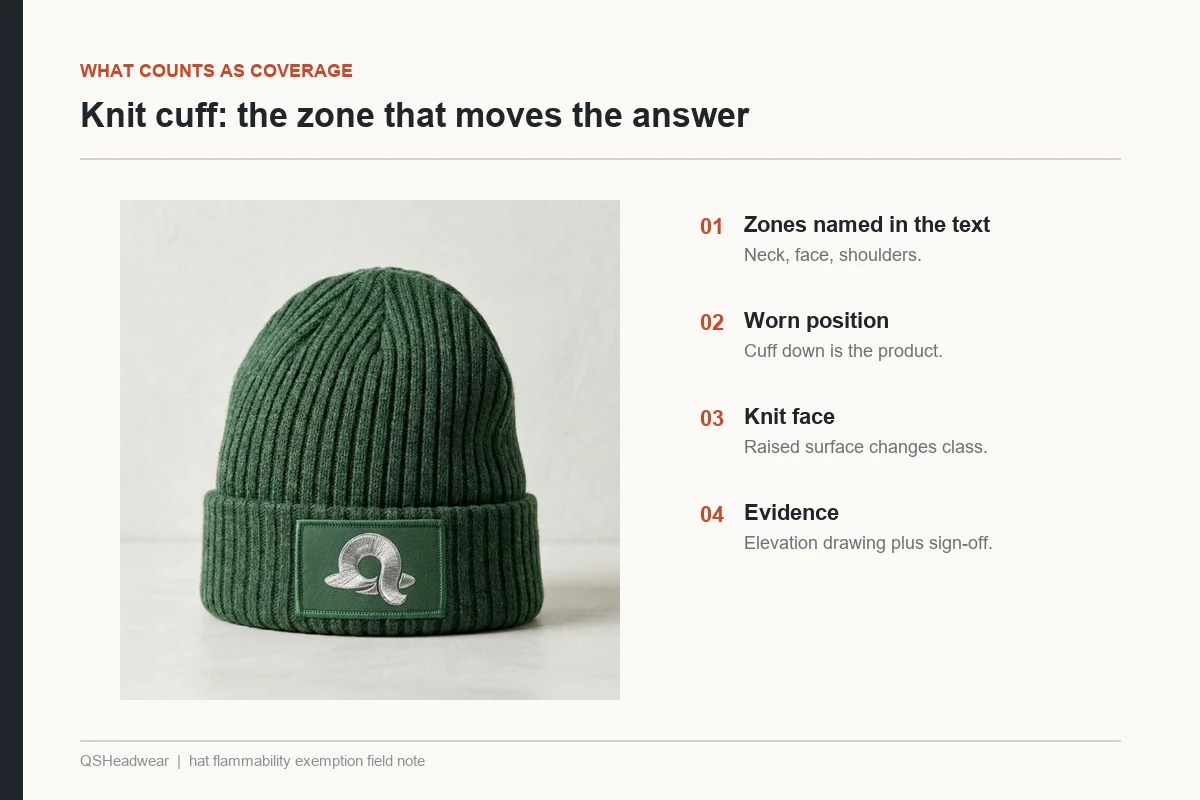
Knit beanies move two variables at once. A cuff can be worn up or down, which changes coverage, and the knit face is a raised-surface textile, which changes classification if the fabric is tested. A beanie sold into a cold-climate programme where the cuff is meant to cover the ears should be specified and photographed worn down, not flat in a studio. Where an adult style becomes a smaller wearer's version, the coverage question travels with the reapproval work described in reapproving a new wearer's SKU.
The exception is not the only gate
Even where the hat is excepted, Part 1610 has two provisions that decide whether a fabric needs testing at all — the parts a buyer can use to cut cost without cutting evidence.
The two fabric exemptions in § 1610.1(d)
Firms issuing an initial guaranty are exempt from any requirement to test two fabric families: plain surface fabrics, regardless of fibre content, weighing 2.6 ounces per square yard or more; and all fabrics, plain or raised surface, regardless of weight, made entirely from acrylic, modacrylic, nylon, olefin, polyester or wool, or a combination of those fibres. Between them they cover much of a normal range — a mid-weight cotton twill shell and an all-polyester knit are both inside.
Why knit is the awkward case
A wool-acrylic blend still qualifies if it is made entirely from listed fibres. A wool-cotton or acrylic-cotton blend does not, and a raised knit face does not get rescued by the plain-surface weight exemption either. That is the case to flag at material selection, because changing a yarn blend after approval restarts the evidence.
Class thresholds if you do test
Where testing is the route, § 1610.4 sets classification. A plain surface fabric is Class 1 at a burn time of 3.5 seconds or more and Class 3, rapid and intense burning, under 3.5 seconds. A raised surface fabric is Class 1 above 7.0 seconds, or where a surface flash occurs without enough intensity to ignite the base fabric, and Class 2 at 4.0 through 7.0 seconds with base burning. Only a laboratory report on your fabric and finish predicts a result.
Covered and exposed parts: what actually gets tested
Only the exposed part is tested
§ 1610.34(a) limits testing to the uncovered or exposed part of wearing apparel. On a cap, the shell, brim face, visible decoration and any exposed lining edge carry the question; a sweatband tucked inside the crown does not.
The interlining paperwork condition
§ 1610.36(a) exempts fabrics intended for interlinings or other covered parts, but only where an invoice or other paper covering the marketing of those fabrics designates the intended end use and records of acquisition, disposition and end use are maintained. It is a documentary condition, not a free pass: a buckram bought against an order that never states its end use is not evidenced.
Film components
Where a cap carries a plastic film component, § 1610.34(b) splits the route: if the outer film layer separates readily from the other layers it is tested under Part 1611 for vinyl plastic film; if it adheres, the multi-layer fabric may be tested under either part unless the required conditioning would damage the film. Clear windows and laminated brims are the components to check; packaging film is a different discussion.
Children's sleepwear is a different question
A children's hat can sit outside Part 1610 and still raise a second question, because Part 1615 defines its product by intended use rather than garment type.
What § 1615.1(a) defines
Children's sleepwear is any product of wearing apparel up to and including size 6X, "such as nightgowns, pajamas, or similar or related items, such as robes, intended to be worn primarily for sleeping or activities related to sleeping", excluding diapers and underwear, infant garments as separately defined, and tight-fitting garments as separately defined. The operative test is "intended to be worn primarily for sleeping". Garment names are examples; intent is the standard.
Marketing can move a beanie into scope
A knit hat sold as a cold-weather accessory is one product. The same hat photographed on a sleeping child, named as a sleep hat, bundled with pyjamas or placed in a nightwear collection is presented as related to sleeping, and "similar or related items" becomes a live question rather than a settled no. Decide deliberately: if sleep positioning matters commercially, treat the item as sleepwear from the brief onward and take market advice. If it does not, keep imagery, naming and collection placement consistent with a daywear accessory, and write that editorial rule down so a later photoshoot does not undo it.
What to change before you print
Title, collection name, model photography, bundle composition and the retailer-facing description should tell one story about intended use. Re-read the label in the same pass, because a label system built for daywear may carry wording that no longer fits — which is why the label system behind a private-label cap is worth building before the first sample.
Five fields that settle it in the tech pack
1. Coverage elevations
Front, side and rear views at the smallest and largest size, every movable element drawn in its worn position, and a note naming the zones the design does and does not reach.
2. Component material map
Every component with its material, visibility and exposure — the discipline that makes a test booking coherent, set out in booking tests by component. The map also shows which parts are covered and outside the exposed-part question.
3. Fibre and weight evidence
Composition and weight per square yard per shell fabric, plus the mill's end-use designation where an interlining exemption is relied on. Where a blend falls outside § 1610.1(d)(2), record the decision: test, substitute, or accept the risk with a named sign-off.
4. Intended wearer and channel
Age band, size range, market and channel, stated once and repeated on the label artwork. The same cap can be a children's product in one channel and a promotional item in another.
5. Test decision and record owner
Which route was chosen, who owns the record, where the guaranty or report lives. Part 1610 attaches record-keeping duties to the person furnishing a guaranty, so a file with no named owner is not a file.
A release gate before bulk
Gate 1 — design
Has anyone looked at the worn-position elevations and agreed in writing whether the design forms part of a covering for the neck, face or shoulders? A yes moves the item to the testing route; a no is signed by a named person, not assumed.
Gate 2 — evidence
Does the fabric evidence match the approved sample, including finish and blend? A wash, coating or yarn substitution can move a fabric out of an exemption relied on at sample stage.
Gate 3 — consumer-facing words
Do title, imagery and collection naming describe the intended use the file relies on? For a children's item this is where a sleepwear question is created or avoided.
Gate 4 — first-article checks
Measure the elements that define coverage on the first article: cuff depth, ear-flap drop, cape length, brim drop at the rear. A 10 mm drift in cuff depth changes the worn-position drawing without changing any other measurement. Fold these checks into existing defect classes using the sampling logic in AQL sampling and defect classes.
Questions buyers ask
Do all hats need US clothing flammability testing?
No. § 1610.1(c)(1) excepts hats that do not constitute or form part of a covering for the neck, face or shoulders. A conventional cap sits inside that exception; a design with worn-down ear flaps, a neck cape or a deep drop behind the collar does not, and then the fabric has to be assessed.
Does the exception cover a beanie with the cuff folded down?
It depends where the cuff sits when worn. Specify and photograph the worn-down position at both ends of the range, and treat the item as outside the exception if the cuff covers the ears and neck. The knit face also removes the plain-surface weight exemption.
Is a polyester cap automatically exempt from testing?
The fabric may be, under § 1610.1(d)(2), which exempts fabrics made entirely from acrylic, modacrylic, nylon, olefin, polyester or wool, or a combination of them, regardless of weight. That concerns the fabric and the guaranty, not the finished product, so it does not by itself answer the coverage question.
Can a children's hat be sold as sleepwear?
That is a positioning decision with compliance consequences. § 1615.1(a) defines children's sleepwear by intended use up to size 6X and includes "similar or related items", so a hat presented as part of a sleep set puts that definition in play and the applicable requirements should be confirmed with qualified market advice.
What this changes about your next brief
The coverage line is the lowest-effort compliance decision in a cap programme, because a drawing and a signed sentence settle it before tooling instead of a laboratory after bulk. Map the zones, record which fabrics carry a weight or fibre exemption, name who signs the coverage call, and keep the marking of a children's item consistent across title, photography and file.
This sits alongside the wider North American market entry file and, for uniform programmes where a cap is issued rather than sold, the job-role specification in workwear cap programmes, where a textile cap stays a uniform item, never head protection. Where the range adds cords or detachable decoration to a smaller wearer's product, pair it with the children's hat cord specification: coverage and attachment hazards are reviewed by different people.
Send worn-position elevations, the component map and the intended market with the first brief; browse the custom headwear product range to see which base constructions the question applies to.