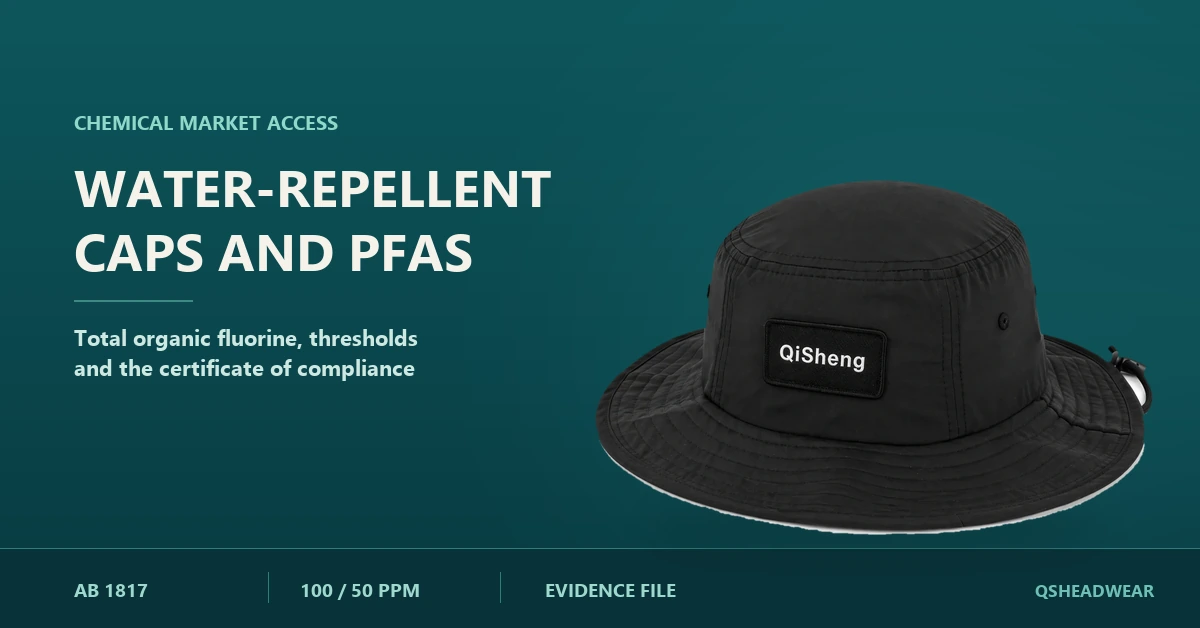


A children's cap with a chin cord is decided long before it is sewn. The buyer chooses a size range, a cord type, a closure at the free end and a fixing method, and every one of those choices travels straight into a bulk order that may run for several seasons. If those choices live only in a chat thread, the first serious compliance question arrives after the tooling is made.
The useful decision is not “does the factory make kids' hats?” It is “which size range is this hat built for, does it need a cord at all, what is the cord attached to, what is on the free end, and what evidence proves bulk matches what we approved?” Answer those five questions in writing and the product becomes reviewable. Leave them to production and you inherit whatever the sample room decided.
This article is a buying and specification framework, not legal advice. Requirements differ by market, by retailer and by the age group a product is intended for. Buyers should confirm the current rules that apply to their own channel and take qualified advice before printing labels or shipping.
Start with the size range, not the hardware
Nearly every cord question is downstream of one earlier decision: who is expected to wear the hat. A cap sold as adult one-size and a cap sold as a toddler sun hat can share a pattern block, a fabric and a decoration, yet they sit in completely different review categories. Fix the intended wearer first, then specify hardware.
Age grading is a documented decision
Write the intended age on the tech pack, on the label artwork and in the order confirmation, and keep those three consistent. The US Consumer Product Safety Commission (CPSC) treats intended use as a matter of evidence, not of preference: label statements, advertising and how a product is commonly recognised all feed into whether it counts as a product for young children. A hat marketed with toddler photographs and sold in a 2T–4T run is a children's product in the eyes of a reviewer, whatever the internal spreadsheet calls it. When you convert an adult style downward, treat it as a new SKU with its own fit, attachment and label evidence rather than a scaled pattern; the reapproval work is described in converting an adult cap into a youth SKU.
Ask whether the cord has to exist
Chin cords are usually a wind decision inherited from adult outdoor styles. In a children's range they are also the component most likely to be questioned. Decide deliberately: cord, no cord, or a cord that releases. Each option has a different cost, a different sample round and a different evidence trail. Choosing “no cord” is a legitimate specification decision, not a downgrade, and it removes an entire review thread from the project.
Separate the three cord hazards
Buyers treat “the cord” as one item. Three separate hazards are actually being managed, each fixed at a different station.
Neck and chin cords: entanglement and catch points
A cord that loops under the chin creates a closed loop near the neck. The CPSC has determined that hood and neck drawstrings on children's upper outerwear in sizes 2T to 12 or the equivalent present a strangulation hazard. Its published business guidance records staff awareness of 26 deaths and 73 nonfatal incidents associated with neck and hood drawstrings on children's outerwear between January 1985 and June 2019, involving children from 18 months to 15 years, with the most common scenarios involving a toggle or knot catching in a gap at the top of a playground slide.
Read the CPSC guidance on drawstrings in children's upper outerwear before approving a chin cord. The hazard logic is about loops and catch points near the neck, and a hat cord sits in the same physical zone even where the letter of a garment rule does not reach it.
Free ends: toggles, knots, beads and barrels
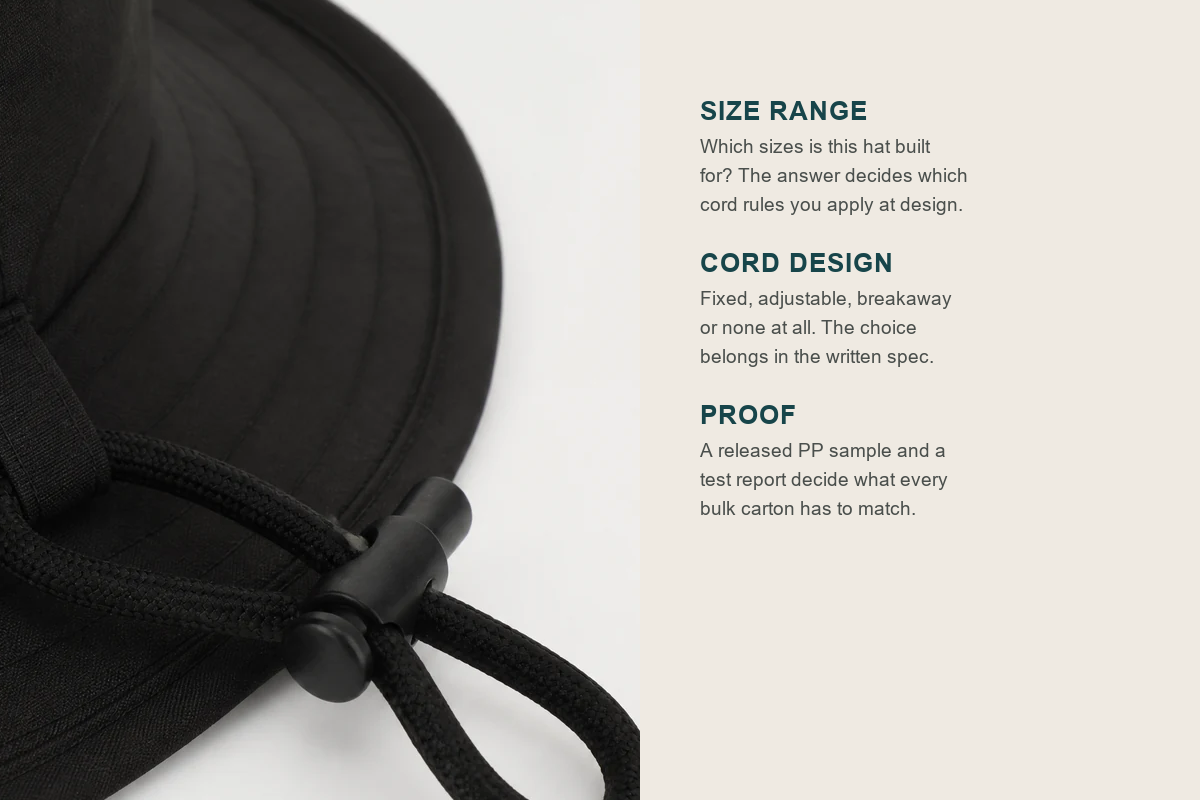
What hangs on the end of the cord decides whether it can catch. A moulded barrel adjuster, a knotted cord end or a metal bead is a hard, protruding object travelling at neck height. The CPSC guidance on waist and bottom drawstrings is explicit that such garments must be free of toggles, knots and other attachments at the free ends, and limits waist and bottom drawstring length to three inches outside the channel when the garment is expanded to its fullest width. That is a garment rule, not a hat rule, but the design reflex it teaches is directly transferable: shorten the free end, remove the hard stop, and keep the loop small enough that it cannot pass over a head.
If the marketing plan needs an adjustable fit, ask for the adjustment to be built into the band or the back closure instead of the neck cord. That keeps the visual reference and deletes the catch point.
Attachment: how the cord is fixed to the hat
The fixing is a quality decision as much as a safety one. A cord bar tacked into the brim seam behaves differently from one threaded through an eyelet or anchored by a press stud. Specify the anchor, the stitch pattern and the pull test the factory must run, and photograph the finished anchor from the inside as well as the outside. Where a cord is one continuous string rather than two ends, state the bar tack requirement in the spec.
What the US rules actually say, and what they leave to you
The US drawstring rule is written for garments, and this matters when a kids' hat programme is reviewed. Title 16 of the Code of Federal Regulations, Part 1120, deems children's upper outerwear in sizes 2T to 16, or the equivalent, that has one or more drawstrings and does not conform to ASTM F 1816-97 to be a substantial product hazard. The same part defines a drawstring as a non-retractable cord, ribbon or tape of any material used to pull together parts of upper outerwear to provide for closure, and it attaches reporting and recall duties to products on that list and provides for refusal of entry into the United States.
The operative phrase is “upper outerwear”. A hat with a chin cord is not upper outerwear in the sense the regulation uses, so a buyer who assumes the federal drawstring rule automatically decides the hat question is assuming too much. The regulation is best read as the risk model to copy, and the 16 CFR Part 1120 text on the substantial product hazard list is short enough to read in full before a specification meeting.
Two consequences follow. Put your own cord rule in the tech pack, because a gap in the regulation is not a gap in retail expectations. And expect a retailer's vendor manual to be stricter than the statute: routing guides and chargeback schedules already police packaging and ticketing on retail programmes, as summarised in retail vendor compliance, routing and chargebacks.
Small parts and decoration: avoid the exemption trap
Hats carry pom-poms, patches, moulded charms, snap buttons and decorative rivets. It is tempting to reason that hats are clothing, clothing is exempt from the small-parts rule, and the decoration therefore needs no thought. That reasoning is half right, and it stops a step too early.
Part 1501 of Title 16 sets out the method for identifying articles intended for use by children under three years of age that present choking, aspiration or ingestion hazards because of small parts, and includes a test cylinder procedure plus use-and-abuse testing for components that can be detached. Its exemption list does cover children's clothing and accessories, including items such as shoe lace holders and buttons. The exemption removes one specific test obligation; it does not remove the buyer's judgement about whether a detachable decoration on a hat for a two-year-old belongs on the product at all.
The practical answer is to split decoration into two classes before sampling. Fixed decoration — embroidery into the panel, a sewn patch with a defined stitch count — is a construction question. Detachable decoration — a snap-on charm, a glued stone, a pin — is a hazard question for young age groups, and should be removed from the toddler range or supported by attachment evidence. Map components first, then book tests; the component method is set out in booking tests by component.
Write the strap decision into the specification
A cord specification that survives bulk has five fields, and all five belong on the tech pack rather than in an email.
The five fields that settle the argument
Size range and intended wearer. The labelled sizes, the intended age band and the market where the SKU will be sold, stated once and repeated on the label artwork.
Cord decision. Cord present, cord absent, or release-on-load. If present, the cord diameter, the material, the colour reference and whether the two ends are one string or two.
Free-end treatment. Bare cord end, sealed end, short barrel adjuster, or no hard component. Give a maximum free length and a maximum loop circumference so the pattern room is not guessing.
Anchor and stitch. The exact fixing point, the stitch type, the number of passes and the position relative to the brim seam. Include a pull-test value the factory can reproduce and record.
Evidence. Which test reports, which photographs and which approved sample define “correct”, and who signs the release.
Once those fields exist, the sample round stops being a negotiation. The first sample either matches the spec or it does not, and the difference is visible in a photograph rather than argued in a thread. The formal release step is worth running as a docket rather than a conversation, as described in the PP sample release docket.
Prove it before bulk, then keep proving it
Children's headwear puts the evidence burden on the seller, so proof has to be planned into the order rather than assembled after a complaint.
Sample-stage evidence
Photograph the finished sample from six angles, including the inside of the crown where the cord anchor and any labelling sit. Measure and record the free-end length and loop circumference on the sealed sample, because these are the two numbers most likely to drift in a repeat run. Keep the approved sample sealed and photographed; the older the programme, the more the sealed sample does the work of a specification.
Test and document evidence
Ask for the test programme in writing before the order is confirmed, with the laboratory named, the components listed and the acceptance criteria stated. If a retailer supplies its own protocol, load it into the order file at the start. Distinguish what the factory can evidence at site level from what the material or component supplier must evidence, because the two arrive on different schedules; the split is explained in factory-level versus material-level evidence.
Bulk inspection points
Add three cord-specific checks to the inspection plan: free-end length against the sealed sample, anchor pull test on a defined sample size, and absence of hard end components where the spec says none. These are cheap to check and expensive to miss, because a cord difference found at the carton stage is a rework decision while the same difference found at the retail DC is a chargeback. Sample size, defect classes and the release gate are covered in AQL sampling and defect classes.
Regional differences that change the answer
The same hat can be acceptable in one market and questioned in another without any change to the product, because the surrounding duties differ. Three variables move first: whether the market treats the item as a children's product with its own conformity documentation, whether the local language must appear on the label, and whether the retailer demands an accredited laboratory report rather than an internal one.
For markets with their own labelling conventions, the file has to be built before the first order rather than retrofitted to a shipment; the separation of size, label and inspection files for two demanding markets is described in Japan and Korea label and size files. For markets where a high-visibility claim is involved, remember that a safety claim attaches duties that a fashion cap never carries, which is why safety caps are not a compliance shortcut. And the label itself is a specification with its own approval cycle, not a print step: build it in the label system for a private-label cap before the first sample is cut.
What to do before the next kids' programme
Bring the age grading forward to the first conversation. Decide whether the cord earns its place, and if it does, reduce the free end, remove the hard stop and document the anchor. Put the five specification fields into the tech pack, name the tests you expect, and add the cord checks to the inspection plan. Then keep the sealed sample and its measurements, because a repeat order two seasons later is where most cord specifications quietly change.
None of this makes a children's hat order complicated. It makes the decisions visible early, when they cost a conversation, instead of late, when they cost a container.