

A payment schedule is not just a date and a percentage. It decides who finances material, development and production; who carries the risk if an approval is delayed; and how much leverage remains when the goods are ready to ship. A familiar deposit-and-balance formula can still be unsafe when the scope, milestone evidence or release conditions are vague.
Strong headwear supplier payment terms connect every transfer to a controlled order state. The buyer knows what has been approved, what the money funds, which party owns the resulting materials or files, and what evidence must exist before the next payment becomes due.
This guide is a commercial control framework, not legal, banking, tax or financial advice. Payment tools, bank rules, currency controls and remedies vary by transaction and jurisdiction. Buyers and suppliers should confirm contract language and payment arrangements with qualified advisers and financial institutions.
Start with risk allocation, not a standard percentage
There is no universal deposit ratio that makes every headwear order fair. A stock-fabric pilot, a custom-dyed launch and a repeat program do not create the same working-capital need. The right schedule reflects the supplier's irreversible commitment and the buyer's exposure at each stage.
Identify what the first payment funds
Separate development, tooling, labels, custom materials, packaging and production capacity. A deposit should not be described as “for the order” when neither party can explain which commitments it triggers.
Measure the buyer's exposure
For every proposed payment, list cash already paid, recoverable materials, work in progress, approved finished goods, transferable files and remaining remedies. This gives the buyer a risk position rather than a percentage without context.
Keep quantity decisions separate
The custom hat MOQ purchase ladder helps select a sensible volume. Payment terms then decide how that selected commitment is financed and evidenced. A lower quantity does not automatically justify full prepayment, and a larger order does not automatically create buyer credit.
Define the commercial baseline before money moves
A deposit should be released against a controlled purchase order or contract, not an informal message thread. The baseline must be detailed enough to identify what the supplier is accepting and what remains provisional.
Lock the parties and order identity
Confirm the legal buyer and seller names, order number, currency, bank beneficiary, product references, quantities, Incoterm and delivery destination. Bank details should be verified through an agreed independent channel, especially when a change request arrives by email.
Separate fixed scope from open decisions
List unresolved color, decoration, packaging, testing and shipping choices with owners and deadlines. State whether delay changes price, schedule or payment dates. A milestone cannot be objective if its inputs remain unspecified. A paid supplier audition order can expose whether the proposed payment schedule works under real production conditions before a larger commitment.
Control cancellation and change
Record which costs become non-refundable after material booking, tooling or production starts. Define how buyer changes are priced and how supplier-caused rework affects the next payment. The contract should distinguish genuine committed cost from a broad claim that every deposit is automatically lost.
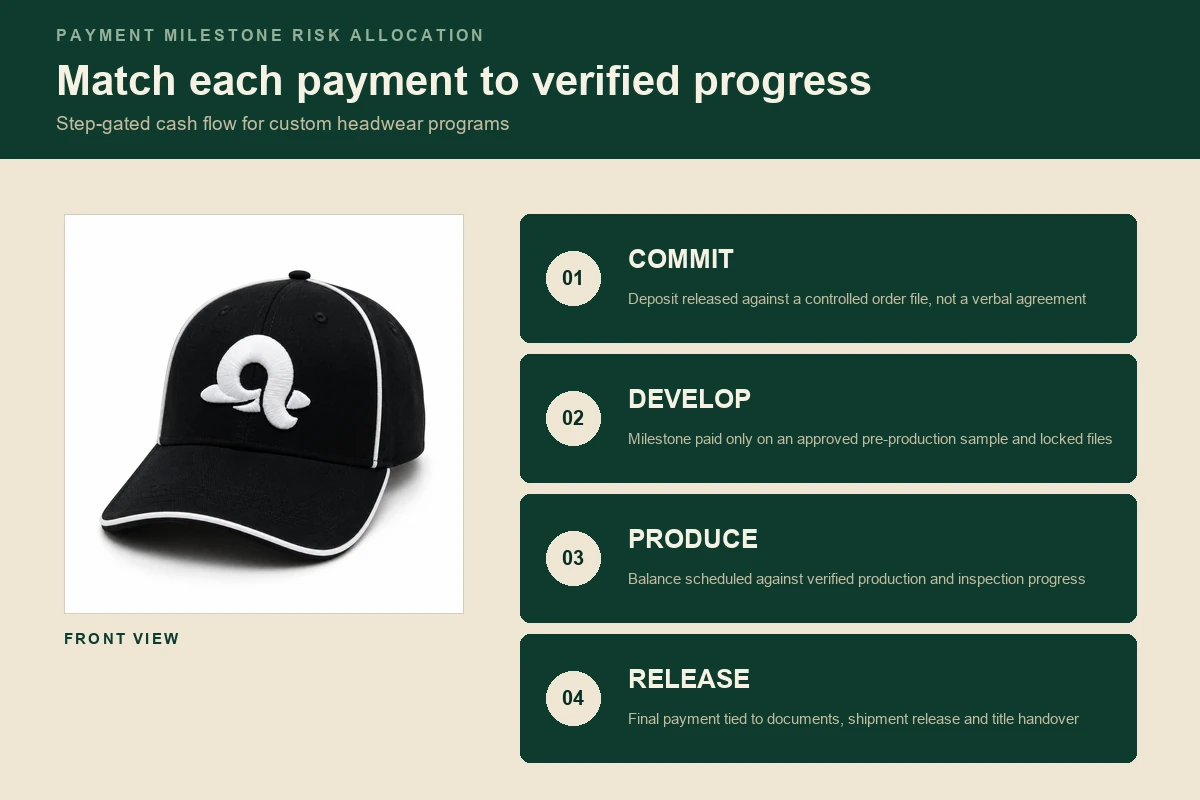
Match payments to verified milestones
Calendar dates alone do not prove progress. Use milestones that another person can verify from records, samples, production status or shipment documents.
Commit: controlled order acceptance
The initial payment can follow signed scope, confirmed beneficiary details, agreed commercial terms and a supplier acknowledgment. If custom materials are included, identify their specification, quantity, ownership and treatment if the order stops.
Develop: approved product baseline
A development milestone can require approved artwork, decoration sew-out, material standard and pre-production sample. The PP sample release docket shows how to document the baseline. Payment should not convert an unresolved sample into silent approval.
Produce: evidenced bulk progress
If a mid-production payment is needed, define the evidence: allocated materials, line start, work-in-progress quantity, production photographs, independent inspection or another agreed record. Avoid “50% complete” unless the method for calculating completion is written.
Release: inspection and shipment control
The final balance may be linked to approved inspection results, corrected defects, commercial documents and the agreed release of goods or title. The exact trigger must align with the Incoterm and transport arrangement. A payment should not be called “before shipment” when no one has defined shipment.
Choose a payment method for the relationship and risk
The US International Trade Administration describes five primary international payment methods: cash in advance, letters of credit, documentary collections, open account and consignment. Each shifts timing, cost, documentation and non-payment risk differently.
Cash in advance
Advance payment reduces seller credit risk but can create unattractive cash flow and performance exposure for the buyer. Use stronger order definition, beneficiary verification and milestone evidence when a substantial amount is paid before goods exist.
Letters of credit
A letter of credit can provide bank-backed payment subject to compliant presentation of specified documents. It does not inspect the caps or replace a workable purchase contract. Documentary conditions must be precise, obtainable and consistent with the shipment plan.
Documentary collection
Banks facilitate document exchange and payment or acceptance, but the official Trade.gov payment-method overview notes that documentary collections provide limited recourse and no bank verification process comparable to an LC. Suitability depends on trust, documents and the parties' risk tolerance.
Open account and consignment
These arrangements improve buyer cash flow but increase seller exposure. Credit assessment, insurance, limits, title terms and collection procedures become more important. They are commercial choices, not rewards that should be granted automatically after one order.
Connect sample, tooling and material payments to ownership
Paying a charge does not automatically answer who owns the resulting file, mold, excess fabric or finished component. Ownership, possession, permitted use and handover must be written separately.
Development and tooling
Identify whether digitizing files, molds, templates or special fixtures are purchased, licensed or supplier-owned. State whether charges are refundable, amortized or credited after a volume threshold, and what the buyer receives if the relationship ends.
Custom material deposits
For dyed fabric, yarn, trims or packaging, record the committed quantity, usable yield, leftover treatment, storage period and proof of purchase. The payment should map to identifiable material, not an unexplained “material fee.”
Exit readiness
The supplier-exit guide explains how to protect product data and tooling. Payment clauses should support that future handover rather than create a dispute over assets after the final order.
Control currency exposure explicitly
When quotation, supplier cost and buyer funding use different currencies, exchange-rate movement can change margin between order confirmation and payment. The parties need to agree which currency controls the obligation and who absorbs movement.
Set the pricing currency
Record invoice currency, payment currency, conversion source and date if conversion is allowed. Do not rely on a screenshot or an unspecified “bank rate.” State who pays bank, intermediary and conversion charges.
Define a review mechanism
For long lead times, parties may agree a validity period, tolerance band or review formula. Avoid unilateral language that allows either party to reset price without a transparent reference and notice process.
Use professional risk tools when appropriate
Trade.gov's foreign-exchange risk guidance explains that currency values can move between deal agreement and receipt of payment, and discusses pricing currency and hedging considerations. Buyers should consult banks or advisers before using financial instruments.
Align cash timing with the production critical path
Payment should enable real work without rewarding delay. Place milestones beside the production calendar so approval dates, material booking and capacity commitments are visible.
Fund irreversible commitments at the right time
A supplier may reasonably require funds before ordering custom material or reserving capacity. The buyer should see the supplier deadline, cancellation cost and supporting evidence. The production critical-path guide helps connect these commitments to approval timing.
Do not pay to solve avoidable delay
If the supplier missed an agreed milestone, an early balance payment should not become the automatic cure. Record recovery actions, new dates and responsibility before changing the payment schedule.
Use inspection evidence without confusing payment and quality
Payment control can motivate resolution, but it is not a substitute for a defined quality system. Inspection scope, defect classification and release authority should already be agreed.
Define the evidence package
Specify the report, sampling basis, photos, measurements and corrective-action evidence needed for the balance trigger. “Inspection passed” is too vague if the buyer cannot identify what was inspected.
Handle disputed defects
Define escalation, reinspection, repair, replacement and concession approval. Keep undisputed amounts separate where appropriate, and avoid using total payment suspension as an unspecified response to every minor issue.
Link supplier performance over time
The quarterly supplier scorecard can support later credit or milestone changes. Better terms should follow repeat evidence, not relationship length alone.
Build a payment risk allocation table
For each milestone, record the trigger, evidence, amount or formula, due date, responsible approver, ownership created, remaining buyer exposure and dispute route. This makes the schedule reviewable by sourcing, finance and operations.
Test the downside case
Ask what happens if the sample fails, material is late, the buyer changes scope, production stops, inspection rejects goods or shipment is delayed. If the schedule cannot explain those cases, it is not ready for approval.
Compare suppliers on equivalent terms
A lower price with full prepayment is not economically equivalent to a higher price with staged exposure. Normalize payment timing, fees, currency and recoverability when comparing quotations. Keep import duty, freight and destination charges in the separate headwear landed-cost map so payment timing does not hide the total cash requirement.
Questions to settle before approving payment terms
- What specific commitment does each payment fund?
- Which order version and beneficiary details control?
- What evidence makes each milestone complete?
- Who owns paid tooling, files and unused materials?
- What happens after buyer change, supplier delay or failed inspection?
- Which party carries currency movement and banking charges?
- When do goods, documents, risk and title transfer?
- How are disputed and undisputed amounts handled?
- What repeat-order evidence can justify improved terms?
Make payment a controlled commercial decision
Good headwear supplier payment terms do not eliminate trust; they make trust testable. Each transfer should fund a known commitment, follow verifiable progress and preserve a reasonable balance of risk.
Start with the order facts, then choose milestones, payment method, currency and release conditions. When sourcing, finance, quality and logistics can all explain the schedule, the buyer is no longer negotiating a percentage. The buyer is designing a controlled path from commitment to delivery.