

Choosing between the European Union, North America and Gulf markets is not a matter of finding the region with the largest headline opportunity. The better first market is the one where a brand can align its product, compliance ownership, channel economics, climate needs and replenishment model with the least uncontrolled risk.
Headwear looks globally portable, but the same cap cannot simply receive three translated product pages and become market-ready. An adjustable lifestyle cap, a performance style, a corporate-gifting program and a cold-weather range each face different buyer expectations. This comparison turns those differences into an entry sequence rather than repeating three separate regional checklists.
Start With an Entry Decision, Not a Region Ranking
There is no universal winner. A market that suits one brand's capabilities may expose another brand's weakest process. Begin by scoring the launch against six questions: product-market fit, compliance readiness, channel access, landed-cost visibility, climate and calendar fit, and operating capacity.
Define the Launch Unit
Compare one controlled launch unit: a specific product family, channel, destination and time window. “Enter Europe” is too broad. “Launch three adjustable adult fashion caps through an EU-based online retailer” creates decisions that a sourcing, compliance and logistics team can actually test.
Set the Evidence Threshold
Record what must be proven before inventory is committed: finished SKU, material identity, label artwork, responsible parties, product-page fields, packaging, customs data and quality gates. Do not let the market choice outrun the product file.
Use a Three-Market Decision Matrix
| Decision area | European Union | North America | Gulf markets |
|---|---|---|---|
| Primary entry pressure | Product-safety roles, fibre information and online-offer controls | Channel economics, customs planning and US/Canada differences | Heat, UV exposure, gifting calendar and distributor execution |
| Useful starting range | Controlled SKU set with complete evidence | Channel-specific core styles and clear price ladder | Breathable performance, corporate and event-ready styles |
| Operational priority | Release-file ownership | Margin and replenishment discipline | Climate testing and calendar planning |
| Main expansion risk | Adding countries or claims before data control is stable | Treating the US and Canada as one regulatory setup | Treating the Gulf as one identical consumer market |
This matrix is a planning framework, not a legal or commercial ranking. Each destination, product claim and channel still needs its own review.
European Union: Enter Through Controlled Product Data
The EU route rewards brands that can connect the physical product, economic-operator information, online offer and supporting evidence. It is less forgiving when product facts live in separate spreadsheets or remain dependent on factory memory.
Make the Finished SKU the Compliance Unit
A material report, factory certificate or approved artwork supports only the scope it actually covers. Build one release file for each finished SKU and link its component data, label, identifier, online listing and inspection evidence.
The EU headwear compliance checklist explains how fibre information, responsible economic-operator details and online product information connect to market release.
Treat the Online Offer as Part of Readiness
Regulation (EU) 2023/988 establishes the EU general product-safety framework and includes provisions for products offered through distance sales. For an entry plan, the practical lesson is that the product page cannot be separated from the controlled product record.
Start With Fewer, Better-Controlled SKUs
A narrow range reduces the number of material routes, claims, labels and online records that must stay aligned. Expand after the release process works repeatedly, not simply after the first shipment clears.
The Digital Product Passport preparation guide shows why structured product and supplier data should be built early even when a particular future requirement is not yet the immediate launch gate.
North America: Enter Through Channel and Margin Fit
North America often offers familiar headwear silhouettes, but the commercial route matters as much as the product. A direct-to-consumer brand, specialty retailer, team dealer and promotional distributor require different packaging, assortment, replenishment and pricing logic.
Do Not Combine the United States and Canada by Default
The two markets share many product and retail patterns, but labels, customs treatment and language expectations cannot be assumed to match. Decide which country launches first and create a documented localization list before combining inventory.
The North America headwear guide compares US and Canadian retail, textile information, duty planning and channel expectations in more detail.
Build the Price Backwards From the Channel
Start with target retail position, channel margin, promotion exposure, fulfillment, duty and returns, then test whether the product specification and order volume still produce a viable landed-cost range. A low factory price does not rescue a weak channel model.
Use the custom headwear pricing framework to separate factory cost, landed cost, wholesale margin and retail economics before comparing the region with alternatives.
Confirm Origin Marking in the Product Plan
US Customs and Border Protection publishes official guidance on country-of-origin marking for US imports. The exact treatment depends on the product and circumstances, so confirm the current requirement and placement before bulk labels or packaging are released.
Gulf Markets: Enter Through Climate and Calendar Fit
The Gulf opportunity is strongest when the product plan reflects heat, sun exposure, indoor-outdoor movement, corporate programs and major commercial periods. Copying a temperate-market range can leave too much weight, insulation or visual mismatch in the assortment.
Design the Range Around Use Conditions
Prioritize breathable constructions, sweat management, shade, adjustable fit and materials appropriate to the intended use. Product claims should remain tied to evidence; a light or sporty appearance alone does not prove technical performance.
The Gulf headwear market guide connects heat, UV exposure, Ramadan timing and corporate gifting to product and procurement decisions.
Plan Corporate and Event Programs Separately
A branded gifting order may prioritize logo execution, recipient-friendly sizing, presentation and event-date certainty. A retail performance range may prioritize repeat wear, material feel and assortment depth. Treat them as different programs even when they use a similar cap base.
Localize by Country and Partner
The Gulf is not one identical retail environment. Validate destination requirements, distributor capabilities, language treatment, channel expectations and commercial calendar for each country rather than applying one regional template.
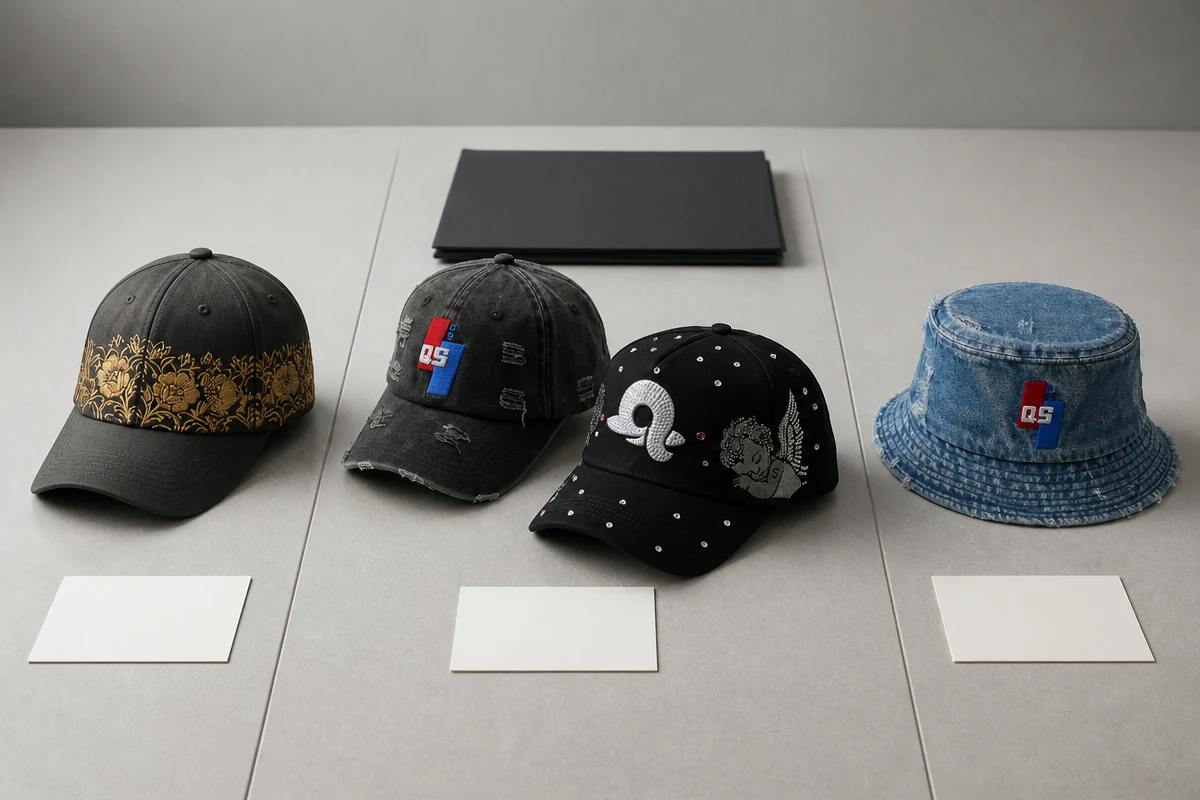
Compare Product Assortment Before Compliance Cost
A market can be legally accessible and still be commercially wrong for the planned range. Map each proposed style to a customer, channel, climate and price role before investing in localization.
European Union Assortment Logic
Begin with a compact range whose material and claim evidence can be controlled. Avoid adding many colourways or decorative variants if they create new component routes that the release file cannot track reliably.
North American Assortment Logic
Build around channel-specific core silhouettes and a clear entry, core and premium ladder. Replenishment readiness can be more valuable than launching many experimental styles at once.
Gulf Assortment Logic
Separate performance, lifestyle and gifting roles. A breathable outdoor cap, premium corporate piece and fashion-led retail style should not share one specification merely because they belong in the same seasonal presentation.
Use Climate as a Specification Input
Climate changes product risk, not just marketing photography. It can affect fabric weight, sweatband choice, colour planning, ventilation, wash expectations and packaging during storage or transport.
Heat and UV Exposure
For hot and high-exposure use, review coverage, ventilation, moisture behaviour, colour stability and any claimed protection. The performance cap fabric and fit guide helps translate activity and environment into construction questions.
Cold and Transitional Weather
For colder North American or European programs, insulation, fibre feel, sizing, itch risk and indoor comfort may matter more. Do not let one winter SKU define the whole regional range; climate varies within each market.
Regional Colour and Visibility
Colour should respond to channel, season, uniform standards and visibility needs. The regional colour-planning framework explains how neutral palettes and high-visibility demand can be separated without turning one assortment into a compromise.
Compare Channel Entry Before Production Volume
The first channel determines data, packaging, service and inventory exposure. Choose it before negotiating a large volume.
Marketplace or Direct-to-Consumer
These routes require strong product-page accuracy, image consistency, customer-service readiness and returns handling. They can provide direct feedback but place more operational responsibility on the brand.
Retailer or Distributor
A partner may provide local access and knowledge but will require margin, product data, delivery discipline and clear responsibility boundaries. Assess what the partner actually controls rather than assuming localization is fully outsourced.
Corporate and Promotional Distribution
This channel can suit adjustable caps and event programs, but dates, artwork approval, packing accuracy and split deliveries become critical. A regional launch through corporate orders should not be evaluated with the same metrics as a consumer retail test.
Build Landed-Cost Scenarios, Not One Cost Sheet
Compare at least a base case, downside case and reorder case for each market. Include product cost, inspection, freight, duty, local handling, channel margin, returns and compliance administration appropriate to the route.
Separate Known Inputs From Open Variables
Do not insert guessed duty rates, tax treatment or logistics charges simply to complete the spreadsheet. Mark the classification, destination, Incoterm and responsible owner for every open input.
Price the Cost of Complexity
Additional labels, languages, packaging versions, colourways, country-specific listings and fragmented shipments create operational cost even when the unit manufacturing price is unchanged. Compare the total number of controlled variants required by each entry route.
Choose an Entry Sequence
The strongest plan may enter one market first and prepare data for the others in parallel. Sequence reduces simultaneous uncertainty and lets the team reuse proven controls.
Choose the EU First When Data Control Is Strong
An EU-first route can suit a brand with defined economic-operator responsibilities, disciplined product records and a controlled SKU range. It is weaker when labels, online information and component evidence remain fragmented.
Choose North America First When Channel Fit Is Proven
A North America-first route can suit a brand with a clear US or Canadian channel, tested retail pricing and reliable replenishment. It is weaker when the plan assumes both countries have identical operational requirements.
Choose the Gulf First When Product and Partner Fit Are Specific
A Gulf-first route can suit performance, promotional or gifting programs built for the climate and calendar with a capable local partner. It is weaker when the range is simply transferred from another region without use-condition review.
Run a Market-Readiness Gate
Before placing the launch order, require each functional owner to confirm the same controlled SKU list. A practical gate covers product, compliance, channel, price, logistics, quality and data readiness.
Product and Evidence Gate
Confirm the approved sample, bill of materials, labels, artwork, packaging, claims and supporting documents. Record unresolved substitutions rather than hiding them in email.
Commercial and Logistics Gate
Confirm channel terms, landed-cost scenario, classification work, delivery route, stock owner, returns process and replenishment trigger.
Post-Launch Learning Gate
Decide in advance what evidence will justify expansion: sell-through, return reasons, retailer feedback, delivery performance, quality results and documentation gaps. Expansion should be a controlled decision, not a reaction to one strong week.
Build One Global Core With Regional Modules
A scalable headwear program keeps one controlled global product core while separating regional modules for labels, operator information, packaging, online fields, channel data and seasonal presentation. This avoids rebuilding the whole product for every market while preventing false standardization.
The right first region is where product fit, ownership and operating evidence align today. Use the comparison to select a launch sequence, close the gaps that block the next market and reuse only the controls that genuinely transfer. That creates a global program built on verified modules rather than three disconnected launches.