


“How many caps fit in a carton?” sounds like a request for one number. It is actually a load-planning decision. Crown structure, brim shape, closure, decoration, assortment, individual packaging and acceptable recovery all change the result. A carton that holds more units is not automatically the lowest-cost or safest option.
A useful headwear carton load plan begins with a verified physical pack. Measure the sealed production carton, record the actual unit count and gross weight, inspect cap recovery after unpacking, then apply the carrier or forwarder's current charging rules. The goal is a cost per acceptable cap, not the highest theoretical count.
This guide uses variables rather than claiming a universal carton quantity, dimensional-weight divisor or container capacity. Those inputs depend on the approved product, route, service, equipment and date of quotation.
Start with the sellable cap, not an empty carton
Carton efficiency begins with the finished unit. A soft visor can flex differently from a structured baseball cap, while a raised patch or high crown creates pressure points. Confirm what must arrive unchanged before calculating load density.
Record the cap's protected envelope
Measure the cap in its approved packed condition, including tissue, insert, bag, hangtag or retail box. The protected envelope is the space the sellable unit really occupies; product dimensions without packaging understate volume.
Define acceptable recovery
Agree how long a cap may rest after unpacking and which characteristics are checked: crown height, brim curve, panel creases, decoration marks and closure function. A temporarily flattened soft cap may recover; a crushed structured crown may not.
Keep sales packaging separate from transport optimization
The existing retail carton and pack-out guide explains unit, inner-pack and channel requirements. Load planning starts after those commercial requirements are known. Do not remove required protection simply to improve a spreadsheet density figure.
Build three pack scenarios
Instead of asking for one count, build conservative, target and maximum-trial scenarios. Each scenario must define orientation, layers, units per layer, dividers, void fill, carton grade and closure method.
Conservative pack
Use this scenario when product protection, premium presentation or a sensitive decoration matters more than maximum density. It provides a baseline for shape retention and inspection.
Target pack
This is the proposed production method. It should balance carton utilization, handling speed, unit protection, gross weight and the receiving workflow.
Maximum trial
Use the maximum only as a controlled test. If extra units require force, distort closures, mark decoration or slow repacking, the count is not operationally acceptable even if the carton closes.
Calculate units from layers and verified clearances
The first calculation is physical, not financial:
Units per carton = units per layer × number of accepted layers
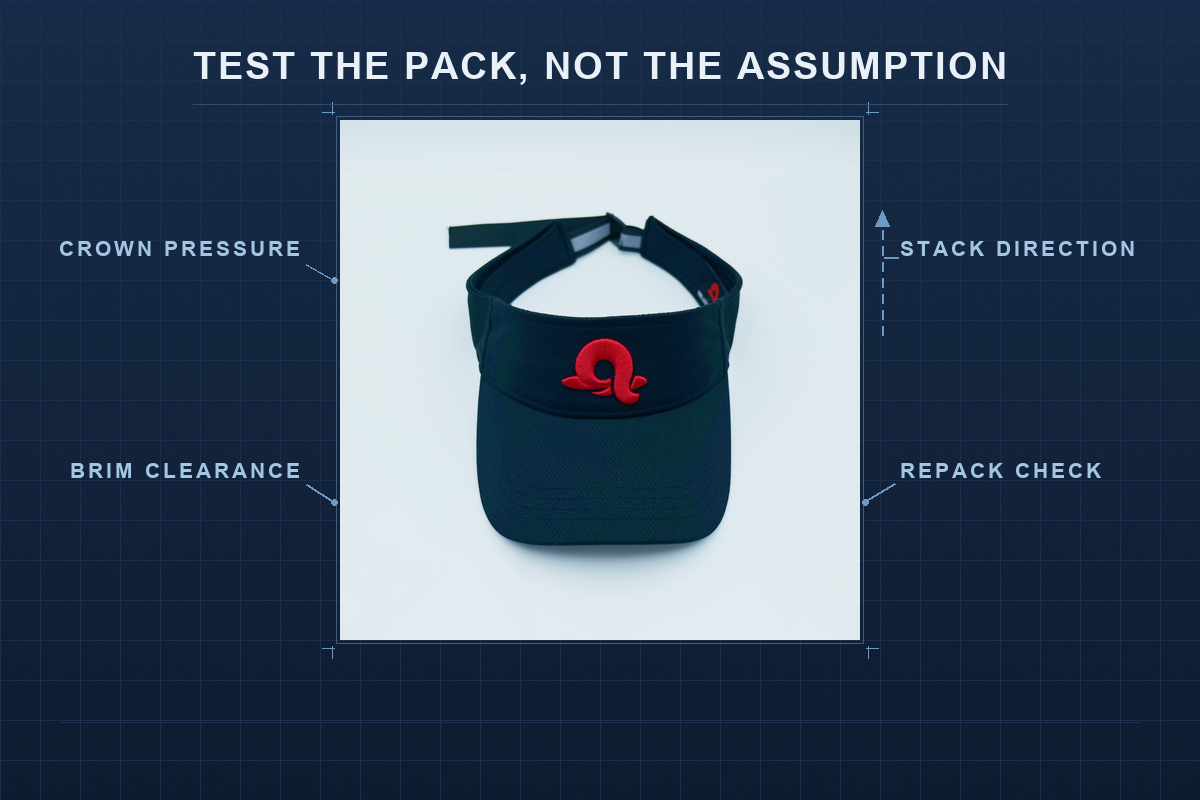
For nested caps, define what counts as one layer and how brims alternate. For visors, record band orientation and whether straps remain inside the product envelope. Mixed colors or sizes may need partitions that reduce nominal capacity.
Use internal dimensions
Carton catalogue dimensions may be external. Pack calculations need usable internal length, width and height after flaps, liners or reinforcements. Measure a production-equivalent carton rather than relying only on a supplier drawing.
Allow working clearance
Operators need enough clearance to load and remove units without scraping, folding or forcing them. A theoretical geometric fit with zero handling clearance will fail at production speed.
Record partial-carton rules
Orders rarely divide perfectly by the target count. State how partials are filled, identified and protected. The last carton can have a different density and should not be mistaken for a full master carton.
Convert the pack into cubic volume
Measure the sealed carton after normal packing:
Carton volume = sealed length × sealed width × sealed height
Volume per cap = carton volume ÷ verified unit count
Use one unit system consistently. Keep the measured carton dimensions with the pack scenario, because a small height change across many cartons can alter shipment volume materially.
Calculate total shipment volume
Total cartons = order quantity ÷ verified units per carton, rounded up
Total shipment volume = full-carton volume + partial-carton volume
Do not multiply every carton by the full-carton volume if partial cartons use different dimensions. Likewise, do not assume a mixed-SKU carton will match a single-SKU pack.
Separate planning from booking data
Planning dimensions support early quotations. Final booking and customs documents should use production packing evidence. The export handover dossier explains how final carton count, weight and dimensions must align across shipment documents.
Test compression without hiding damage
Compression is not a single percentage. It can come from nesting, closure tension, lid pressure, carton stacking and movement in transit. Test the actual product and pack route.
Inspect pressure points
Look at brim edges, top buttons, raised embroidery, patches, eyelets and closure hardware. Separate components that can rub, transfer color or leave permanent impressions.
Condition before evaluation
Record how long the carton remains packed and the temperature or humidity if those conditions matter. After unpacking, wait the agreed recovery time, then compare with the approved reference.
Test repeatability
A method is not ready because one technician packed a perfect sample. Ask normal packing operators to repeat it, measure cycle time and inspect several cartons. Repeatability is part of cost.
Calculate actual and billed shipment inputs separately
A shipment can be charged by actual weight, dimensional or volumetric weight, a container or pallet rate, or another commercial basis. The formula, divisor, rounding and minimum charge can vary by carrier, service, lane and date. Obtain those rules from the actual quotation.
Measure gross weight
Gross shipment weight = sum of sealed-carton gross weights
Weigh packed cartons rather than estimating from cap unit weight alone. Carton board, inserts, bags, labels and partials add weight.
Calculate dimensional weight with the quoted rule
Dimensional weight = carrier-defined function of packed dimensions
Insert the current divisor, rounding method and unit convention supplied by the carrier or forwarder. Do not copy a divisor from a previous route without confirmation.
Identify the commercial charging basis
For parcel or air, compare actual and dimensional inputs under the quoted rule. For consolidated or sea freight, check the forwarder's chargeable measure, minimums, equipment assumptions and local charges. Keep duty and customs valuation in the separate headwear landed-cost map.
Calculate freight per acceptable cap
The useful comparison includes the full transport quote and the quantity expected to arrive acceptable:
Freight per shipped cap = quoted transport cost ÷ shipped quantity
Freight per acceptable cap = quoted transport cost ÷ expected acceptable quantity
The second metric prevents aggressive compression from appearing cheaper when it raises deformation, rework or claim risk. Use verified trial results and an agreed quality assumption rather than inventing a damage percentage.
Include pack-related commercial inputs
Compare carton, insert, bag, divider, label, packing labor and inspection costs alongside transport. A smaller carton can cost more to assemble; a denser pack may need more recovery work at destination.
Keep route-specific charges visible
Separate main freight, fuel or security adjustments, pickup, terminal handling, documentation, delivery and other quoted items. Do not label all destination charges as “freight” if responsibility changes with the trade term.
Run sensitivity tests
Change one input at a time: unit count, carton height, gross weight, damage outcome, carrier rate or shipment mode. Sensitivity shows which assumption deserves another physical test or quotation.
Protect quality during carton and container loading
The IMO/ILO/UNECE CTU Code publication provides official context for proper packing of cargo transport units. A cap carton plan must still respect load distribution, package strength, movement control and safe handling; high cubic utilization alone is not a release criterion.
Check carton stacking strength
Cartons at the bottom experience the greatest load. Test the proposed stack height with production-equivalent board, humidity exposure and packed contents. Avoid relying on an empty-carton certificate alone.
Control voids and movement
A container can reach a high utilization percentage and still allow cartons to shift. Define palletization, dunnage, blocking or other controls with the logistics provider. Do not let those materials press directly on sensitive product surfaces.
Respect weight distribution
Distribute heavy and light cartons according to equipment and transport requirements. Confirm payload and axle or floor limits with qualified logistics parties; this article does not replace a load plan for a specific container or vehicle.
Plan mixed SKUs and assortments
Mixed orders complicate density. A visor, structured cap and bucket hat may need different carton systems. Combining them can save a partial carton or create damage and receiving confusion.
Compare homogeneous and mixed plans
Calculate each SKU separately, then compare a controlled mixed carton. Record physical partitions, SKU quantities, identifiers and unloading sequence. Choose the option with the best combined quality, labor and transport result.
Protect retail routing data
If the shipment serves a retailer, carton quantity, labels and ASN content must match the approved pack. Connect the final scenario to the retail vendor compliance workflow before booking.
Freeze late assortment changes
A color or size change can alter carton count and shipment volume. Establish a cutoff after which assortment changes require a new pack calculation and freight confirmation.
Release the pack through evidence
A pack plan should have a trial record: product revision, packaging components, carton specification, orientation, unit count, sealed dimensions, gross weight, recovery result, handling time and approver.
Inspect after the full route simulation
Compression alone may miss vibration, drops, humidity or extended storage. Select tests that match the route and customer requirement. Inspect both product condition and label readability.
Connect to shipment quality release
Use the headwear AQL inspection plan for the agreed shipment sample and defect rules, then add targeted checks for carton count, deformation and pack execution.
Reconcile the final shipment
Carton sequence, quantity, net and gross weight, dimensions and PO data should agree with the packing list, invoice, booking and labels. Reconcile before cargo leaves the factory.
A practical carton-load comparison
Use a simple comparison table without filling it with assumed numbers:
| Input | Conservative | Target | Maximum trial |
|---|---|---|---|
| Units per carton | Verified count | Verified count | Trial count |
| Sealed dimensions | Measured | Measured | Measured |
| Gross weight | Measured | Measured | Measured |
| Recovery result | Pass/fail | Pass/fail | Pass/fail |
| Packing cycle | Timed | Timed | Timed |
| Quoted transport cost | Current quote | Current quote | Current quote |
| Freight per acceptable cap | Calculated | Calculated | Calculated |
Choose the target only after the physical trial and current transport quote are available. A theoretical maximum is not a production specification.
Questions to send before requesting a freight quote
- Which cap revision and unit packaging will be used?
- What are the three proposed carton scenarios?
- What are the sealed internal and external dimensions?
- How many verified units fit without unacceptable deformation?
- What is the gross weight of full and partial cartons?
- Which assortment and mixed-carton rules apply?
- What recovery and handling tests passed?
- Which carrier formula, divisor, rounding and minimum apply?
- Which origin, destination, service and validity date define the quote?
- What shipment charges are included or excluded?
Use carton density as a tested decision
The best carton count is not the largest number that can be forced under the flaps. It is the repeatable quantity that protects the approved cap, moves efficiently through packing and receiving, and produces a defensible freight cost per acceptable unit.
Measure the real pack, quote the real route and retain the evidence. If order quantity or assortment changes, update the small-batch cost waterfall and logistics assumptions rather than carrying forward a carton plan from a different program.